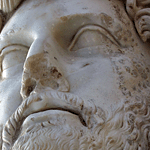
It was discovered in a rubble-filled building where parts of a huge statue of the emperor Hadrian were unearthed last year.
The discovery, at the ancient site of Sagalassos, is thought to show Faustina the Elder, wife of Roman emperor Antoninus Pius. Sagalassos was once an important urban centre. It was abandoned after being hit by several strong earthquakes.
A team led by Marc Waelkens, from the Catholic University of Leuven in Belgium, has been excavating the site since 1990.
The head of Faustina was lying face down in rubble that fills
the ruins of a bath house that was partially destroyed by an earthquake
between AD 540 and AD 620. It was unearthed just 6m from the spot where the Hadrian statue was found, but was sitting higher up in the rubble.
At first, exacavators thought they had found a statue belonging
to Hadrian's wife, Vibia Sabina, who was forced into a marriage with
the homosexual emperor at the age of 14.
the usual depictions of Sabina. This was a more mature woman with
fleshy lips and a distinctive hairstyle.
The building in which the statues were found at Sagalassos was
probably a "frigidarium" - a room with a cold pool which Romans could
dip into after a hot bath. It is part of a larger bath complex that is being carefully uncovered by archaeologists.
The fragments were found not on the floor of the frigidarium -
beneath the rubble from the earthquake - but higher up in the debris
pile. This suggests they did not originally stand in this room, but
were hauled there from elsewhere in the bath complex - probably from
the "Kaisersaal", or emperor's room. They speculate that the Kaisersaal once hosted statues of
Hadrian, Faustina the Elder and other members of Rome's so-called
Antonine dynasty - many of whom belonged to a Spanish or southern
French provincial aristocracy. The Hadrian statue was probably brought to the frigidarium
either to remove its gilded armour or to be burned to cement in a
nearby kiln.
If this is the case I'm so glad the workman were somehow interrupted. I shudder to think of all of the magnificent art that was destroyed just to provide common building material.