A beautiful horse head with traces of gilt has been retrieved from a well near Waldgrimes in central Germany. Archaeologists speculate that the horse was part of an equestrian statue bearing the emperor Augustus that was ritually destroyed by Germanic tribesmen after their victory over Roman legions at Teutoburg Vald in 9 C.E. The rider's foot was also recovered.
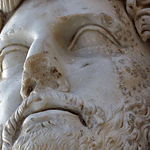
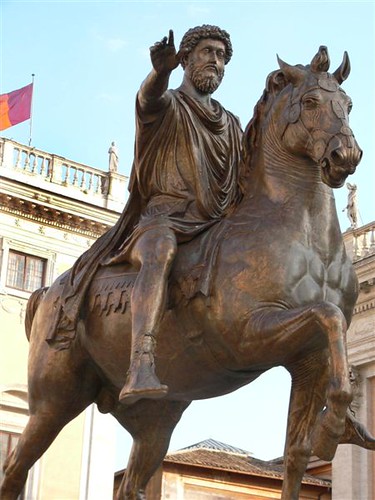
It would be wonderful if enough fragments could be found to reconstruct the work. There is only one other equestrian statue of Augustus known in the world at this time. Sadly, equestrian statues contained so much bronze that they were prized targets of medieval recyclers so few Roman period equestrian statues survive intact. It is said that the famous equestrian statue of Marcus Aurelius at the Capitoline Museum in Rome only survived because it was thought to be Constantine I, revered by early Christians for making Christianity the official religion of the empire. Judging from the picture provided by the Science Ministry of Hessen (above left), the Augustan statue must have been as breathtaking as the Aurelian statue in Rome (right). The horse's bridle
 depicts figures of Mars, the Roman god of war, and Nike, personification of victory.
Previous excavations at Waldgrimes have yielded a Roman forum, lead waterpipes and a retail center. The statue may have been the centerpiece of a cult temple of Augustus. Such a temple was erected in Lugdunum by Drusus as a transitory step to making Gaul a Roman province following suppression of a revolt over a Roman census there. As a symbol of Romanization, it would have naturally been a target following news of the successful ambush by Arminius.
Panic swept through Roman settlements in Germania and Gaul.
"After the defeat of Varus there was panic throughout the Roman population living in Gaul and
Nevertheless the Romans soon ran out of supplies and had to make an escape attempt. Using a rainstorm and darkness as cover the Romans slipped out and met up with Roman forces to the west. Archeological evidence from Haltern shows that it was hastily abandoned around 9 AD as shown by the tremendous amount of buried hordes throughout the fort. Romans fleeing to the
We've all heard of Augustus' response - rending his clothes and crying out "Varus, give me back my legions!" But Augustus was not just being melodramatic. Cassius Dio writes, "... there were no more men available in reserve. The Roman armies had reached the point of breaking, between the rebellions in
For a graphic view of the battle of Teutoburg Forest, check out these videos on YouTube, excerpts from the History Channel series "Decisive Battles."
Hopefully, we'll learn even more about this tumultuous period with continued excavations.


 Archaeologists restoring the imperial residences on the Palatine Hill, in the heart of ancient