Showing posts with label Turkey. Show all posts

Monday, August 25, 2008

Sagalassos Dig Yields Marcus Aurelius Statue


Parts of a giant, exquisitely-carved marble sculpture depicting the
Roman emperor Marcus Aurelius have been found at an archaeological site
in Turkey.


Fragments of the statue were unearthed at the ancient city of Sagalassos.


So far the statue's head, right arm and lower legs have been discovered, high in the mountains of southern Turkey.


Last year, the team led by Prof Marc Waelkens, from the Catholic
University of Leuven in Belgium, uncovered fragments of a colossal
marble statue of the emperor Hadrian in the rubble.


This month, the researchers found a huge marble head belonging to Faustina the Elder - wife of the emperor Antoninus Pius.

Archaeologists now think the room hosted a gallery of statues
depicting the "Antonine dynasty" - rulers of Spanish origin who
presided over the Roman Empire during the second century AD.


Foot of Marcus Aurelius statue (Sagalassos Archaeological Research Project)
The emperor wore army boots decorated with lion skins


Early on 20 August, a huge pair of marble lower legs, broken just above the knee, turned up in the room's debris.

They also found a 1.5m-long (5ft-long) right arm and hand holding a
globe which was probably once crowned by a gilded bronze "Victory"
figure.

But it was the giant marble head which identified this statue
as the young Marcus Aurelius. The colossal head, which is just under 1m
(3ft) in height, is said to bear his characteristic bulging eyes and
beard.

Prof Waelkens said the pupils were gazing upwards "as if in
deep contemplation, perfectly fitting to an emperor who was more of a
philosopher than of a soldier".


He added that this was one of the best-known depictions of the Roman ruler.


The emperor wore exquisitely carved army boots decorated with a lion skin, tendrils and Amazon shields.

The torso was probably covered in bronze armour filled inside
with terracotta or wood. When the niche's vault collapsed in the
earthquake, the torso would have exploded. - BBC News


Thursday, August 14, 2008

Head of Faustina Found in Sagalassos Frigidarium

Archaeologists digging in Turkey have found the colossal marble head of a Roman empress.
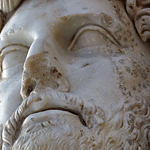
It was discovered in a rubble-filled building where parts of a huge statue of the emperor Hadrian were unearthed last year.

The discovery, at the ancient site of Sagalassos, is thought to show Faustina the Elder, wife of Roman emperor Antoninus Pius. Sagalassos was once an important urban centre. It was abandoned after being hit by several strong earthquakes.


A team led by Marc Waelkens, from the Catholic University of Leuven in Belgium, has been excavating the site since 1990.

The head of Faustina was lying face down in rubble that fills
the ruins of a bath house that was partially destroyed by an earthquake
between AD 540 and AD 620. It was unearthed just 6m from the spot where the Hadrian statue was found, but was sitting higher up in the rubble.

At first, exacavators thought they had found a statue belonging
to Hadrian's wife, Vibia Sabina, who was forced into a marriage with
the homosexual emperor at the age of 14.

But when they turned it over, the face was very different from
the usual depictions of Sabina. This was a more mature woman with
fleshy lips and a distinctive hairstyle.

The building in which the statues were found at Sagalassos was
probably a "frigidarium" - a room with a cold pool which Romans could
dip into after a hot bath. It is part of a larger bath complex that is being carefully uncovered by archaeologists.

The fragments were found not on the floor of the frigidarium -
beneath the rubble from the earthquake - but higher up in the debris
pile. This suggests they did not originally stand in this room, but
were hauled there from elsewhere in the bath complex - probably from
the "Kaisersaal", or emperor's room. They speculate that the Kaisersaal once hosted statues of
Hadrian, Faustina the Elder and other members of Rome's so-called
Antonine dynasty - many of whom belonged to a Spanish or southern
French provincial aristocracy. The Hadrian statue was probably brought to the frigidarium
either to remove its gilded armour or to be burned to cement in a
nearby kiln.


If this is the case I'm so glad the workman were somehow interrupted. I shudder to think of all of the magnificent art that was destroyed just to provide common building material.


Tuesday, October 02, 2007

Jupiter Relief Found in Turkey

A 130-centimeter-long relief depicting the Roman god Jupiter taking a vow with his wife Iuno Regina was found during excavations in the ancient city of Dülük in Gaziantep.

The relief is the first evidence of the mythological king of the gods and god of thunder and lightning to be discovered in the city believed to be his hometown.

Professor Engelbert Winter, excavation head of Germany's Münster University, said there were many other findings depicting Jupiter in southern Europe, but that this is first time something was discovered in Dülek. 'We had an idea of what he looked like from excavations held in southern Europe, but we couldn't find anything other than inscription in the ancient city so far. The (discovery of this) relief will shed light on our future works (in the city),' he said.

The relief is 130 x 70 centimeters in size and depicts Jupiter and his wife Iuno Regina in a ceremony at an altar with two priests. Jupiter holds a bunch of lightning in his right hand and a pair of axes in his left hand. This symbolically represents the power of the god of thunder.

Located 10 kilometers south of Gaziantep, the ancient city of Dülük lies on the historical Silk Road and ancient trade routes.

Stone tools were discovered at the Şarklı Cave on the borders of Dülük, indicating that the area was settled in around 6000 B.C. The city is believed to be the ancient city of Doliche, which was a religious center of Teşup, the master deity of Hittite civilization.

Friday, August 03, 2007

Colossal statue of the emperor Hadrian discovered at Sagalassos, Turkey

This is truly a fantastic find. I always wondered what the colossal statue of Nero looked like that used to stand outside the Colosseum and of course we'd all like to know what the Colossus of Rhodes really looked like!

"A huge, exquisitely carved marble statue of the Roman emperor Hadrian is the latest find from Sagalassos, an ancient Greco-Roman city in south-central Turkey. Archaeologists estimate that the figure was originally between 13 and 16 feet in height (four to five meters). It is, says excavation director Marc Waelkens, one of the most beautiful portraits of Hadrian ever found.

The discovery was made by archaeologists from the Katholieke Universiteit Leuven (Belgium), who, under Waelkens' direction, have been investigating the site since 1990. Last month a new excavation campaign started, and the Belgians resumed work at the Roman Bath, focusing on the southeastern corner of the complex.

On Sunday the first fragments of a over life-size statue, a foot and part of a leg, were unearthed. The foot is 31.5 inches (0.80 meters) long; the leg, from just above the knee to the ankle, is nearly five feet (1.5 meters). The elaborate sandal depicted on the footed indicated to the archaeologists that the fragments were from the statue of an emperor. On Monday, the almost intact head of the statue was discovered, revealing that the statue was of Hadrian, who ruled from A.D. 117 to 138. The head measures more than 27 inches (0.70 meters).

Construction of the bath complex in Sagalassos was started during Hadrian's reign, though the building was finished only several decades later. The bath complex is one of several major building projects at Sagalassos that can be dated to the time of Hadrian and the city had a sanctuary of the imperial cult dedicated to Hadrian and his successor Antoninus Pius.

The statue probably dates from the beginning of Hadrian's rule. For updates on the current excavation campaign, including any additional finds related to the Hadrian statue, see the Interactive Dig, City in the Clouds."

Wednesday, July 25, 2007

The ‘Ephesus’ of the Black Sea to be unveiled - Turkish Daily News Jul 24, 2007


The ‘Ephesus’ of the Black Sea to be unveiled - Turkish Daily News Jul 24, 2007: " The remains of an ancient city on the Black Sea coast will be unearthed for the first time next month. Archaeologists are beginning excavations and underwater dives with the aim of unveiling the architectural plan of Teion (or Tion), located in Zonguldak's Filyos district.

Speaking to the Anatolia news agency, archaeologist S�mer Atasoy said the excavation team conducted surface research last year but that the major digging will start in August with a 30-member excavation team.

He said they had outlined an aqueduct, a theater, defensive walls, a breakwater, a port and port walls by examining remains close to the surface. �The ancient city hosted many civilizations including Persians, Romans, Genoas and Ottomans. The work, which was carried out for the first time on the Black Sea coast, indicates that the ancient city was an important trade center in the region. Its inhabitants sold forest products and bonitos. We uncovered an ancient Roman theater with a 2,000-person capacity as well as marble and bronze statues.�"

Friday, July 13, 2007

Augustan Ruins Draw Visitors to Side, Turkey


Side is an ancient maritime city in Pamphylia, the region from the Mediterranean to Mount Taurus. Located near the Mediterranean villages of Manavgat and Selimiye in Antalya, this city was the seat of some of the most important ancient civilizations. With a visit to Side today, you will discover not only this history but also the striking natural beauty of this region.

The ruins of ancient Side include a Roman-style theater complex which was used for gladiator fights and later as a church; well-preserved city walls; a monumental gate dating back to the second century; old Roman baths; an agora where pirates used to sell slaves; the early Roman Temple of Dionysus next to the theater; a fountain and the remains of a Byzantine Basilica.