Showing posts with label baths. Show all posts

Friday, January 08, 2010

Roman era tombs unearthed in southern Syria


Archaeologists have been busy in southern Syria.  Wafa al-Audi, head of Bosra's Antiquities Department reports that five tombs dating back to the Byzantine era have been found in Daraa.  One yielded copper bracelets as well as one made of iron.

[Image: Roman ruins north of the citadel in present-day Basra.  Courtesy of Wikimedia Commons.]

Four more Byzantine-era tombs were found in Jedia.  They, too, contained bracelets, coins and bronze shards.  Skeletal remains of a 20-year-old man were found in yet another Roman tomb unearthed in Selmine.


In a continuing excavation of the Nabataean Cathedral in Bosra, a French team has unearthed remains of a private bath in Trajan's Palace.

I'm afraid the article in DNA did not include any images of the artifacts recovered.

Cosmos Global Documentaries IN THE LAND OF THE NABATEANS Arabia's Mystic Traders  Roman Syria and the Near East   Studies In The History Of The Roman Province Of Syria (1915)   Soldiers, Cities, and Civilians in Roman Syria  Archaeology of the Bronze Age, Hellenistic, and Roman Remains at an Ancient Town on the Euphrates River: Excavations at Tell Es-Sweyhat, Syria Volume 2 (Oriental Institute Publications)

Thursday, August 14, 2008

Head of Faustina Found in Sagalassos Frigidarium

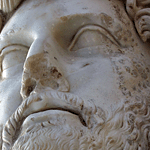
Archaeologists digging in Turkey have found the colossal marble head of a Roman empress.

It was discovered in a rubble-filled building where parts of a huge statue of the emperor Hadrian were unearthed last year.

The discovery, at the ancient site of Sagalassos, is thought to show Faustina the Elder, wife of Roman emperor Antoninus Pius. Sagalassos was once an important urban centre. It was abandoned after being hit by several strong earthquakes.


A team led by Marc Waelkens, from the Catholic University of Leuven in Belgium, has been excavating the site since 1990.

The head of Faustina was lying face down in rubble that fills
the ruins of a bath house that was partially destroyed by an earthquake
between AD 540 and AD 620. It was unearthed just 6m from the spot where the Hadrian statue was found, but was sitting higher up in the rubble.

At first, exacavators thought they had found a statue belonging
to Hadrian's wife, Vibia Sabina, who was forced into a marriage with
the homosexual emperor at the age of 14.

But when they turned it over, the face was very different from
the usual depictions of Sabina. This was a more mature woman with
fleshy lips and a distinctive hairstyle.

The building in which the statues were found at Sagalassos was
probably a "frigidarium" - a room with a cold pool which Romans could
dip into after a hot bath. It is part of a larger bath complex that is being carefully uncovered by archaeologists.

The fragments were found not on the floor of the frigidarium -
beneath the rubble from the earthquake - but higher up in the debris
pile. This suggests they did not originally stand in this room, but
were hauled there from elsewhere in the bath complex - probably from
the "Kaisersaal", or emperor's room. They speculate that the Kaisersaal once hosted statues of
Hadrian, Faustina the Elder and other members of Rome's so-called
Antonine dynasty - many of whom belonged to a Spanish or southern
French provincial aristocracy. The Hadrian statue was probably brought to the frigidarium
either to remove its gilded armour or to be burned to cement in a
nearby kiln.


If this is the case I'm so glad the workman were somehow interrupted. I shudder to think of all of the magnificent art that was destroyed just to provide common building material.


Friday, August 17, 2007

Team continues excavation of Visigothic remains at Marina Alta


"This summer dozens of students from all over Europe visited the Marina Alta town to toil in the sunshine as volunteer labour for the residential experts. Work took place on the slopes of the famous Penon de Ifach landmark -where remains of a 4th Century church has been discovered along with artefacts of a community dating back to 700 BC - and surrounding site of the Queen's Baths. However, it is the 5th Century church alongside the Roman baths and built over part of an extensive villa that has excited archaeologists. Ana Ronda, who is in charge of the dig, told Round Town News the church was constructed during the Visigoth Empire's spread into Iberia - after the once barbarian hordes converted to Roman Catholicism -and it was first identified in 2004.

"We have been very surprised at the sheer scale of the church and have yet to find the altar," she said. "However, we have uncovered the pool - the 'baptismo' - where people were baptised through total immersion. We are still trying to discover just how large the building is and so work continues." The dig has already identified 25 tombs, the graves unearthed inside and outside the walls of the church. Ana said skeletons were found in 23 of the graves. Discoveries from the project are taken to Alicante and housed in the MARQ archaeological museum. The Queen's Baths and Roman fish pools at Calpe were identified a number of years ago, along with a factory producing terracotta pottery. However, the huge villa alongside the baths and a Roman street and houses leading away towards the modern town are more recent finds."

Friday, August 03, 2007

Colossal statue of the emperor Hadrian discovered at Sagalassos, Turkey

This is truly a fantastic find. I always wondered what the colossal statue of Nero looked like that used to stand outside the Colosseum and of course we'd all like to know what the Colossus of Rhodes really looked like!

"A huge, exquisitely carved marble statue of the Roman emperor Hadrian is the latest find from Sagalassos, an ancient Greco-Roman city in south-central Turkey. Archaeologists estimate that the figure was originally between 13 and 16 feet in height (four to five meters). It is, says excavation director Marc Waelkens, one of the most beautiful portraits of Hadrian ever found.

The discovery was made by archaeologists from the Katholieke Universiteit Leuven (Belgium), who, under Waelkens' direction, have been investigating the site since 1990. Last month a new excavation campaign started, and the Belgians resumed work at the Roman Bath, focusing on the southeastern corner of the complex.

On Sunday the first fragments of a over life-size statue, a foot and part of a leg, were unearthed. The foot is 31.5 inches (0.80 meters) long; the leg, from just above the knee to the ankle, is nearly five feet (1.5 meters). The elaborate sandal depicted on the footed indicated to the archaeologists that the fragments were from the statue of an emperor. On Monday, the almost intact head of the statue was discovered, revealing that the statue was of Hadrian, who ruled from A.D. 117 to 138. The head measures more than 27 inches (0.70 meters).

Construction of the bath complex in Sagalassos was started during Hadrian's reign, though the building was finished only several decades later. The bath complex is one of several major building projects at Sagalassos that can be dated to the time of Hadrian and the city had a sanctuary of the imperial cult dedicated to Hadrian and his successor Antoninus Pius.

The statue probably dates from the beginning of Hadrian's rule. For updates on the current excavation campaign, including any additional finds related to the Hadrian statue, see the Interactive Dig, City in the Clouds."

Sunday, July 22, 2007

Hadrian-era bath complex found inRome


A large 2nd-century bath complex believed to be part of a wealthy Roman's luxurious residence has been partially dug up, archaeologists said Thursday.

The exceptionally well-preserved two-story complex, which extends for at least five acres, includes ornate hot rooms, vaults, changing rooms, marble latrines and an underground room where slaves lit the fire to warm the baths.

Statues and water cascades decorated the interiors, American archaeologist Darius A. Arya, the excavation's head, said during a tour offered to The Associated Press on Thursday. Only pedestals and fragments have been recovered.

The complex was believed to be part of a multi-story villa that belonged to the Roman-era equivalent of a billionaire, a man called Quintus Servilius Pudens who was a friend of Emperor Hadrian, Arya said. It was unclear whether the baths were open to the public or reserved for the owner's distinguished guests.

Friday, July 13, 2007

Augustan Ruins Draw Visitors to Side, Turkey


Side is an ancient maritime city in Pamphylia, the region from the Mediterranean to Mount Taurus. Located near the Mediterranean villages of Manavgat and Selimiye in Antalya, this city was the seat of some of the most important ancient civilizations. With a visit to Side today, you will discover not only this history but also the striking natural beauty of this region.

The ruins of ancient Side include a Roman-style theater complex which was used for gladiator fights and later as a church; well-preserved city walls; a monumental gate dating back to the second century; old Roman baths; an agora where pirates used to sell slaves; the early Roman Temple of Dionysus next to the theater; a fountain and the remains of a Byzantine Basilica.