Showing posts with label Roman Empire. Show all posts

Tuesday, February 22, 2011

Town Council stands firm on disapproval of builders' plans to erect housing over site of Southwell Roman Villa

A reader sent me a link to this blog post about the battle over developers' plans to build housing on top of the site containing the remains of the Southwell Roman Villa.   Some people will never grasp the importance of preservation of our cultural heritage.  I'm glad there are still those willing to take a stand against others more interested in profit.

http://priorieshistoricalsociety.blogspot.com/2011/02/news-insult-to-our-history-southwell.html

I wonder if, after all the dust settles in Tunis, Libya, Morocca, etc. new governments will take a pro-preservation stance over Roman remains in those countries?  The remains of ancient Carthage were already being overtaken by Tunisian developers building retreats for the wealthy despite verbal obeisance to cultural preservation.
Enhanced by Zemanta

Friday, February 26, 2010

Ulysses-adorned amphitheater found near Fiumicino airport

Somehow with all the bustle that always accompanies the approaching holidays I somehow missed seeing this notice of a marvelous find of a "mini-Colosseum" near Rome's Fiumicino airport reported a few months ago.  When I visited Ostia in March 2009, I remember reading that much more of the ancient port remained unexcavated because it lay under the Fiumicino airport. 

[Image of Ulysses sculpture courtesy of the University of Southhampton]

This small amphitheater, however, is considered part of the ancient Roman port of Portus that actually succeeded Ostia as the Roman Empire's primary port at the mouth of the Tiber River in the second century CE. 

Apparently, the site was originally discovered in the 1860s but has remained largely undisturbed since then.  Now, researchers have been able to employ 3-D geophysics, computer visualization, environmental analysis and digital recording as well as excavation to reveal the details of what became one of  the largest maritime infrastructures of the ancient world.

"With the help of ground penetrating radar, the archaeologists have uncovered luxuriously decorated rooms, a colonnaded garden, a finely carved marble head, possibly depicting the Greek hero Ulysses, and a well-preserved toilet, designed to be used by three people at a time.

"The toilet belonged to the palace. It is located between the amphitheater and a porticoed garden. It is really an impressive building, with marbled floor and walls," said Simon Keay, project director and leading expert in Roman archaeology at the University of Southampton.

The researchers are now analyzing the dirt from the toilet -- basically ancient human waste -- to build a picture of the diet of the people who frequented the site." - More: Discovery News 

Daily Life in the Roman City: Rome, Pompeii, and Ostia   Mayfair Games Ostia The Harbor of Rome   Roman Amphitheaters (Watts Library)   Look Around a Roman Amphitheater (Virtual History Tours)   The Roman Games: Historical Sources in Translation (Blackwell Sourcebooks in Ancient History)   The Story of the Roman Amphitheatre

Tuesday, February 02, 2010

East Asian Remains Found in 1st century CE Roman cemetery

A research team working in a 1st -2nd century CE Roman necropolis near the ancient town of Vagnari in southern Italy have unearthed a skeleton of a man with East Asian ancestry, according to DNA analysis.  When I was researching an article on the Han Dynasty for Heritage Key, I read that one of the important achievements of the period was the development of trade with the Roman Empire in the 2nd century CE. But the age of the remains and the possibility that there are more than one individual in the cemetery with East Asian descent makes it appear that there could have been a substantial group of East Asians in Vagnari before history tells us a formal delegation from the Han Dynasty had even made "First Contact". 

Vagnari was actually part of the emperor's estate during this time with its inhabitants engaged in tile production and iron working.

"So far the evidence suggests that Vagnari was a settlement of artisans and lower status individuals. The most likely location for the house of the imperial procurator who would have managed the estate is up the hill near the top of the plateau now called San Felice where a building provisionally interpreted as a villa is being excavated by a Canadian team directed by Hans vanderLeest (Mount Allison University) and Myles McCallum (St Mary’s University, Halifax)." - The Vagnari Project  

What seems puzzling is that if this man or even more than one of the 73 burials unearthed in Vagnari were slaves from China, how did the Roman emperor acquire them?  We don't know of any campaigns by the Romans that far east during that time.  Were they presented as a gift to him by a trade delegation? 


It will be interesting to see if any East Asian artifacts turn up as the excavation progresses.  Although the slaves could have been without significant possessions I can't imagine them living out their lives without fashioning some amulet or talisman to remind them of their former homeland, especially since the Romans did not discourage foreign religions.


The research team hope ongoing excavations will provide clues to globalization, human mobility, identity, and diversity in Roman Italy.

"This multi-faceted research demonstrates that human skeletal remains can provide another layer of evidence in conjunction with archaeological and historical information," says Tracey Prowse, Assistant Professor of Anthropology, initially of McMaster University (Hamilton, Ontario) and, since 2006, of Southern  Illinois University Carbondale, the lead author on the study. . - DNA testing on 2,000-year-old bones in Italy reveal East Asian ancestry

  Comparison between Roman and Han Empires: Military of ancient Rome, Culture of ancient Rome, Huo Qubing, Wei Qing, Emperor Wu of Han, Roman mythology, ... Roman law, Government of the Han Dynasty   The Establishment of the Han Empire and Imperial China (Greenwood Guides to Historic Events of the Ancient World)   The Early Chinese Empires: Qin and Han (History of Imperial China)

Thursday, October 22, 2009

Hadrian's Athenaeum latest "Metro" discovery in Rome

Following a grand stairway made with sheets of granite andantique yellow marble, Archaeologists trying to locate a relatively "sterile" area of the Piazza Venezia to construct a subway station for the new Metro C line in Rome have uncovered what they think is Emperor Hadrian's "Athenaeum" -- an auditorium ancient writers say he built at his own expense on his return from Palestine around A.D. 135. Hadrian, an avid fan of Greek theater and literature sponsored plays, speeches and political debates in the covered rectangular structure.

The amphitheater is just one of a number of significant archaeological finds that have been discovered during excavation for the new Metro line. Other discoveries include the Greek gymnasium that the Emperor Nero had built near his baths, and a section of a Roman canal built to drain the marshy land Rome was built upon.

Monday, August 31, 2009

First Saudi in space opens up the Kingdom to western archaeologists


How exciting to read that Saudi Arabia, after decades of discouraging excavations of pre-Islamic civilizations, has begun to allow foreign archaeologists to explore largely untouched sites. I was also intrigued to learn that Madain Saleh, Saudi Arabia's first UNESCO World Heritage Site is now open to the public.

[Image - Nabatean tombs at Madain Saleh, Saudi Arabia's first UNESCO heritage site, resemble those of Petra in Jordan over 450 miles away. Image courtesy of Wikimedia Commons.]

The ancient city, once known as Hegra, was built by the Nabateans and its tombs resemble those found in Petra, 450 miles away. The UNESCO site encompasses 131 tombs over about 13 kilometers. Roman archaeologists were particularly excited when an inscription referring to the Roman emperor Marcus Aurelius was discovered there in 2000.

Prince Sultan bin Salman, the first Saudi to venture into space aboard the U.S. space shuttle Discovery in 1985 and now secretary general of the governmental Saudi Commission for Tourism and Antiquities, is leading the effort. Small bronze statues of Hercules and Apollo on display at the King Saud University in Riyadh hint at the remains awaiting researchers in the desert sands.

Will Fragments of Augustan Equestrian Statue Found in Germany Lead to Insight on Turmoil after Varus Disaster?


A beautiful horse head with traces of gilt has been retrieved from a well near Waldgrimes in central Germany. Archaeologists speculate that the horse was part of an equestrian statue bearing the emperor Augustus that was ritually destroyed by Germanic tribesmen after their victory over Roman legions at Teutoburg Vald in 9 C.E. The rider's foot was also recovered.

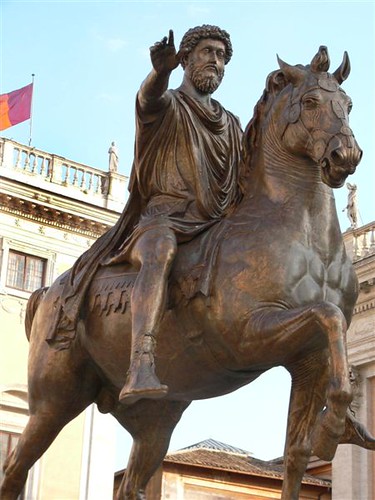
It would be wonderful if enough fragments could be found to reconstruct the work. There is only one other equestrian statue of Augustus known in the world at this time. Sadly, equestrian statues contained so much bronze that they were prized targets of medieval recyclers so few Roman period equestrian statues survive intact. It is said that the famous equestrian statue of Marcus Aurelius at the Capitoline Museum in Rome only survived because it was thought to be Constantine I, revered by early Christians for making Christianity the official religion of the empire. Judging from the picture provided by the Science Ministry of Hessen (above left), the Augustan statue must have been as breathtaking as the Aurelian statue in Rome (right). The horse's bridle depicts figures of Mars, the Roman god of war, and Nike, personification of victory.

Previous excavations at Waldgrimes have yielded a Roman forum, lead waterpipes and a retail center. The statue may have been the centerpiece of a cult temple of Augustus. Such a temple was erected in Lugdunum by Drusus as a transitory step to making Gaul a Roman province following suppression of a revolt over a Roman census there. As a symbol of Romanization, it would have naturally been a target following news of the successful ambush by Arminius.

Panic swept through Roman settlements in Germania and Gaul.

"After the defeat of Varus there was panic throughout the Roman population living in Gaul and Germany. Most of the forts established by Drusus and Tiberius in Germany were abandoned immediately after the disaster. All but one of the Roman garrisons stationed in Northern Germany was destroyed, with only the garrison at Aliso holding out. Dio describes the events which surrounded Aliso. Aliso has been tentatively identified as the base Haltern. Haltern, a Roman legionary base in Germany illustrates the panic that spread through the Romans in Germany. Haltern, founded in 5 BC, is situated about 54 km from Vetera on the north bank of the Lippe River, where the river has its confluence with the Stever River. Haltern may have served as the wintering quarters for Varus and his legions in the winter 9 AD. The fort supported a large number of troops and had all the logistical and administrative support that a large force of soldiers would require to function. The amount of housing for officers is unusually high at Haltern implying that the post served as an administrative hub for the Roman army deployed east of the Rhine River. Dio attributes the Romans success at Haltern to German ignorance of siege warfare and Roman employment of archers. The archers held the Germans off, inflicting heavy losses on the Germans.

Nevertheless the Romans soon ran out of supplies and had to make an escape attempt. Using a rainstorm and darkness as cover the Romans slipped out and met up with Roman forces to the west. Archeological evidence from Haltern shows that it was hastily abandoned around 9 AD as shown by the tremendous amount of buried hordes throughout the fort. Romans fleeing to the Rhine, not wanting to be slowed down with material goods, buried several hordes around the fort in anticipation of retrieving them again. These hordes consist primarily of weapons and coinage. Other Roman bases on the Lippe were similarly abandoned: Anreppen, Oberaden, and Holsterhausen. " - Rome’s Bloody Nose: The Pannonian Revolt, Teutoburg Forest and the Formation of Roman Frontiers by Nolan Doyle, Western Oregon University.

We've all heard of Augustus' response - rending his clothes and crying out "Varus, give me back my legions!" But Augustus was not just being melodramatic. Cassius Dio writes, "... there were no more men available in reserve. The Roman armies had reached the point of breaking, between the rebellions in Pannonia and Germany the losses could not be easily replaced anymore. Augustus had to resort to conscriptions of men and nobody wanted to be conscripted. Augustus made the men draw lots with twenty percent of those under the age of thirty-five and ten percent of those older conscripted into the army. When people still were not excited enough to be conscripted Augustus had several men executed. Augustus also called up veterans and conscripted freedmen and put them into service. " - Rome’s Bloody Nose: The Pannonian Revolt, Teutoburg Forest and the Formation of Roman Frontiers by Nolan Doyle, Western Oregon University.

For a graphic view of the battle of Teutoburg Forest, check out these videos on YouTube, excerpts from the History Channel series "Decisive Battles."

Hopefully, we'll learn even more about this tumultuous period with continued excavations.

Thursday, August 06, 2009

Vespasian's Villa Found?


It looks like there's a real possibility the villa of the Roman emperor Vespasian has been found! Vespasian is one of those "good" emperors that rose from the ranks to claim the purple. He even took a freedwoman for a mistress and, although unable to marry her because of his social status, maintained a relationship with her throughout his lifetime. Their relationship is the subject of one of my favorite books by English author, Lindsey Davis, entitled "Course of Honor".

[Image - Fragmentary Colossal Bust of the Roman Emperor Vespasian, Museo Archaeologico di Napoli, Naples, Italy. Photo by Mary Harrsch]

Suetonius tells us how Vespasian, far from wealthy as a young man, was viewed by the common people of Rome:

"...he got by lot the province of Africa, which he governed with great reputation, excepting that once, in an insurrection at Adrumetum, he was pelted with turnips. It is certain that he returned thence nothing richer; for his credit was so low, that he was obliged to mortgage his whole property to his brother, and was reduced to the necessity of dealing in mules, for the support of his rank; for which reason he was commonly called "the Muleteer."

He didn't make many points with the emperor Nero either since he fell asleep during the emperor's musical performances.

"Caius Caesar, being enraged at his not taking care to have the streets kept clean, ordered the soldiers to fill the bosom of his gown with dirt, some persons at that time construed it into a sign that the government, being trampled under foot and deserted in some civil commotion, would fall under his protection, and as it were into his lap. - - C. Suetonius Tranquillus, The Lives of the Twelve Caesars.

Of course the Romans were very sensitive to perceived omens and many more omens were related that pointed to Vespasian's eventual exalted position:

He dreamt in Achaia that the good fortune of himself and his family would begin when Nero had a tooth drawn; and it happened that the day after, a surgeon coming into the hall, showed him a tooth which he had just extracted from Nero. In Judaea, upon his consulting the oracle of the divinity at Carmel [740], the answer was so encouraging as to assure him of success in anything he projected, however great or important it might be. And when Josephus [741], one of the noble prisoners, was put in chains, he confidently affirmed that he should be released in a very short time by the same Vespasian, but he would be emperor first [742]. Some omens were likewise mentioned in the news from Rome, and among others, that Nero, towards the close of his days, was commanded in a dream to carry Jupiter's sacred chariot out of the sanctuary where it stood, to Vespasian's house, and conduct it thence into the circus. Also not long afterwards, as Galba was going to the election, in which he was created consul for the second time, a statue of the Divine Julius [743] turned towards the east. And in the field of Bedriacum [744], before the battle began, two eagles engaged in the sight of the army; and one of them being beaten, a third came from the east, and drove away the conqueror. - C. Suetonius Tranquillus, The Lives of the Twelve Caesars.

Italian archeologists may have uncovered the summer villa of the Roman Emperor Vespasian near his birthplace in the mountains northeast of Rome, La Stampa newspaper reported. Four years of digs led by archeologist Filippo Coarelli of the University of Perugia have uncovered an ornate villa with marble quarried in North Africa and ornate mosaic floors, Stampa said. While no inscription has been found that says the villa belonged to the emperor, the location, size and quality of the structure suggest it was, Coarelli said. - More: Bloomberg.com


Read more about him:


Saturday, May 16, 2009

Dipity tool creates Roman Archaeology Timeline effortlessly

Today when I was searching for a particular video I had watched on YouTube several months ago (I had forgotten to favorite it), I came across a video that demonstrated how to create a timeline with multimedia links using a new tool called Dipity. I created my first "category" timeline by simply inputing the keywords "Roman Archaeology" the references Dipity found on the web appear to be very relevant. Impressive!


Of course Dipity includes Web 2.0 sharing utilities so you can share your timelines with Facebook, etc. Dipity is still in alpha release and has a few glitches but I'm quite impressed with what I have seen so far and it appears to represent a useful instructional tool.

Wednesday, April 29, 2009

1st Century Millefiori dish found in east London


When I was in Rome last month, I saw millefiori articles for sale in shops all over the city. My friend Pat collects millefiori paperweights so, of course, we had to check out each one.

Although the technique used to create these little glass masterpieces is associated with Venice, it actually goes back to ancient Rome, as indicated by the estimated age of this dish discovered in the section of London that was originally part of Roman Londinium.

A rare Roman millefiori dish has been unearthed by archaeologists from the grave of a wealthy Londoner.

The dish, which has gone on display at the Museum of London in Docklands, was found during excavations in Prescot Street, in Aldgate, east London.

It was pieced together from its many fragments.

It is made up of hundreds of translucent blue indented glass petals, bordered with white embedded in a bright red glass background.

The dish formed part of the grave goods of the Roman Londoner whose cremated remains were uncovered in a container in a cemetery in Londinium's (the Roman name for London) eastern quarter. - BBC News
The millefiori technique involves the production of glass canes or rods, known as murrine, with multicolored patterns which are viewable only from the cut ends of the cane. A murrine rod is heated in a furnace, pulled until thin while still maintaining the cross section's design, and then cut into beads or discs when cooled.

[Image right courtesy of Murano Millefiori]

[Millefiori] canes, probably made in Italy, have been found as far away as 8th century archaeological sites in Ireland, and millefiori was used in thin slices to brilliant effect in the early 7th century Anglo-Saxon jewellery from Sutton Hoo. - Wikipedia


Thursday, January 15, 2009

Villa delle Vignacce excavation yields another bath complex and religious sculpture


Excavations at an ancient Roman villa and bath complex in the outskirts of Rome have unearthed a wealth of surprisingly well-preserved artifacts, including the marble head of a Greek god, archaeologists said. The site of the Villa delle Vignacce, toward Ciampino airport south of Rome, was first explored by archaeologists in 1780 who found statues that are now in the Vatican museum. But excavations began in earnest only about two years ago, revealing a residence attached to an elaborate thermal bath complex dating to the 1st century A.D. complete with hot baths, large tubs and a communal latrine.

Although dating stratigraphy at the villa has been challenging because the site was mined for building materials and decorative elements in the Middle Ages, initial studies indicate the bath complex on the north side of the villa was not originally used for that purpose but later converted to a bathing facility in the second century. Still later, in the third century, bathing was relocated once more to the recently discovered vaulted complex on the south side of the villa.

Since then, archaeologists said they had also uncovered prized artifacts including fragments of columns, floor slabs and the head of a marble statue believed to represent either the Greek divinity of Zeus Serapide or Asclepius, the god of medicine and healing.

Another discovery of note included a colored-glass mosaic of leaves and vegetation lining the inside of a vault.

The complex appeared to have been used and modified from the second
through the fifth centuries, and was just a short distance away from a
Barbaric camp in the sixth century, though its links to the camp are
unclear, said Darius Arya, an archaeologist with the American Institute of Roman Culture, which is handling the excavations.

The complex initially belonged to Quintus Servilius Pudens, a wealthy friend of Emperor Hadrian, who probably held private parties in the baths for his friends, archaeologists said.
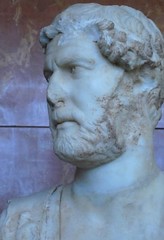
[Image - Bust of the Emperor Hadrian found at Heraklion on Crete 127-128 CE, The Louvre, Paris, France]

At present, the Institute is examining the secondary subterranean spaces, including drainage systems and corridors for activities performed by slaves—an area of the grounds that covers at least five acres. Future explorations will reconcile the relationship between the newly discovered bath complex and the previously known bathing facilities of the sprawling villa complex, unearth the other sections of the villa (including a huge garden area), and relate the history of the villa to this area of Rome's suburbium, unknown before this project.
The institute is presently accepting applications for participants in the fourth excavation season to be conducted from June 14, 2009 through August 02, 2009.

"This season’s summer program aims to supply participants with both a chronological and diachronic approach to the study of Roman civilization. Through this dual approach those involved in the program will gain a more comprehensive historical and cultural overview of Roman civilization from its rise to power in this rich Mediterranean area, understanding how this civilization set a standard of cultural values that have had long lasting influence over the entire Western world to this day."

Sunday, November 02, 2008

6,000 gold Roman coins from age of Diocletian found in Wales

A deposit of almost 6,000 ancient Roman coins was unearthed in a farmer’s field by a metal detecting enthusiast.

A present-day value is yet to be put on the coins, found buried in two pots and compared by one expert to an early single European currency.

The pots’ combined contents of 5,913 copper-alloy coins from the early fourth century were uncovered over two days in April near Sully, in the Vale of Glamorgan.

Most of the coins were minted in London, Trier and Lyon, but some came from more distant imperial outposts in what is now Croatia and Syria.

National Museum Wales numismatist Edward Besly said the Emperor Diocletian reformed the Roman currency around 295AD, although some of the coins belonged to an earlier denomination.

He said: “They are the same standard, same design.

Technorati Tags: , , , , , , , , , , ,

Saturday, October 18, 2008

Buried Roman neighborhood of the dead uncovered

A dig has turned up the tomb of a nobleman who led Rome's legions in the second century A.D.Workers renovating a rugby stadium have uncovered a vast complex of tombs beneath Rome that mimic the houses, blocks and streets of a real city, according to officials, who have unveiled a series of new finds.

A dig has turned up the tomb of a nobleman who led Rome's legions in the second century A.D.

Culture Ministry officials said Thursday that medieval pottery shards in the city of the dead, or necropolis, show the area may have been inhabited by the living during the Dark Ages after being used for centuries for burials during the Roman period.

It is not yet clear who was buried in the ancient cemetery, but archaeologists at the still partially excavated site believe at least some of the dead were freed slaves of Greek origin.

Friday, July 11, 2008

Roman ceremonial lance found in Caerleon site


Archaeologists excavating one of the most important Roman sites in Britain have made an "extremely rare" find.

The team digging at part of the Roman fortress in Caerleon near Newport found what they believe is a legionary's ceremonial lance.

Dr Peter Guest said he thought the iron staff, broken into three pieces, was the first of its type found in the UK.

He also believed it was likely to have belonged to a high-ranking commander who was "not to be tampered with".

Dr Guest, of Cardiff University, said: "It's a very unusual find and there's not more than a dozen of them.

"I don't know of any of that type in Britain.

"There are a few at fortresses and forts around the Rhine and Danube, the frontiers of the Roman Empire."

The staff would probably have featured some type of decoration such as plumes, which indicated that the carrier was no ordinary soldier.

He would probably have been on special assignment, perhaps with the legion's commander or other high-ranking member of the Roman government in Britain."

Monday, June 16, 2008

Roman chariot unearthed in Greece


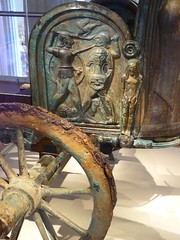
I wish this article had included a picture. I would like to have compared it to this bronze Etruscan chariot I saw at the Metropolitan Museum of Art in New York to see what changes were made in chariot design over 700 years.

"Archaeologists have dug up the skeletons of 16 horses and a two-wheeled chariot in a grave dating back to the Roman Empire in north-east Greece, the culture ministry announced.

Half of the horses were buried in pairs, whilst two human skeletons were also discovered in a dig near Lithohori, in the Kavala region.

Near to the remains of six of the horses archaeologists found a shield, weapons and various other accessories.

Ten of the horse skeletons were complete and in addition to the horses, diggers found a grave and four tombs covered with a ceramic lid, which contained four bronze coins dating back to the fourth century AD.

The chariot, dating from the first or second century AD, was "undoubtedly designed to be used in war or hunting," the ministry said.

The chariot was decorated with a frieze relief in bronze, depicting three of Hercules' labours - namely the Cerberus dog, the wild boar of Erymanthian, and the Stymphalian birds."

Friday, May 02, 2008

Roman burials near Gloucester appear to be Antonine plague victims

"A study into a mass Roman grave excavated in Gloucester appears to show the dead had been killed by smallpox.

The remains of around 91 individuals uncovered in 2005 are in part of Wooton Cemetery, which was the burial ground for the fortress at nearby Kingsholm.

The bodies appear to have been thrown in the grave haphazardly during the second half of the 2nd Century.

Oxford Archaeology who analysed the remains say they are the victims of an epidemic, perhaps the Antonine Plague.

This outbreak of smallpox swept across the Roman Empire between AD 165 and 189.

"The skeletons of adult males, females, and children were lying in a very haphazard fashion, their bones completely entangled, reflecting the fact that they had been dumped, unceremoniously in a hurried manner," said Louise Loe, Head of Burial Archaeology.

Inscribed tombstones

"When we studied the skeletons we were looking for evidence, such as trauma, that would explain why they had been buried in such a way.

"In fact, very little trauma was found on the skeletons...this led us to conclude that the individuals were the victims of an epidemic that did not discriminate against age or sex," she said.

Such outbreaks of disease killed quickly and tended not to leave marks on bone, she said.

Future DNA tests will be carried out on the skeletons in the hope of confirming the theory.

Also unearthed on the site on London Road were two 1st Century sculptured and inscribed tombstones which helped the team make a direct connection between documentary evidence and the archaeological record of the site.

One tombstone was for a 14-year-old slave, the other for a soldier of the 20th legion, Lucius Octavius Martialis, son of Lucius, of the Pollian voting tribe from Eporedia.

The legion was stationed at Gloucester until the late 1st Century with soldiers from Sporedia, modern Ivrea north of Turin."

Sunday, April 13, 2008

Justinian's Plague Victims Found


"The remains of hundreds of victims, believed to have been killed in a plague that swept Italy 1500 years ago, have been found south of Rome.

The bodies of men, women and children were found in Castro dei Volsci, in the region of Lazio, during excavations carried out by Lazio archaeological office.

News of the extraordinary discovery was reported in the magazine, "Archeologia Viva".

The victims are believed to have been victims of the Justinian Plague, a pandemic that killed as many as 100 million people around the world during a 50 year period in the 6th century A.D.

It spread through Europe as far north as Denmark and as far west as Ireland.

The archaeological find is the first evidence of the devastating impact of the plague.

The plague swept across the Mediterranean during the reign of Byzantine Emperor Justinian I in the early 540s and according to some historians changed the course of European history because the empire then entered a period of decline."

You can read more about this plague and period of history in "Justinian's Flea" by William Rosen.

Sunday, March 16, 2008

Trepanation Evidence Found in excavation of Roman Veria in Greece

GREECE ANCIENT SURGERY

The skeleton of a young woman from a 3rd century A.D. grave in Veria, northern Greece, is seen in this undated handout photo provided by the Greek Culture Ministry on Tuesday, March 11, 2008. Archaeologists believe a large hole on the front of the skull, above the eyes, was caused by _ apparently failed _ brain surgery nearly 1,800 years ago. Although references to such delicate operations abound in ancient writings, discoveries of surgically perforated skulls are uncommon in Greece.

"Greek archaeologists said Tuesday they have unearthed evidence of what they believe was brain surgery performed nearly 1,800 years ago on a young woman - who died during or shortly after the operation.

Although references to such delicate operations abound in ancient writings, discoveries of surgically perforated skulls are uncommon in Greece.

Site excavator Ioannis Graikos said the woman's skeleton was found during a rescue dig last year in Veria, a town some 75 kilometers (46 miles) west of Thessaloniki.

"We interpret the find as a case of complicated surgery which only a trained and specialized doctor could have attempted," Graikos said.

A bone expert who studied the finds said the skeleton belonged to a woman up to 25 years old who had suffered a severe blow to the crown of her head, Graikos said. The operation was apparently an attempt to save her life.

He said the clearly defined shape of the hole left in the woman's skull was a sign of relatively sophisticated surgery.

"She probably did not survive the operation, as the wound was very large, and there are no signs of healing around the edges," Graikos told The Associated Press.

The discovery in Veria appears to be similar to several others made in other parts of the former Roman Empire, said Simon Mays, an expert on human skeletal remains at English Heritage, a body which advises the British government.

"That kind of operation dates back a long way ... the earliest example dates back about 5,000 years ago in Europe," said Mays, who was not connected to the Greek excavation.

In early examples, cruder holes were made in the skull by slowly scraping the bone away around the edges, but more precise instruments were used in Roman times, he said.

"We know that (brain) surgery was carried out in the Roman empire, and some of the Roman textual sources give quite precise instructions as to how it should be carried out," Mays said.

"This probably fits in with a pattern about what we know (the Romans) could do surgically."

Graikos said the find attested to the social and medical sophistication in Veria, which in the 3rd century A.D. - during the period of Roman rule - was one of Greece's main civic centers, and the capital of a federation of Macedonian cities."

Tuesday, March 11, 2008

Roman villa discovered near Cambridgeshire

The discovery of the remains of a Roman villa in Cambridgeshire has left archaeologists "blown away".

The villa, hidden deep in more than a square mile of ancient woodland at Bedford Purlieus, near Peterborough, had gone unnoticed over the centuries.

Experts believe the remains at the site, just off the A47 at Wansford, probably date back to between the second and fourth centuries AD.

Painted plasterwork, pottery, and local limestone joined with mortar have been found.

"The ground has never been cultivated, so the remains can still be seen as lumps and bumps rather than just outlines," said Ben Robinson, archaeologist for Peterborough City Council.

"The quality and variety of what we've found so far suggests this was part of a wealthy town, combining manufacturing and cultural development - a sort of cross between Cambridge and Stoke-on-Trent."

Sunday, October 28, 2007

Mosaic Floors of Roman villa unearthed in Austria

As mosaics are one of my passions, I tried to find a picture of some of the mosaic floors discovered at this villa but no luck so far. I do wish archaeologists on major digs would consider including a field digital photographer as part of the team so news releases could be properly illustrated.

"Archaeologists in the western Austrian province Tyrol unearthed the remains of a large-scale Roman villa, complete with extensive floor mosaics that may have been also a source for a number of local legends.

The archaeologists from Innsbruck University stumbled upon references to the 1 800-year-old, long since forgotten building situated near the town Lienz in a manuscript penned in Latin, dating back to the mid-18th century. Tyrolean proto-archaeologist Anton Roschmann wrote that he found Roman remains in 1746, but his findings were lost, the Austrian Press Agency reported.

During a dig in October the remains of five rooms of a building dating back to Roman times wear unearthed on a 300-square-metre plot. The remains of the walls show colourful wall paintings, the archaeologists said, but the most astounding find were large-scale floor mosaics in three of the rooms.

The mosaics were unique in the region regarding their dimensions and state of preservation, the archaeologists said. Furthermore, the villa had been partly equipped with wall and floor heatings.

The heating vaults under the floors remained partly intact. The fact that they had not collapsed as usual added to the good condition of the mosaics.

In the 18th century, the low-ceilinged vaults were believed to be the home of dwarfs, leading to the creation of local legends about a "dwarf city" in the region.

The alpine region that today represents the Austrian province Tyrol was conquered by Rome in 15 BC While it profited from Roman trade, the region was never particularly attractive for Roman settlers."

Wednesday, October 03, 2007

UK Housing Partnership Uncovers Grave of Roman Centurion

"Matrix Housing Partnership has discovered the Romans in a Worcestershire village. The partnership, which includes Accord, Ashram, Caldmore, Trident and Rooftop, is currently developing a site on the outskirts of picturesque Eckington. Image

During the archaeological inspection of the site the ancient burial site of a Roman centurion was uncovered.

This is a rare discovery in South Worcestershire as the soil has usually degraded the bone beyond recognition. However this find includes a near complete skull and the majority of the skeleton.

Birmingham University archaeology team have removed the bones for further analysis.

Toby Whiting, communications manager for Rooftop who is leading the development, dressed up as a centurion for the day to commemorate the find. He said: "We're delighted by the discovery. Matrix developments pride themselves on addressing the needs of future communities but this is a wonderful reminder that communities last a very long time indeed. It's great opportunity to learn more about Eckington's past and share that with the rest of the village."