Showing posts with label Germany. Show all posts

Monday, August 31, 2009

Will Fragments of Augustan Equestrian Statue Found in Germany Lead to Insight on Turmoil after Varus Disaster?


A beautiful horse head with traces of gilt has been retrieved from a well near Waldgrimes in central Germany. Archaeologists speculate that the horse was part of an equestrian statue bearing the emperor Augustus that was ritually destroyed by Germanic tribesmen after their victory over Roman legions at Teutoburg Vald in 9 C.E. The rider's foot was also recovered.

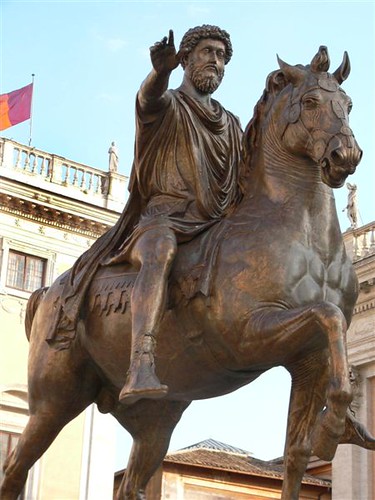
It would be wonderful if enough fragments could be found to reconstruct the work. There is only one other equestrian statue of Augustus known in the world at this time. Sadly, equestrian statues contained so much bronze that they were prized targets of medieval recyclers so few Roman period equestrian statues survive intact. It is said that the famous equestrian statue of Marcus Aurelius at the Capitoline Museum in Rome only survived because it was thought to be Constantine I, revered by early Christians for making Christianity the official religion of the empire. Judging from the picture provided by the Science Ministry of Hessen (above left), the Augustan statue must have been as breathtaking as the Aurelian statue in Rome (right). The horse's bridle depicts figures of Mars, the Roman god of war, and Nike, personification of victory.
Previous excavations at Waldgrimes have yielded a Roman forum, lead waterpipes and a retail center. The statue may have been the centerpiece of a cult temple of Augustus. Such a temple was erected in Lugdunum by Drusus as a transitory step to making Gaul a Roman province following suppression of a revolt over a Roman census there. As a symbol of Romanization, it would have naturally been a target following news of the successful ambush by Arminius.

Panic swept through Roman settlements in Germania and Gaul.

"After the defeat of Varus there was panic throughout the Roman population living in Gaul and Germany. Most of the forts established by Drusus and Tiberius in Germany were abandoned immediately after the disaster. All but one of the Roman garrisons stationed in Northern Germany was destroyed, with only the garrison at Aliso holding out. Dio describes the events which surrounded Aliso. Aliso has been tentatively identified as the base Haltern. Haltern, a Roman legionary base in Germany illustrates the panic that spread through the Romans in Germany. Haltern, founded in 5 BC, is situated about 54 km from Vetera on the north bank of the Lippe River, where the river has its confluence with the Stever River. Haltern may have served as the wintering quarters for Varus and his legions in the winter 9 AD. The fort supported a large number of troops and had all the logistical and administrative support that a large force of soldiers would require to function. The amount of housing for officers is unusually high at Haltern implying that the post served as an administrative hub for the Roman army deployed east of the Rhine River. Dio attributes the Romans success at Haltern to German ignorance of siege warfare and Roman employment of archers. The archers held the Germans off, inflicting heavy losses on the Germans.

Nevertheless the Romans soon ran out of supplies and had to make an escape attempt. Using a rainstorm and darkness as cover the Romans slipped out and met up with Roman forces to the west. Archeological evidence from Haltern shows that it was hastily abandoned around 9 AD as shown by the tremendous amount of buried hordes throughout the fort. Romans fleeing to the Rhine, not wanting to be slowed down with material goods, buried several hordes around the fort in anticipation of retrieving them again. These hordes consist primarily of weapons and coinage. Other Roman bases on the Lippe were similarly abandoned: Anreppen, Oberaden, and Holsterhausen. " - Rome’s Bloody Nose: The Pannonian Revolt, Teutoburg Forest and the Formation of Roman Frontiers by Nolan Doyle, Western Oregon University.

We've all heard of Augustus' response - rending his clothes and crying out "Varus, give me back my legions!" But Augustus was not just being melodramatic. Cassius Dio writes, "... there were no more men available in reserve. The Roman armies had reached the point of breaking, between the rebellions in Pannonia and Germany the losses could not be easily replaced anymore. Augustus had to resort to conscriptions of men and nobody wanted to be conscripted. Augustus made the men draw lots with twenty percent of those under the age of thirty-five and ten percent of those older conscripted into the army. When people still were not excited enough to be conscripted Augustus had several men executed. Augustus also called up veterans and conscripted freedmen and put them into service. " - Rome’s Bloody Nose: The Pannonian Revolt, Teutoburg Forest and the Formation of Roman Frontiers by Nolan Doyle, Western Oregon University.

For a graphic view of the battle of Teutoburg Forest, check out these videos on YouTube, excerpts from the History Channel series "Decisive Battles."

Hopefully, we'll learn even more about this tumultuous period with continued excavations.

Thursday, December 18, 2008

3rd century Roman Battlefield uncovered in northern Germany

Well, it seems that Arminius didn't have the last laugh in northern Germania after all!

[A knife case binder. Photo: C.S. Fuchs]

ARCHAEOLOGISTS say the history books about Roman legions in Europe will have to be revised following the "sensational" discovery of a battlefield in northern Germany this week.

Arrowheads, axes, catapults, spears, coins and lucky charms of the centurions of Rome

who clashed with the Hun tribesmen in the 3rd century AD have been found in a forest. The clash of arms, say experts, would have resembled those portrayed in the Russell Crowe epic Gladiator.

Six hundred artefacts have been dug up so far in what archaeologists are calling "the find of the century".

The detritus of war lies in a patch of land near Northeim, about 50 kilometres from Hanover. The spear tips and arrowheads have the DNA of their victims on them, centuries after they died in a ferocious battle.

What makes the find unique is that it shows Roman armies in action long after the last clash — the great battle of the Teutoburg Forest in AD9 when Arminius annihilated three of the seven legions of Rome — was thought to have occurred.

"Evidently the Romans and Germans fought a bloody battle in the third century AD," said archaeologist Petra Loenne. "Some 1000 Roman legionnaires may have been involved in the fight."

Intriguingly, the find includes more than 300 iron projectiles that were fired by powerful Roman torsion weapons known as scorpions, which could catapult heavy darts with a high velocity and deadly accuracy.

It had a range of 300 metres and was portrayed in the opening battle scene of Gladiator.

"The bolts were found densely clustered," said archaeologist Henning Hassmann.