Showing posts with label Augustus. Show all posts

Wednesday, January 05, 2011

Remains of Crimean legionary post discovered by Polish team

City-ruler in the Bosporan Kingdom,
Roman vassal state in the Crimea
from the Pushkin Museum.  Courtesy
of Wikipedia.
The remains of a Roman legionary house, once part of a Roman settlement near ancient Symbolon Limen, later called Balaklava, has been discovered on the Crimean peninsula by a team of  Polish archeologists supervised by Radoslaw Karasiewicz-Szczypiorski from the Archeology Institute at the University of Warsaw.  The structure is thought to have been built in 2 C.E. after the initial Roman settlement was burned down in 1 C.E.
 
“The building that we discovered was several times remodeled: old walls were pulled down and new were erected, floors and roofs were repaired. In 3 A.D. the house was destroyed by fire and much later, probably between 15th and 16th  centuries a Tatar settlement replaced the Roman fort,” says the archeologist. - News from Poland

Once known as "Chersonesus Taurica" by the Romans, the Crimean peninsula came under Roman control after Pompey The Great defeated Mithridates VI Eupator in the 1st century BCE. The local client king, Aspurgus, received Roman citizenship and adopted the Roman names "Tiberius Julius" because he enjoyed the patronage of the first two Roman Emperors, Augustus and Tiberius. All of the following kings adopted these two Roman names followed by a third name, mostly of Pontic, Thracian or Sarmatian origin. Bosporan kings struck coinage throughout the kingdom period, which included gold staters bearing portraits of the respective Roman Emperors.

The Romans later built a large naval base at Chersonesos.

Roman troops were stationed in the peninsula, perhaps a division of the Pontic fleet, certainly a detachment of the Moesian army, (other garrisons in Panticapaeum and Chersonesos); their presence even in small numbers showed to the barbarians that the dreaded legionary stood behind (the Bosporanum Regnum). -  Mommsen. The Provinces of the Roman Empire p. 317


Forts in Ukraine: Roman Forts in Ukraine, Zaporizhian Sich, Çufut Qale, Charax, Crimea, Lysa Hora, Kiev Fortress   Mithradates VI Af Pontos Roms Perfekte Fjende (Danish Edition)   The Poison King: The Life and Legend of Mithradates, Rome's Deadliest Enemy   Mithridates VI and the Pontic Kingdom (Black Sea Studies)    Pompey the Great: A Political Biography (Blackwell Ancient Lives) 
Enhanced by Zemanta

Monday, August 31, 2009

Will Fragments of Augustan Equestrian Statue Found in Germany Lead to Insight on Turmoil after Varus Disaster?


A beautiful horse head with traces of gilt has been retrieved from a well near Waldgrimes in central Germany. Archaeologists speculate that the horse was part of an equestrian statue bearing the emperor Augustus that was ritually destroyed by Germanic tribesmen after their victory over Roman legions at Teutoburg Vald in 9 C.E. The rider's foot was also recovered.

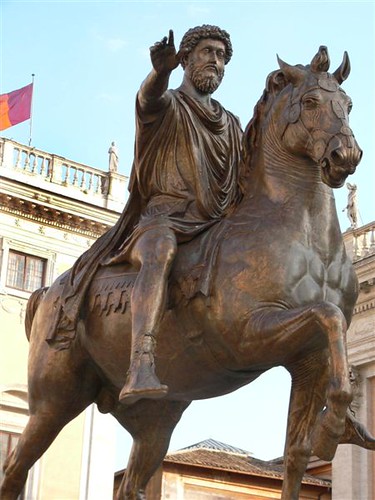
It would be wonderful if enough fragments could be found to reconstruct the work. There is only one other equestrian statue of Augustus known in the world at this time. Sadly, equestrian statues contained so much bronze that they were prized targets of medieval recyclers so few Roman period equestrian statues survive intact. It is said that the famous equestrian statue of Marcus Aurelius at the Capitoline Museum in Rome only survived because it was thought to be Constantine I, revered by early Christians for making Christianity the official religion of the empire. Judging from the picture provided by the Science Ministry of Hessen (above left), the Augustan statue must have been as breathtaking as the Aurelian statue in Rome (right). The horse's bridle depicts figures of Mars, the Roman god of war, and Nike, personification of victory.

Previous excavations at Waldgrimes have yielded a Roman forum, lead waterpipes and a retail center. The statue may have been the centerpiece of a cult temple of Augustus. Such a temple was erected in Lugdunum by Drusus as a transitory step to making Gaul a Roman province following suppression of a revolt over a Roman census there. As a symbol of Romanization, it would have naturally been a target following news of the successful ambush by Arminius.

Panic swept through Roman settlements in Germania and Gaul.

"After the defeat of Varus there was panic throughout the Roman population living in Gaul and Germany. Most of the forts established by Drusus and Tiberius in Germany were abandoned immediately after the disaster. All but one of the Roman garrisons stationed in Northern Germany was destroyed, with only the garrison at Aliso holding out. Dio describes the events which surrounded Aliso. Aliso has been tentatively identified as the base Haltern. Haltern, a Roman legionary base in Germany illustrates the panic that spread through the Romans in Germany. Haltern, founded in 5 BC, is situated about 54 km from Vetera on the north bank of the Lippe River, where the river has its confluence with the Stever River. Haltern may have served as the wintering quarters for Varus and his legions in the winter 9 AD. The fort supported a large number of troops and had all the logistical and administrative support that a large force of soldiers would require to function. The amount of housing for officers is unusually high at Haltern implying that the post served as an administrative hub for the Roman army deployed east of the Rhine River. Dio attributes the Romans success at Haltern to German ignorance of siege warfare and Roman employment of archers. The archers held the Germans off, inflicting heavy losses on the Germans.

Nevertheless the Romans soon ran out of supplies and had to make an escape attempt. Using a rainstorm and darkness as cover the Romans slipped out and met up with Roman forces to the west. Archeological evidence from Haltern shows that it was hastily abandoned around 9 AD as shown by the tremendous amount of buried hordes throughout the fort. Romans fleeing to the Rhine, not wanting to be slowed down with material goods, buried several hordes around the fort in anticipation of retrieving them again. These hordes consist primarily of weapons and coinage. Other Roman bases on the Lippe were similarly abandoned: Anreppen, Oberaden, and Holsterhausen. " - Rome’s Bloody Nose: The Pannonian Revolt, Teutoburg Forest and the Formation of Roman Frontiers by Nolan Doyle, Western Oregon University.

We've all heard of Augustus' response - rending his clothes and crying out "Varus, give me back my legions!" But Augustus was not just being melodramatic. Cassius Dio writes, "... there were no more men available in reserve. The Roman armies had reached the point of breaking, between the rebellions in Pannonia and Germany the losses could not be easily replaced anymore. Augustus had to resort to conscriptions of men and nobody wanted to be conscripted. Augustus made the men draw lots with twenty percent of those under the age of thirty-five and ten percent of those older conscripted into the army. When people still were not excited enough to be conscripted Augustus had several men executed. Augustus also called up veterans and conscripted freedmen and put them into service. " - Rome’s Bloody Nose: The Pannonian Revolt, Teutoburg Forest and the Formation of Roman Frontiers by Nolan Doyle, Western Oregon University.

For a graphic view of the battle of Teutoburg Forest, check out these videos on YouTube, excerpts from the History Channel series "Decisive Battles."

Hopefully, we'll learn even more about this tumultuous period with continued excavations.

Friday, July 24, 2009

Will 1st century BCE Shipwrecks Off Ancient Pandateria Yield Imperial Correspondence?

A virtual graveyard of Roman ships has been discovered off the coast of ancient Pandateria, the abode of a number of famous Roman exiles. Pandateria, now called Ventotene, was the site Augustus selected for his daughter Julia the Elder in 2 BCE when he ordered her banished for her sexual escapes in defiance of her father's morality laws.

Later Tiberius ordered his grand-niece, Agrippina the elder, there in 29 CE after she fomented a public outcry for the suspected poisoning of her husband, Germanicus. She died there, probably a victim of starvation, four years later.

[Image - Agrippina the Elder Landing at Brundisium with the Ashes of Germanicus by Benjamin West, 1768. Oil on canvas.]

Agrippina's youngest daughter, Julia Livilla, was deported to Pandateria by the emperor, Claudius, being charged with adultery with the philosopher Seneca. She was later starved to death, probably at the urging of Claudius' vengeful wife, Messalina.

The island claimed yet another distinguished lady of the Julio-Claudians. In 62 CE, Claudia Octavia, the first wife of emperor Nero, was sent to Pandateria where she was eventually executed as well.

I know it is unlikely that any royal correspondence would be found among the wrecks but wouldn't it be thrilling if any were discovered among the countless amphoras?

An archaeology team has found five intact shipwrecks belonging to ancient Roman trading vessels off the Italian island of Ventotene.

The shipwrecks, which were found over 100 meters underwater, are amongst the deepest discovered in the Mediterranean and date back to the first century BCE to the fifth century CE.

Located halfway between Rome and Naples, Ventotene Island was once a sheltering place for ships during the rough weather in the Tyrrhenian Sea, Reuters reported.

The island was known as Pandataria in Roman times and was used to exile disgraced Roman noblewomen.
- More: Press TV

Sunday, January 13, 2008

More evidence of Roman trade unearthed in India

"HYDERABAD: Historians have discovered a 25-ft high mound spread over 100 acres at Kondapur in Medak district which they presume to be a Buddhist stupa with myriad segments throwing light on the Buddhist link of the present Telangana region.

The Archaeological Survey of India has decided to excavate the site-dating to 200 BC- 200 AD -from April. If a stupa is unearthed as hoped by the ASI, this will be the first Buddhist site in Telangana, firmly establishing the belief among historians that this region too was part of the Satavahana empire that extended into present Maharashtra and that Kondapur, indeed, was a city that had a direct connection with Paithan...

Historians led by D. Jithendra Das, superintending archaeologist, ASI, Hyderabad Circle, who inspected the mound recently, found it to be “extremely fruitful” with its upper strata already yielding several antiquities without digging.

Nearly 2,000 coins and many coin-moulds, ornaments made of gold and semi-precious stones, beads and terracotta figurines have been recovered from the surface area itself.

A valuable find was a gold coin of the Roman king Augustus."

Friday, July 13, 2007

Augustan Ruins Draw Visitors to Side, Turkey


Side is an ancient maritime city in Pamphylia, the region from the Mediterranean to Mount Taurus. Located near the Mediterranean villages of Manavgat and Selimiye in Antalya, this city was the seat of some of the most important ancient civilizations. With a visit to Side today, you will discover not only this history but also the striking natural beauty of this region.

The ruins of ancient Side include a Roman-style theater complex which was used for gladiator fights and later as a church; well-preserved city walls; a monumental gate dating back to the second century; old Roman baths; an agora where pirates used to sell slaves; the early Roman Temple of Dionysus next to the theater; a fountain and the remains of a Byzantine Basilica.