Showing posts with label excavation. Show all posts

Friday, February 26, 2010

Ulysses-adorned amphitheater found near Fiumicino airport

Somehow with all the bustle that always accompanies the approaching holidays I somehow missed seeing this notice of a marvelous find of a "mini-Colosseum" near Rome's Fiumicino airport reported a few months ago.  When I visited Ostia in March 2009, I remember reading that much more of the ancient port remained unexcavated because it lay under the Fiumicino airport. 

[Image of Ulysses sculpture courtesy of the University of Southhampton]

This small amphitheater, however, is considered part of the ancient Roman port of Portus that actually succeeded Ostia as the Roman Empire's primary port at the mouth of the Tiber River in the second century CE. 

Apparently, the site was originally discovered in the 1860s but has remained largely undisturbed since then.  Now, researchers have been able to employ 3-D geophysics, computer visualization, environmental analysis and digital recording as well as excavation to reveal the details of what became one of  the largest maritime infrastructures of the ancient world.

"With the help of ground penetrating radar, the archaeologists have uncovered luxuriously decorated rooms, a colonnaded garden, a finely carved marble head, possibly depicting the Greek hero Ulysses, and a well-preserved toilet, designed to be used by three people at a time.

"The toilet belonged to the palace. It is located between the amphitheater and a porticoed garden. It is really an impressive building, with marbled floor and walls," said Simon Keay, project director and leading expert in Roman archaeology at the University of Southampton.

The researchers are now analyzing the dirt from the toilet -- basically ancient human waste -- to build a picture of the diet of the people who frequented the site." - More: Discovery News 

Daily Life in the Roman City: Rome, Pompeii, and Ostia   Mayfair Games Ostia The Harbor of Rome   Roman Amphitheaters (Watts Library)   Look Around a Roman Amphitheater (Virtual History Tours)   The Roman Games: Historical Sources in Translation (Blackwell Sourcebooks in Ancient History)   The Story of the Roman Amphitheatre

Palace of Tarquinius Superbus unearthed in Gabii

When I heard that Italian archaeologists think they have unearthed the palace of the notorious son of the last king of Rome, I felt a rush of excitement.  The Tarquin dynasty holds such a colorful place in early Roman history, especially considering all the lore surrounding the fateful rape of Lucretia, that the discovery of the actual palace that may have been near the site of the notorious desecration  is like the Roman equivalent of Schliemann's discovery of Troy.

[Image - Tarquinius and Lucretia by Titian, 1571.  Courtesy of Wikimedia Commons]

Archaeologists say the richly decorated monumental roof was dismantled and they hope to reconstruct it later this spring. Archaeologist Marco Fabbri of Rome's Tor Vergata University, directed the excavation.

"Fabbri and colleagues from Rome's Archaeological Superintendency believe that the residence was furiously demolished, probably during the Roman revolt in 510 B.C. that ultimately led to the foundation of the Roman Republic.  The ongoing excavation has so far unearthed three, disconnected rooms which most likely opened onto a porticoed area.  Under the building's exceptionally well-preserved floor slabs, eight round cells contained the remains of five stillborn babies.

'We hope to unearth the rest of the residence this spring. In particular, we are looking to piece together the richly decorated roof,' Fabbri said.

A terracotta fragment of the roof has already been found. It features the image of the Minotaur, an emblem of the Tarquins.

'It's a strong piece of evidence to support the hypothesis that the edifice was built for the Tarquin family,' Fabbri said." - Discovery News
 The Rapes of Lucretia: A Myth and Its Transformations   Etruscan Civilization: A Cultural History   Etruscan Life and Afterlife: A Handbook of Etruscan Studies   Etruscan Myths (The Legendary Past)   Etruscan Roman Remains by Leland, Charles (BETRROM)

Tuesday, February 02, 2010

East Asian Remains Found in 1st century CE Roman cemetery

A research team working in a 1st -2nd century CE Roman necropolis near the ancient town of Vagnari in southern Italy have unearthed a skeleton of a man with East Asian ancestry, according to DNA analysis.  When I was researching an article on the Han Dynasty for Heritage Key, I read that one of the important achievements of the period was the development of trade with the Roman Empire in the 2nd century CE. But the age of the remains and the possibility that there are more than one individual in the cemetery with East Asian descent makes it appear that there could have been a substantial group of East Asians in Vagnari before history tells us a formal delegation from the Han Dynasty had even made "First Contact". 

Vagnari was actually part of the emperor's estate during this time with its inhabitants engaged in tile production and iron working.

"So far the evidence suggests that Vagnari was a settlement of artisans and lower status individuals. The most likely location for the house of the imperial procurator who would have managed the estate is up the hill near the top of the plateau now called San Felice where a building provisionally interpreted as a villa is being excavated by a Canadian team directed by Hans vanderLeest (Mount Allison University) and Myles McCallum (St Mary’s University, Halifax)." - The Vagnari Project  

What seems puzzling is that if this man or even more than one of the 73 burials unearthed in Vagnari were slaves from China, how did the Roman emperor acquire them?  We don't know of any campaigns by the Romans that far east during that time.  Were they presented as a gift to him by a trade delegation? 


It will be interesting to see if any East Asian artifacts turn up as the excavation progresses.  Although the slaves could have been without significant possessions I can't imagine them living out their lives without fashioning some amulet or talisman to remind them of their former homeland, especially since the Romans did not discourage foreign religions.


The research team hope ongoing excavations will provide clues to globalization, human mobility, identity, and diversity in Roman Italy.

"This multi-faceted research demonstrates that human skeletal remains can provide another layer of evidence in conjunction with archaeological and historical information," says Tracey Prowse, Assistant Professor of Anthropology, initially of McMaster University (Hamilton, Ontario) and, since 2006, of Southern  Illinois University Carbondale, the lead author on the study. . - DNA testing on 2,000-year-old bones in Italy reveal East Asian ancestry

  Comparison between Roman and Han Empires: Military of ancient Rome, Culture of ancient Rome, Huo Qubing, Wei Qing, Emperor Wu of Han, Roman mythology, ... Roman law, Government of the Han Dynasty   The Establishment of the Han Empire and Imperial China (Greenwood Guides to Historic Events of the Ancient World)   The Early Chinese Empires: Qin and Han (History of Imperial China)

Monday, September 28, 2009

2nd century civilian Roman settlement unearthed near Mainz

It looks like more evidence of civilian Roman settlements in ancient Germania have been discovered near Mainz by U.S. Army Corps of Engineers working on an expansion to the Weisbaden Army Air Field.A team of archaeology students and experts believe they have unearthed remnants of a Roman settlement from the second or third century near the construction site of an Army housing project.

The team, from nearby Mainz University, discovered a Roman coin, pieces of pottery, roof tiles, decorated bricks and 23 pieces of raw lead. The students also believe they have found the wall outlines of a building.

"If it’s from the second century A.D., it would be a civilian building and we didn’t expect this. We expected only military buildings," said Dr. Guntram Schwitalla, a district archaeologist in Hessen.

- More: Stars and Stripes

Wednesday, May 27, 2009

Roman Sewn Ship Found in Croatia


From the description of the site, it sounds like a sewn ship will be the first of numerous discoveries in the former Roman city of Cissa.

Archaeologists have found an ancient sewn ship over 2000 years old in Novalia, Croatia. The ship, including body panels, ship skeleton and stitches, was found in the Caska Bay on the Island of Pag, near Novalja.

[Image - Reconstruction of a sewn boat. Courtesy of The Sewn Boat homepage.]

“In Roman times, Novalja was known for its port accommodation and was located on the old sea route from Greece to northern Italy and central Europe. The ships would wait in Novalja for suitable winds and because of that a town developed there that had various suitable services,” said professor Zdenko Brusic from Zadar University.

“Today, there are numerous remains of Roman architecture under the whole region, like water supply lines, well equipped basilicas, graves,” he added. - More: Sindh Today

I wonder if this new discovery exhibits the combination of construction techniques found in a Greek vessel raised off the coast of Sicily late last year? That 2500 year-old vessel was built with both sewing and mortise-and-tenon joints. According to National Geographic, other finds show that Egyptians and Phoenician-Punic people used this method of boat building as well.

On the Sewn Boat Homepage, Misha Naimark explains that the stitching material for sewn boats (at least those built in Northern Europe) was usually made from the roots of trees like spruce or pine.

Gathered roots must be cleaned from the bark (which is also loose and peels off quite easily) and immediately immersed into a bucket of tar; the roots are soft only while they are fresh and wet, but when they get dry they become quite crisp and stiff. So the roots are to be kept immersed in the tar, and taken out just before sewing. To protect them against rotting and deteriorating in the boat, the roots must be boiled in the tar until they are completely impregnated with it; this will make them softer, too.

Thus prepared, the spruce roots are flexible enough for sewing; but if a root is too thick and stiff, one can easily rip it lengthwise into two equal thong-like parts, which are very fit for sewing. Each part can further be ripped into halves to obtain thin and flexible enough yarns. Usually thick roots were split into yarns this way, and sometimes several such yarns were twisted together into strands and used for sewing instead of whole roots. - More: The Sewn Boat Homepage


Wednesday, May 20, 2009

New Ceramics Dating Process Developed in UK

I thought this article in Chemistry World was quite interesting. I'm a little confused about one statement in the article that says the dating method can be applied regardless of whether the artifact is buried , exposed, etc. but at the end of the article it says results can be compromised by fluctuations in temperature and environmental conditions over a long timescale. Still, it sounds like a more definitive way to use potsherds to date a site than comparison with other potsherds. Proximity can be misleading with debris from occasional trade activities. Ancient peoples, like modern ones, liked to pick up souvenirs on their wanderings.
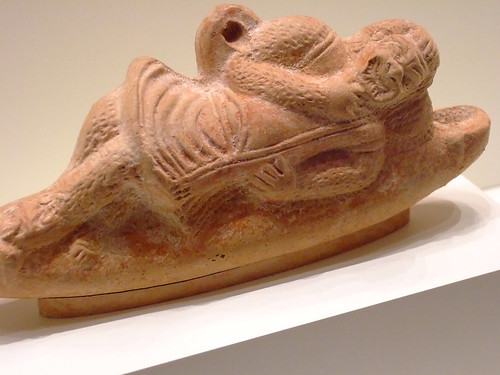
[Image -Roman Terracotta Lamp with Reclining Comic Actor 100-200 CE in the permanent collection of the Getty Villa, Malibu, California. Photo by Mary Harrsch.]

A new way to find the age of ceramic objects, such as ancient pottery, has been developed by scientists in the UK. The technique measures how much water the items have absorbed since they were fired - simply and accurately revealing when they were made.

Broken pottery, brickwork or tiles are unearthed at almost every archaeological dig site, but they are often of little use to archaeologists as determining how old they are is difficult. Carbon dating cannot be used because ceramics are made from finely-grained mineral clay, and alternative dating methods are complex and costly.

Now, UK scientists have found a way to date these artefacts and thus give fresh insight into the history and construction of excavated ruins or items. Key to the process is the knowledge that there is an ultra-slow recombination of moisture in fired-clay ceramic objects as they absorb moisture from the air, and that this 'rehydroxylation' process occurs at a predictable rate once an object is fired.

The researchers indicate that the technique may also find uses in spotting fake objects or uncovering whether buildings have been re-built or experienced a fire. For example, while testing a variety of bricks and tiles provided by the Museum of London - including Roman, medieval and modern samples - all but one of the samples were accurately dated.

The sample that threw the results was a clay brick from a medieval priory in Canterbury, UK, which was dated at only 66 years old instead of several hundred. On further investigation, the team found that the priory had been bombed during World War II, resulting in the clay bricks being heated over 500°C, which would have dried them out and thus affected the results. - More: Chemistry World


Thursday, January 15, 2009

Villa delle Vignacce excavation yields another bath complex and religious sculpture


Excavations at an ancient Roman villa and bath complex in the outskirts of Rome have unearthed a wealth of surprisingly well-preserved artifacts, including the marble head of a Greek god, archaeologists said. The site of the Villa delle Vignacce, toward Ciampino airport south of Rome, was first explored by archaeologists in 1780 who found statues that are now in the Vatican museum. But excavations began in earnest only about two years ago, revealing a residence attached to an elaborate thermal bath complex dating to the 1st century A.D. complete with hot baths, large tubs and a communal latrine.

Although dating stratigraphy at the villa has been challenging because the site was mined for building materials and decorative elements in the Middle Ages, initial studies indicate the bath complex on the north side of the villa was not originally used for that purpose but later converted to a bathing facility in the second century. Still later, in the third century, bathing was relocated once more to the recently discovered vaulted complex on the south side of the villa.

Since then, archaeologists said they had also uncovered prized artifacts including fragments of columns, floor slabs and the head of a marble statue believed to represent either the Greek divinity of Zeus Serapide or Asclepius, the god of medicine and healing.

Another discovery of note included a colored-glass mosaic of leaves and vegetation lining the inside of a vault.

The complex appeared to have been used and modified from the second
through the fifth centuries, and was just a short distance away from a
Barbaric camp in the sixth century, though its links to the camp are
unclear, said Darius Arya, an archaeologist with the American Institute of Roman Culture, which is handling the excavations.

The complex initially belonged to Quintus Servilius Pudens, a wealthy friend of Emperor Hadrian, who probably held private parties in the baths for his friends, archaeologists said.
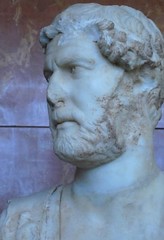
[Image - Bust of the Emperor Hadrian found at Heraklion on Crete 127-128 CE, The Louvre, Paris, France]

At present, the Institute is examining the secondary subterranean spaces, including drainage systems and corridors for activities performed by slaves—an area of the grounds that covers at least five acres. Future explorations will reconcile the relationship between the newly discovered bath complex and the previously known bathing facilities of the sprawling villa complex, unearth the other sections of the villa (including a huge garden area), and relate the history of the villa to this area of Rome's suburbium, unknown before this project.
The institute is presently accepting applications for participants in the fourth excavation season to be conducted from June 14, 2009 through August 02, 2009.

"This season’s summer program aims to supply participants with both a chronological and diachronic approach to the study of Roman civilization. Through this dual approach those involved in the program will gain a more comprehensive historical and cultural overview of Roman civilization from its rise to power in this rich Mediterranean area, understanding how this civilization set a standard of cultural values that have had long lasting influence over the entire Western world to this day."

Thursday, December 18, 2008

Farmer uncovers pre-Roman sanctuary near Aprilia

I wonder how many artifacts the farmer managed to pass on to the black market before he was discovered!

"A farmer working his land south of Rome dug up hundreds of artifacts from a 2,600-year-old sanctuary, but ran afoul of police when he tried to sell the ancient hoard, officials said Wednesday.

After spotting fragments of pottery in soil dug up by the farmer, authorities searched his home last month and seized more than 500 artifacts, including perfume vials, cups and miniature vases used as votive objects.

The art squad of the Carabinieri paramilitary police said the farmer was placed under investigation for allegedly trafficking in antiquities. Ancient artifacts found in Italy are considered state property, and finds must be reported to authorities.

Archaeologists said they will continue to excavate the sanctuary, which dates back to the 7th-6th century B.C. and is located outside the town of Aprilia, near a small lake some 25 miles (40 kilometers) south of Rome.

The find could expand knowledge about the area's history in pre-Roman times, when it was inhabited by Latin-speaking people under the influence of the Etruscan civilization that dominated central Italy, experts said.

The pottery, some of which was imported from Greece, was offered to a deity probably connected to the lake, said Stefano De Caro, director of archaeology at the Italian Culture Ministry." - More, GMA News.TV

3rd century Roman Battlefield uncovered in northern Germany

Well, it seems that Arminius didn't have the last laugh in northern Germania after all!

[A knife case binder. Photo: C.S. Fuchs]

ARCHAEOLOGISTS say the history books about Roman legions in Europe will have to be revised following the "sensational" discovery of a battlefield in northern Germany this week.

Arrowheads, axes, catapults, spears, coins and lucky charms of the centurions of Rome

who clashed with the Hun tribesmen in the 3rd century AD have been found in a forest. The clash of arms, say experts, would have resembled those portrayed in the Russell Crowe epic Gladiator.

Six hundred artefacts have been dug up so far in what archaeologists are calling "the find of the century".

The detritus of war lies in a patch of land near Northeim, about 50 kilometres from Hanover. The spear tips and arrowheads have the DNA of their victims on them, centuries after they died in a ferocious battle.

What makes the find unique is that it shows Roman armies in action long after the last clash — the great battle of the Teutoburg Forest in AD9 when Arminius annihilated three of the seven legions of Rome — was thought to have occurred.

"Evidently the Romans and Germans fought a bloody battle in the third century AD," said archaeologist Petra Loenne. "Some 1000 Roman legionnaires may have been involved in the fight."

Intriguingly, the find includes more than 300 iron projectiles that were fired by powerful Roman torsion weapons known as scorpions, which could catapult heavy darts with a high velocity and deadly accuracy.

It had a range of 300 metres and was portrayed in the opening battle scene of Gladiator.

"The bolts were found densely clustered," said archaeologist Henning Hassmann.

Saturday, October 18, 2008

Buried Roman neighborhood of the dead uncovered

A dig has turned up the tomb of a nobleman who led Rome's legions in the second century A.D.Workers renovating a rugby stadium have uncovered a vast complex of tombs beneath Rome that mimic the houses, blocks and streets of a real city, according to officials, who have unveiled a series of new finds.

A dig has turned up the tomb of a nobleman who led Rome's legions in the second century A.D.

Culture Ministry officials said Thursday that medieval pottery shards in the city of the dead, or necropolis, show the area may have been inhabited by the living during the Dark Ages after being used for centuries for burials during the Roman period.

It is not yet clear who was buried in the ancient cemetery, but archaeologists at the still partially excavated site believe at least some of the dead were freed slaves of Greek origin.

Caligula's Murder Scene Unearthed

http://internetservices.readingeagle.com/blog/moviehouse/caligula.jpgArchaeologists restoring the imperial residences on the Palatine Hill, in the heart of ancient Rome, believe they have discovered the underground passageway in which the despotic Emperor Caligula was murdered by his own guards.

[Left: Actor Malcolm McDowell as "Caligula"]

The hill, which his honeycombed with ruins of palaces and villas, has also yielded frescoes and black-and-white mosaics in the first century B.C. home of a patrician, the ministry said in a statement.

Technorati Tags: , , , , , ,

Monday, August 25, 2008

Archaeologists may have discovered the capital of Dacia Malvensis in Romania

Archaeologists digging near the town of Cioroiu
Nou, in Dolj country in southern Romania, have come across a Roman fort
that might have been the capital of the province of Dacia Malvensis.

"We've made some important discoveries. We're almost certain that we've
unearthed the capital of Dacia Malvensis, something archaeologists were
searching to find for hundred of years," Mihai Fifor, director of
Oltenia Muzeum, told the local press agency NewsIn.

Dolj country is located in southern Romania and almost two millennia ago it was part of the Roman province of Dacia Malvensis.

Until now, it was believed that the province got its name from its capital
Malva, like Dacia Porolissensis which was named after its capital
Porolissum, but archaeological evidence could not empower the theory.

"We're waiting for a confirmation that it really is Malva. Our experts from
the University of Craiova are currently analyzing an inscription we've
found. It is the first time an inscription bears the name of this Roman
city," said Fifor.

Due to the outbreak of the Marcomanic Wars, when German tribes forced the border of the Roman Empire, Emperor Marcus Aurelius split the Dacian province in three financial districts, Dacia Porolissensis, Dacia Malvensis and Dacia Apulensis and added
another legion to the one already present in Dacia.

Other important findings have been reported near the town of Cioroiu Nou.

Archaeologists have discovered a temple, a necropolis, administrative and military
buildings all suggesting the presence of a Roman fort. Additionally,
statues, coins, weapons and ceramics were discovered. - Daily India

Thursday, August 14, 2008

Head of Faustina Found in Sagalassos Frigidarium

Archaeologists digging in Turkey have found the colossal marble head of a Roman empress.

It was discovered in a rubble-filled building where parts of a huge statue of the emperor Hadrian were unearthed last year.

The discovery, at the ancient site of Sagalassos, is thought to show Faustina the Elder, wife of Roman emperor Antoninus Pius. Sagalassos was once an important urban centre. It was abandoned after being hit by several strong earthquakes.


A team led by Marc Waelkens, from the Catholic University of Leuven in Belgium, has been excavating the site since 1990.

The head of Faustina was lying face down in rubble that fills
the ruins of a bath house that was partially destroyed by an earthquake
between AD 540 and AD 620. It was unearthed just 6m from the spot where the Hadrian statue was found, but was sitting higher up in the rubble.

At first, exacavators thought they had found a statue belonging
to Hadrian's wife, Vibia Sabina, who was forced into a marriage with
the homosexual emperor at the age of 14.

But when they turned it over, the face was very different from
the usual depictions of Sabina. This was a more mature woman with
fleshy lips and a distinctive hairstyle.

The building in which the statues were found at Sagalassos was
probably a "frigidarium" - a room with a cold pool which Romans could
dip into after a hot bath. It is part of a larger bath complex that is being carefully uncovered by archaeologists.

The fragments were found not on the floor of the frigidarium -
beneath the rubble from the earthquake - but higher up in the debris
pile. This suggests they did not originally stand in this room, but
were hauled there from elsewhere in the bath complex - probably from
the "Kaisersaal", or emperor's room. They speculate that the Kaisersaal once hosted statues of
Hadrian, Faustina the Elder and other members of Rome's so-called
Antonine dynasty - many of whom belonged to a Spanish or southern
French provincial aristocracy. The Hadrian statue was probably brought to the frigidarium
either to remove its gilded armour or to be burned to cement in a
nearby kiln.


If this is the case I'm so glad the workman were somehow interrupted. I shudder to think of all of the magnificent art that was destroyed just to provide common building material.


Tuesday, August 12, 2008

Roman Temple Unearthed in Zippori

"Ruins of a Roman temple from the second century CE have recently been unearthed in the Zippori National Park.The discovery indicated that Zippori, the Jewish capital of the Galilee during the Roman period, had a significant pagan population which built a temple in the heart of the city center. The central location of the temple which is positioned within a walled courtyard and its architectural relation to the surrounding buildings enhance our knowledge regarding the planning of Zippori in the Roman era.

The building of the church on the foundation of the temple testifies to the preservation of the sacred section of the city over time. This new finding demonstrates not only the religious life, culture and society in Roman and Byzantine Zippori, but also that this was a city in which Jews, pagans and later Christians lived together and developed their hometown with various buildings.

The newly discovered temple is located south of the decumanus - colonnaded street - which ran from east to west and was the main thoroughfare in the city during the Roman through Byzantine period. The temple, measuring approximately 24 by 12 meters, was built with a decorated façade facing the street. The temple’s walls were plundered in ancient times and only its foundations remain.

No evidence has been found that reveals the nature of the temple’s rituals, but some coins dating from the time of Antoninus Pius, minted in Diocaesarea (Zippori), depict a temple to the Roman gods Zeus and Tyche. The temple ceased to function at an unknown date, and a large church, the remains of which were uncovered by the Hebrew University excavation team in previous seasons, was built over it in the Byzantine period.

North of the decumanus, opposite the temple, a monumental building was partially excavated this summer. Its role is still unclear, although its nature and size indicate that it was an important building. A courtyard with a well-preserved stone pavement of smooth rectangular slabs executed in high quality was uncovered in the center of the building, upon which were found a pile of collapsed columns and capitals - probably as a result of an earthquake. The decoration on these architectural elements was executed in stucco. Beyond a row of columns, an adjacent aisle and additional rooms were discovered. Two of them were decorated with colorful, geometrical mosaics."

Friday, July 11, 2008

Roman ceremonial lance found in Caerleon site


Archaeologists excavating one of the most important Roman sites in Britain have made an "extremely rare" find.

The team digging at part of the Roman fortress in Caerleon near Newport found what they believe is a legionary's ceremonial lance.

Dr Peter Guest said he thought the iron staff, broken into three pieces, was the first of its type found in the UK.

He also believed it was likely to have belonged to a high-ranking commander who was "not to be tampered with".

Dr Guest, of Cardiff University, said: "It's a very unusual find and there's not more than a dozen of them.

"I don't know of any of that type in Britain.

"There are a few at fortresses and forts around the Rhine and Danube, the frontiers of the Roman Empire."

The staff would probably have featured some type of decoration such as plumes, which indicated that the carrier was no ordinary soldier.

He would probably have been on special assignment, perhaps with the legion's commander or other high-ranking member of the Roman government in Britain."

Tuesday, July 01, 2008

Roman fortress explored in Caerleon (UK)


"Archaeologists from Cardiff University today began excavating part of the remains of the 2,000 year old Roman Fortress in Caerleon, Newport.

Led by Dr Peter Guest, of the School of History and Archaeology, the team of 50 archaeologists from Cardiff and University College London will excavate the remains of a monumental courtyard building in the south-western corner of the fortress.

The building's existence was discovered during geophysical surveys undertaken by staff and students from the University and was investigated during trial excavations in 2007.

This year's excavation will open a large trench over the building, which is believed to be a store-building or warehouse. It is hoped that the excavations will reveal a wealth of new information about the storage facilities, provisioning, and supply of a Legion in Britain."

Monday, June 16, 2008

Roman chariot unearthed in Greece


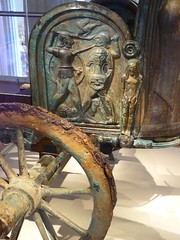
I wish this article had included a picture. I would like to have compared it to this bronze Etruscan chariot I saw at the Metropolitan Museum of Art in New York to see what changes were made in chariot design over 700 years.

"Archaeologists have dug up the skeletons of 16 horses and a two-wheeled chariot in a grave dating back to the Roman Empire in north-east Greece, the culture ministry announced.

Half of the horses were buried in pairs, whilst two human skeletons were also discovered in a dig near Lithohori, in the Kavala region.

Near to the remains of six of the horses archaeologists found a shield, weapons and various other accessories.

Ten of the horse skeletons were complete and in addition to the horses, diggers found a grave and four tombs covered with a ceramic lid, which contained four bronze coins dating back to the fourth century AD.

The chariot, dating from the first or second century AD, was "undoubtedly designed to be used in war or hunting," the ministry said.

The chariot was decorated with a frieze relief in bronze, depicting three of Hercules' labours - namely the Cerberus dog, the wild boar of Erymanthian, and the Stymphalian birds."

Monday, February 18, 2008

Possible Druid grave unearthed near Colchester


"A series of graves found in a gravel quarry at Stanway near Colchester, Essex, have been dated to 40-60 A.D. At least one of the burials, it appears, may have been that of a Druid, according to a report published in British Archaeology.

Within the wooden, chambered burial site, researchers have excavated a wine warmer, cremated human remains, a cloak pinned with brooches, a jet bead, divining rods (for fortune-telling), a series of surgical instruments, a strainer bowl last used to brew Artemisia-containing tea, a board game carefully laid out with pieces in play, as well as other objects.

Archaeologist Mike Pitts said the collection mirrors basic medical tools from other parts of the Roman world.

The board game and its arranged pieces, however, are anything but common. None other like it has ever been found at Roman-era sites in Great Britain.

Surviving metal corners and hinges from the board allowed Pitts to reconstruct it as an 8-inch by 12-inch rectangle. Raised sides suggest dice might have been used. The white and blue glass counters were positioned with care. Some were straight across the sides, another in a diagonal line and one white marker close to the board’s center.

Pitts believes the game may have been another “divination tool,” along with the rods, jet bead and scent bottles also excavated at Stanway.

Philip Crummy, director of the Colchester Archaeological Trust, told Discovery News that the person in the burial could very well have been a Druid “given the healing and divination attributes..."

"He is, however, not yet convinced the person was Celtic, since the medical kit was “fairly Romanized” and the individual may have acted “like a Roman surgeon/doctor would have done.”

“Divination was widely practiced in the Roman world too,” he added.

Because of site’s age and location, Pitts is more inclined to believe the person was indeed a Celtic Druid and could have been closely related to Cunobelin, a chief or king of the Catuvellauni tribe."

Monday, December 17, 2007

Large hoard of Roman tableware found in London

Archaeologists have unearthed a hoard of more than 1,000 ancient Roman artefacts in central London.

Buckets, bowls and dishes mostly made of copper alloy were among the items discovered in Moorgate, on the edge of the city's financial district.

Also discovered was the most complete wooden door to have survived anywhere in the Roman Empire and 19 metal vessels in the bottom of a wood-lined well.

Jenny Hall, curator of Roman London at the Museum of London, which revealed the finds, described them as "amazing".

"I just couldn't stop grinning when I first saw them," she told The Times newspaper.

"In size and scale they are simply unprecedented.

"Nothing like this has ever been found in London before, or anywhere else in Britain."

The items, from the first to third centuries AD, were discovered by archaeologist Chris Jarrett and are expected to give researchers a unique insight into the Roman city of Londinium.

New studies show Roman Caister structures less condensed than previously

New investigations at Caistor Roman town using the latest technology have revealed the plan of the buried town at an extraordinary level of detail which has never been seen before. The high-resolution geophysical survey used a Caesium Vapour magnetometer to map buried remains across the entire walled area of the Roman town.

The research at Caistor is being directed by Dr Will Bowden of The University of Nottingham, who worked with Dr David Bescoby and Dr Neil Chroston of the University of East Anglia on the new survey, sponsored by the British Academy. Around 30 local volunteer members of the Caistor Roman Town Project also assisted.

The survey has produced the clearest plan of the town yet seen confirming the street plan (shown by previous aerial photographs), the town’s water supply system (detecting the iron collars connecting wooden water pipes), and the series of public buildings including the baths, temples and forum, known from earlier excavations.

However, the survey also showed that earlier interpretations of the town as a densely occupied urban area — given by reconstruction paintings — may be totally wrong. Buildings were clustered along the main streets of the town, but other areas within the street grid seem to have been empty and were perhaps used for grazing or cultivation.

Dr Bowden, a lecturer in Roman Archaeology, said: "The results of the survey have far exceeded our expectations. It's not an exaggeration to say that the survey has advanced our knowledge of Caistor to the same extent that the first aerial photograph did 80 years ago.

“The presence of possible Iron Age and Saxon features suggests that the town had a much longer life than we previously thought and the fact that it's just sitting there in open fields instead of being under a modern town means we can ask the questions we want to.

“For an archaeologist it's a dream opportunity to really examine how European towns developed."

A new Roman theatre?

One of the most exciting new discoveries from the survey is what looks like a Roman theatre. Clear traces of a large semi-circular building have been found next to the town’s temples — the typical location for a theatre in Roman Britain.