 I thought this article in Chemistry World was quite interesting. I'm a little confused about one statement in the article that says the dating method can be applied regardless of whether the artifact is buried , exposed, etc. but at the end of the article it says results can be compromised by fluctuations in temperature and environmental conditions over a long timescale. Still, it sounds like a more definitive way to use potsherds to date a site than comparison with other potsherds. Proximity can be misleading with debris from occasional trade activities. Ancient peoples, like modern ones, liked to pick up souvenirs on their wanderings.
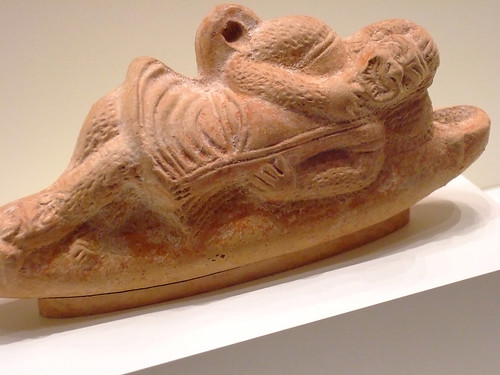
[Image -Roman Terracotta Lamp with Reclining Comic Actor 100-200 CE in the permanent collection of the Getty Villa, Malibu, California. Photo by Mary Harrsch.]
A new way to find the age of ceramic objects, such as ancient pottery, has been developed by scientists in the UK. The technique measures how much water the items have absorbed since they were fired - simply and accurately revealing when they were made.Broken pottery, brickwork or tiles are unearthed at almost every archaeological dig site, but they are often of little use to archaeologists as determining how old they are is difficult. Carbon dating cannot be used because ceramics are made from finely-grained mineral clay, and alternative dating methods are complex and costly.
Now, UK scientists have found a way to date these artefacts and thus give fresh insight into the history and construction of excavated ruins or items. Key to the process is the knowledge that there is an ultra-slow recombination of moisture in fired-clay ceramic objects as they absorb moisture from the air, and that this 'rehydroxylation' process occurs at a predictable rate once an object is fired.
The researchers indicate that the technique may also find uses in spotting fake objects or uncovering whether buildings have been re-built or experienced a fire. For example, while testing a variety of bricks and tiles provided by the Museum of London - including Roman, medieval and modern samples - all but one of the samples were accurately dated.
The sample that threw the results was a clay brick from a medieval priory in Canterbury, UK, which was dated at only 66 years old instead of several hundred. On further investigation, the team found that the priory had been bombed during World War II, resulting in the clay bricks being heated over 500°C, which would have dried them out and thus affected the results. - More: Chemistry World


