Showing posts with label ancient. Show all posts

Wednesday, May 27, 2009

Roman Sewn Ship Found in Croatia


From the description of the site, it sounds like a sewn ship will be the first of numerous discoveries in the former Roman city of Cissa.

Archaeologists have found an ancient sewn ship over 2000 years old in Novalia, Croatia. The ship, including body panels, ship skeleton and stitches, was found in the Caska Bay on the Island of Pag, near Novalja.

[Image - Reconstruction of a sewn boat. Courtesy of The Sewn Boat homepage.]

“In Roman times, Novalja was known for its port accommodation and was located on the old sea route from Greece to northern Italy and central Europe. The ships would wait in Novalja for suitable winds and because of that a town developed there that had various suitable services,” said professor Zdenko Brusic from Zadar University.

“Today, there are numerous remains of Roman architecture under the whole region, like water supply lines, well equipped basilicas, graves,” he added. - More: Sindh Today

I wonder if this new discovery exhibits the combination of construction techniques found in a Greek vessel raised off the coast of Sicily late last year? That 2500 year-old vessel was built with both sewing and mortise-and-tenon joints. According to National Geographic, other finds show that Egyptians and Phoenician-Punic people used this method of boat building as well.

On the Sewn Boat Homepage, Misha Naimark explains that the stitching material for sewn boats (at least those built in Northern Europe) was usually made from the roots of trees like spruce or pine.

Gathered roots must be cleaned from the bark (which is also loose and peels off quite easily) and immediately immersed into a bucket of tar; the roots are soft only while they are fresh and wet, but when they get dry they become quite crisp and stiff. So the roots are to be kept immersed in the tar, and taken out just before sewing. To protect them against rotting and deteriorating in the boat, the roots must be boiled in the tar until they are completely impregnated with it; this will make them softer, too.

Thus prepared, the spruce roots are flexible enough for sewing; but if a root is too thick and stiff, one can easily rip it lengthwise into two equal thong-like parts, which are very fit for sewing. Each part can further be ripped into halves to obtain thin and flexible enough yarns. Usually thick roots were split into yarns this way, and sometimes several such yarns were twisted together into strands and used for sewing instead of whole roots. - More: The Sewn Boat Homepage


Wednesday, April 29, 2009

1st Century Millefiori dish found in east London


When I was in Rome last month, I saw millefiori articles for sale in shops all over the city. My friend Pat collects millefiori paperweights so, of course, we had to check out each one.

Although the technique used to create these little glass masterpieces is associated with Venice, it actually goes back to ancient Rome, as indicated by the estimated age of this dish discovered in the section of London that was originally part of Roman Londinium.

A rare Roman millefiori dish has been unearthed by archaeologists from the grave of a wealthy Londoner.

The dish, which has gone on display at the Museum of London in Docklands, was found during excavations in Prescot Street, in Aldgate, east London.

It was pieced together from its many fragments.

It is made up of hundreds of translucent blue indented glass petals, bordered with white embedded in a bright red glass background.

The dish formed part of the grave goods of the Roman Londoner whose cremated remains were uncovered in a container in a cemetery in Londinium's (the Roman name for London) eastern quarter. - BBC News
The millefiori technique involves the production of glass canes or rods, known as murrine, with multicolored patterns which are viewable only from the cut ends of the cane. A murrine rod is heated in a furnace, pulled until thin while still maintaining the cross section's design, and then cut into beads or discs when cooled.

[Image right courtesy of Murano Millefiori]

[Millefiori] canes, probably made in Italy, have been found as far away as 8th century archaeological sites in Ireland, and millefiori was used in thin slices to brilliant effect in the early 7th century Anglo-Saxon jewellery from Sutton Hoo. - Wikipedia


Friday, April 17, 2009

Second century sculpture of Roman boxer found in Jerusalem


This is an interesting find from the excavations in Jerusalem. At first I thought it might be a well worn head of the Roman emperor Hadrian himself but the experts suspect it is a boxer from the shape of the ears.

Archaeologists have unearthed a marble figurine they say dates back to the second or third century C.E. during an excavation in Jerusalem's City of David.

The marble bust of a bearded man's head was discovered during the excavations that the Israel Antiquities Authority is conducting in the Givati car park in the walls around Jerusalem National Park.

Dr. Doron Ben-Ami and Yana Tchekhanovets, directors of the excavation at the site on behalf of the Israel Antiquities Authority, said that the figurine's short curly beard and head tilted to the right is indicative of Greek influence and can be dated to the time of the emperor Hadrian or shortly thereafter (second-third centuries C.E.).
According to Ben-Ami and Tchekhanovets, "The high level of finish on the figurine is extraordinary, while meticulously adhering to the tiniest of details."

They added that the pale-yellow shade of the marble may point to the eastern origin of the raw material from which the image was carved, but they are still verifying that matter.

The figure's stylistic motifs, such as its short hair style, the prominent lobes and curves of the ears, as well as the almond-shaped eyes, suggest that the object most likely portrays an athlete, probably a boxer.

Boxing was one of the most popular fields of heavy athletics in Roman culture and more than once Roman authors mention the demand by the Roman public in general, and the elite in particular, for boxing matches.- More: Haaretz.com
I had never visited the City of David website and was quite impressed with the number of multimedia elements it includes. I particularly liked the Timeline feature that provides a slider to change a picture of the modern city to resemble a view from centuries ago. They also included a nice fly-thru of a reconstruction of the ancient city. Be sure to have your computer's volume control turned down a bit, though, as the music is a little overwhelming!

Thursday, December 18, 2008

Farmer uncovers pre-Roman sanctuary near Aprilia

I wonder how many artifacts the farmer managed to pass on to the black market before he was discovered!

"A farmer working his land south of Rome dug up hundreds of artifacts from a 2,600-year-old sanctuary, but ran afoul of police when he tried to sell the ancient hoard, officials said Wednesday.

After spotting fragments of pottery in soil dug up by the farmer, authorities searched his home last month and seized more than 500 artifacts, including perfume vials, cups and miniature vases used as votive objects.

The art squad of the Carabinieri paramilitary police said the farmer was placed under investigation for allegedly trafficking in antiquities. Ancient artifacts found in Italy are considered state property, and finds must be reported to authorities.

Archaeologists said they will continue to excavate the sanctuary, which dates back to the 7th-6th century B.C. and is located outside the town of Aprilia, near a small lake some 25 miles (40 kilometers) south of Rome.

The find could expand knowledge about the area's history in pre-Roman times, when it was inhabited by Latin-speaking people under the influence of the Etruscan civilization that dominated central Italy, experts said.

The pottery, some of which was imported from Greece, was offered to a deity probably connected to the lake, said Stefano De Caro, director of archaeology at the Italian Culture Ministry." - More, GMA News.TV

Gynecology exam depicted on Roman lamp

The Romans seemed to have absolutely no taboos when it came to depicting daily life on such common objects as oil lamps. I guess this is a prime example:

A group of archaeologists has found in the northern Spanish region of Leon a ceramic lamp dating from the beginning of the 1st century that shows a representation of the gynecological exam performed on a sick woman.

Archaeology professor at Madrid's Universidad Complutense Angel Morillo, told Efe that this is a "unique find without parallel in the Roman world."

Morillo on Tuesday night in Leon city will present the results of the investigation that has lasted six years during a conference entitled "From the Legions to the Barbarians: New perspectives on Roman Archaeology."

The find is of an oil lamp, "an exceptional piece that illustrates the presence of doctors in the city," and - specifically - a military hospital, the expert said.

On the lamp's surface "appears a very slender woman, possibly affected by a serious illness, like cancer, and a doctor who is performing a gynecological exam with a vaginal speculum," Morillo said.

Possibly the image is of a specific examination that one of the Roman doctors performed, he said - More: Latin American Herald Tribune
.

Monday, August 25, 2008

Archaeologists may have discovered the capital of Dacia Malvensis in Romania

Archaeologists digging near the town of Cioroiu
Nou, in Dolj country in southern Romania, have come across a Roman fort
that might have been the capital of the province of Dacia Malvensis.

"We've made some important discoveries. We're almost certain that we've
unearthed the capital of Dacia Malvensis, something archaeologists were
searching to find for hundred of years," Mihai Fifor, director of
Oltenia Muzeum, told the local press agency NewsIn.

Dolj country is located in southern Romania and almost two millennia ago it was part of the Roman province of Dacia Malvensis.

Until now, it was believed that the province got its name from its capital
Malva, like Dacia Porolissensis which was named after its capital
Porolissum, but archaeological evidence could not empower the theory.

"We're waiting for a confirmation that it really is Malva. Our experts from
the University of Craiova are currently analyzing an inscription we've
found. It is the first time an inscription bears the name of this Roman
city," said Fifor.

Due to the outbreak of the Marcomanic Wars, when German tribes forced the border of the Roman Empire, Emperor Marcus Aurelius split the Dacian province in three financial districts, Dacia Porolissensis, Dacia Malvensis and Dacia Apulensis and added
another legion to the one already present in Dacia.

Other important findings have been reported near the town of Cioroiu Nou.

Archaeologists have discovered a temple, a necropolis, administrative and military
buildings all suggesting the presence of a Roman fort. Additionally,
statues, coins, weapons and ceramics were discovered. - Daily India

Friday, July 11, 2008

Etruscan tomb uncovered in Perugia


"An ancient Etruscan tomb has resurfaced after centuries underground during the course of building work in the central Italian city of Perugia.

The tomb, which has been preserved in excellent condition, contains
seven funerary urns, the municipal archaeology department said. It is in
the shape of a square and was covered by a sheet of travertine marble,
which had apparently remained untouched since being laid centuries ago.
The tomb is split into two halves by a pillar and there are two benches
running along each side. The funerary urns, which were placed on the
benches, were marked with brightly coloured mythological and religious
motifs. A preliminary study suggests that writing on the side of the
urns probably refers to a family that was called the Aneis. In addition
to the urns, the tomb also housed the remains of a bronze bed and
various pottery shards. The site was discovered during digging work for
a new roundabout in the Strassacapponi neighbourhood on the outskirts of
the Umbrian town."

Wednesday, July 02, 2008

Roman "shopping center" found in British dig


"One of Britain's very first shopping centres has been unearthed - a high street that was fashionable 1,800 years ago when togas were still in vogue.

A row of narrow shop buildings uncovered by archaeologists shows that the Romans in Britain had their very own well-heeled fashionistas.

The shop buildings used by the stylish Romans in ancient Britain were uncovered by archaeologists in fields at Monmouthshire, South Wales.

The site, now occupied only by the rural village of Caerwent near Newport, was formerly Venta Silurum - one of 15 major towns in Britain at the time.

Crucially for archaeologist, unlike most of these 15 towns Venta Silurum did not stay important. Instead it declined - and so escaped the demolition, rebuilding and enlargement that have obliterated early remains elsewhere over the centuries.

Archaeologists say the surviving evidence show it was affluent and fashionable in Roman times, with wealthy villas in the suburbs.

A villa with painted walls and mosaic floors among the other finds also points to the town being home to wealthy Romans in the Third Century AD, when Venta Silurum was booming.

Archaeologist Tom Scott described the 44-acre site as 'beautifully preserved'.

Seven trenches were dug at three different locations to uncover more about previously unexcavated parts of the town.

Long thin buildings were also found in several places - believed to be shop buildings on the high street.

Key finds included a penknife hilt of bone depicting two gladiators fighting.

Other artefacts uncovered included coins, glass, ceramics, human and animal bones, lead patches used for repairing, and bits of mosaic.

Mr Scott said: 'This type of town was a "civitas capital" - a civilian town and centre of local Roman government..."

Monday, June 16, 2008

Roman chariot unearthed in Greece


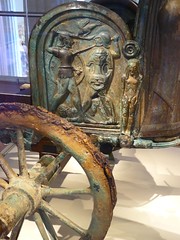
I wish this article had included a picture. I would like to have compared it to this bronze Etruscan chariot I saw at the Metropolitan Museum of Art in New York to see what changes were made in chariot design over 700 years.

"Archaeologists have dug up the skeletons of 16 horses and a two-wheeled chariot in a grave dating back to the Roman Empire in north-east Greece, the culture ministry announced.

Half of the horses were buried in pairs, whilst two human skeletons were also discovered in a dig near Lithohori, in the Kavala region.

Near to the remains of six of the horses archaeologists found a shield, weapons and various other accessories.

Ten of the horse skeletons were complete and in addition to the horses, diggers found a grave and four tombs covered with a ceramic lid, which contained four bronze coins dating back to the fourth century AD.

The chariot, dating from the first or second century AD, was "undoubtedly designed to be used in war or hunting," the ministry said.

The chariot was decorated with a frieze relief in bronze, depicting three of Hercules' labours - namely the Cerberus dog, the wild boar of Erymanthian, and the Stymphalian birds."

Monday, February 18, 2008

Possible Druid grave unearthed near Colchester


"A series of graves found in a gravel quarry at Stanway near Colchester, Essex, have been dated to 40-60 A.D. At least one of the burials, it appears, may have been that of a Druid, according to a report published in British Archaeology.

Within the wooden, chambered burial site, researchers have excavated a wine warmer, cremated human remains, a cloak pinned with brooches, a jet bead, divining rods (for fortune-telling), a series of surgical instruments, a strainer bowl last used to brew Artemisia-containing tea, a board game carefully laid out with pieces in play, as well as other objects.

Archaeologist Mike Pitts said the collection mirrors basic medical tools from other parts of the Roman world.

The board game and its arranged pieces, however, are anything but common. None other like it has ever been found at Roman-era sites in Great Britain.

Surviving metal corners and hinges from the board allowed Pitts to reconstruct it as an 8-inch by 12-inch rectangle. Raised sides suggest dice might have been used. The white and blue glass counters were positioned with care. Some were straight across the sides, another in a diagonal line and one white marker close to the board’s center.

Pitts believes the game may have been another “divination tool,” along with the rods, jet bead and scent bottles also excavated at Stanway.

Philip Crummy, director of the Colchester Archaeological Trust, told Discovery News that the person in the burial could very well have been a Druid “given the healing and divination attributes..."

"He is, however, not yet convinced the person was Celtic, since the medical kit was “fairly Romanized” and the individual may have acted “like a Roman surgeon/doctor would have done.”

“Divination was widely practiced in the Roman world too,” he added.

Because of site’s age and location, Pitts is more inclined to believe the person was indeed a Celtic Druid and could have been closely related to Cunobelin, a chief or king of the Catuvellauni tribe."

Monday, December 17, 2007

Large hoard of Roman tableware found in London

Archaeologists have unearthed a hoard of more than 1,000 ancient Roman artefacts in central London.

Buckets, bowls and dishes mostly made of copper alloy were among the items discovered in Moorgate, on the edge of the city's financial district.

Also discovered was the most complete wooden door to have survived anywhere in the Roman Empire and 19 metal vessels in the bottom of a wood-lined well.

Jenny Hall, curator of Roman London at the Museum of London, which revealed the finds, described them as "amazing".

"I just couldn't stop grinning when I first saw them," she told The Times newspaper.

"In size and scale they are simply unprecedented.

"Nothing like this has ever been found in London before, or anywhere else in Britain."

The items, from the first to third centuries AD, were discovered by archaeologist Chris Jarrett and are expected to give researchers a unique insight into the Roman city of Londinium.

Sunday, November 04, 2007

20-foot section of Aurelian Wall Collapses


"A 20-foot section of Rome's ancient Aurelian Wall collapsed near the capital's central train station after days of heavy rain, a conservation official said yesterday.

The wall, part of a 16th century restoration, crumbled into a pile of bricks Thursday evening after water infiltrated the section, said Paola Virgili, an official in charge of the wall's restoration. No one was reported hurt.

The Aurelian Wall — named after the third century emperor who built it to defend the city against the first barbarian onslaughts — surrounds Rome with more than 11 miles of fortifications, towers and gates.

Experts had previously determined that the entire wall section in the area, a 1,100-foot stretch in the north of the capital, was in danger of collapsing and they had planned to start restoring it Monday."

I thought it interesting that a section repaired in the 16th century collapsed while the majority of the Roman wall that is almost 1700 years old did not. Obviously masonry techniques had not yet regained the level of the ancient Romans by the 16th century.

Wednesday, October 03, 2007

Susan Alcock studies rural Roman Empire with satellite imaging

Susan Alcock is currently one of four co-directors of an archaeological project in southern Armenia called the Vorotan Project. A diachronic study, it focuses on all periods from the Stone Age to the Soviet era and attempts to build an understanding of how and why the landscape has evolved through time, Alcock said.

For Alcock, the site is of particular interest because of its location between the ancient Roman and Parthian empires - the inhabitants of the region would have been caught between two formidable empires, she said.

Alcock, professor of classics and director of the Joukowsky Institute for Archaeology and the Ancient World, uses advanced technology to study the geography of ancient landscapes for clues into the behavior and movements of ancient peoples.

She uses satellite imaging, aerial photography and geographic information system technology to study landscapes. Alcock's work focuses on the Greek and Roman rural countryside, which she said had been largely ignored in favor of urban areas when she began her work. She said she employs the relatively new methodology of systematic pedestrian survey, or regional survey, which involves walking an area of land and examining the surface for agricultural features, remains of settlements and pottery.

Alcock said she is particularly interested in the collective memory of ancient peoples. Often, she explained, texts from the period aren't representative of the greater part of society - the poor, commoners and farmers - but of an elite fragment.

Wednesday, August 01, 2007

Archaeologists Excavate Ancient Roman Tannery


ROME -- Archaeologists excavating an ancient tannery believed to be the largest ever found in Rome said Tuesday they might need to move the entire work site, which is being threatened by railroad construction. The 1,255-square-yard complex includes a tannery dating to the second or third century, as well as burial sites and part of a Roman road.

At least 97 tubs, some measuring more than three feet in diameter, have been dug up so far in the tannery, archaeologists said.

The complex, located in the Casal Bertone area in the outskirts of Rome, lies between two tunnels of a high-speed railway being built to link Rome and Naples, said Stefano Musco, the director of the archaeological excavations.

"(Even though) there are only 109 yards of railway left to build, the archaeological complex has no chance of surviving," Musco told reporters during a tour of the dig. "Either it stays the way it is and the works are stopped or, if the railway must be built, these remains will have to be cut out and rebuilt entirely."

He said they might be moved to a nearby park.