Showing posts with label Roman villa. Show all posts

Tuesday, February 22, 2011

Town Council stands firm on disapproval of builders' plans to erect housing over site of Southwell Roman Villa

A reader sent me a link to this blog post about the battle over developers' plans to build housing on top of the site containing the remains of the Southwell Roman Villa.   Some people will never grasp the importance of preservation of our cultural heritage.  I'm glad there are still those willing to take a stand against others more interested in profit.

http://priorieshistoricalsociety.blogspot.com/2011/02/news-insult-to-our-history-southwell.html

I wonder if, after all the dust settles in Tunis, Libya, Morocca, etc. new governments will take a pro-preservation stance over Roman remains in those countries?  The remains of ancient Carthage were already being overtaken by Tunisian developers building retreats for the wealthy despite verbal obeisance to cultural preservation.
Enhanced by Zemanta

Thursday, January 15, 2009

Villa delle Vignacce excavation yields another bath complex and religious sculpture


Excavations at an ancient Roman villa and bath complex in the outskirts of Rome have unearthed a wealth of surprisingly well-preserved artifacts, including the marble head of a Greek god, archaeologists said. The site of the Villa delle Vignacce, toward Ciampino airport south of Rome, was first explored by archaeologists in 1780 who found statues that are now in the Vatican museum. But excavations began in earnest only about two years ago, revealing a residence attached to an elaborate thermal bath complex dating to the 1st century A.D. complete with hot baths, large tubs and a communal latrine.

Although dating stratigraphy at the villa has been challenging because the site was mined for building materials and decorative elements in the Middle Ages, initial studies indicate the bath complex on the north side of the villa was not originally used for that purpose but later converted to a bathing facility in the second century. Still later, in the third century, bathing was relocated once more to the recently discovered vaulted complex on the south side of the villa.

Since then, archaeologists said they had also uncovered prized artifacts including fragments of columns, floor slabs and the head of a marble statue believed to represent either the Greek divinity of Zeus Serapide or Asclepius, the god of medicine and healing.

Another discovery of note included a colored-glass mosaic of leaves and vegetation lining the inside of a vault.

The complex appeared to have been used and modified from the second
through the fifth centuries, and was just a short distance away from a
Barbaric camp in the sixth century, though its links to the camp are
unclear, said Darius Arya, an archaeologist with the American Institute of Roman Culture, which is handling the excavations.

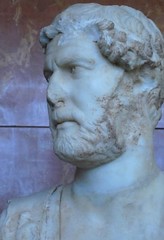
The complex initially belonged to Quintus Servilius Pudens, a wealthy friend of Emperor Hadrian, who probably held private parties in the baths for his friends, archaeologists said.
[Image - Bust of the Emperor Hadrian found at Heraklion on Crete 127-128 CE, The Louvre, Paris, France]

At present, the Institute is examining the secondary subterranean spaces, including drainage systems and corridors for activities performed by slaves—an area of the grounds that covers at least five acres. Future explorations will reconcile the relationship between the newly discovered bath complex and the previously known bathing facilities of the sprawling villa complex, unearth the other sections of the villa (including a huge garden area), and relate the history of the villa to this area of Rome's suburbium, unknown before this project.
The institute is presently accepting applications for participants in the fourth excavation season to be conducted from June 14, 2009 through August 02, 2009.

"This season’s summer program aims to supply participants with both a chronological and diachronic approach to the study of Roman civilization. Through this dual approach those involved in the program will gain a more comprehensive historical and cultural overview of Roman civilization from its rise to power in this rich Mediterranean area, understanding how this civilization set a standard of cultural values that have had long lasting influence over the entire Western world to this day."

Monday, August 25, 2008

Possible Home of Allectus found on Isle of Wight


Mosaic inside the Brading Roman Villa

Remains of a Mosaic inside the Brading Roman Villa discovered at the site in 1879
Photo: Clara Molden


The discovery is one of the largest and best-preserved Roman villas yet discovered in the country.

Shaped like a church, the building was discovered on the Isle of Wight, and has been likened to a medieval hall.

Its
remains were discovered at the site of another Roman villa in Brading,
and are believed to have been constructed 150 years before the other
building.

The later Brading villa's remains had disappeared from
sight until 1879 when a couple of local men stumbled across them by
chance.

Its ornate decorations are unrivalled in Britain and the
building may have belonged to Allectus, who in AD293 murdered his
predecessor Carausius, a Roman army commander who had proclaimed
himself Emperor of Britain. - Telegraph.co.uk

Wednesday, July 02, 2008

Roman "shopping center" found in British dig


"One of Britain's very first shopping centres has been unearthed - a high street that was fashionable 1,800 years ago when togas were still in vogue.

A row of narrow shop buildings uncovered by archaeologists shows that the Romans in Britain had their very own well-heeled fashionistas.

The shop buildings used by the stylish Romans in ancient Britain were uncovered by archaeologists in fields at Monmouthshire, South Wales.

The site, now occupied only by the rural village of Caerwent near Newport, was formerly Venta Silurum - one of 15 major towns in Britain at the time.

Crucially for archaeologist, unlike most of these 15 towns Venta Silurum did not stay important. Instead it declined - and so escaped the demolition, rebuilding and enlargement that have obliterated early remains elsewhere over the centuries.

Archaeologists say the surviving evidence show it was affluent and fashionable in Roman times, with wealthy villas in the suburbs.

A villa with painted walls and mosaic floors among the other finds also points to the town being home to wealthy Romans in the Third Century AD, when Venta Silurum was booming.

Archaeologist Tom Scott described the 44-acre site as 'beautifully preserved'.

Seven trenches were dug at three different locations to uncover more about previously unexcavated parts of the town.

Long thin buildings were also found in several places - believed to be shop buildings on the high street.

Key finds included a penknife hilt of bone depicting two gladiators fighting.

Other artefacts uncovered included coins, glass, ceramics, human and animal bones, lead patches used for repairing, and bits of mosaic.

Mr Scott said: 'This type of town was a "civitas capital" - a civilian town and centre of local Roman government..."

Tuesday, March 11, 2008

Roman villa discovered near Cambridgeshire

The discovery of the remains of a Roman villa in Cambridgeshire has left archaeologists "blown away".

The villa, hidden deep in more than a square mile of ancient woodland at Bedford Purlieus, near Peterborough, had gone unnoticed over the centuries.

Experts believe the remains at the site, just off the A47 at Wansford, probably date back to between the second and fourth centuries AD.

Painted plasterwork, pottery, and local limestone joined with mortar have been found.

"The ground has never been cultivated, so the remains can still be seen as lumps and bumps rather than just outlines," said Ben Robinson, archaeologist for Peterborough City Council.

"The quality and variety of what we've found so far suggests this was part of a wealthy town, combining manufacturing and cultural development - a sort of cross between Cambridge and Stoke-on-Trent."