Showing posts with label Greece. Show all posts

Thursday, October 02, 2008

Ancient statue found in harbor wall

An undated Greek Culture Ministry handout photo shows the head of a bearded man, part of two Roman-era statue fragments found in a submerged ancient port on the Greek island of Kythnos.
A Roman sculpture of the head of a bearded man, right, and a stone torso, both of which were used to build an ancient harbour wall, have been rediscovered in Greece.

The artefacts, which were found during an underwater survey in Mandraki, Kythnos, come from the period of Roman rule in Greece between 146BC and AD330.

The torso of a man in armour, which is about 4ft 5in, and the head had been used as building materials in the wall. The Greek Culture Ministry said that it was not clear whether the body and head came originally from the same statue.- APTechnorati Tags: , , , , , , , , , , ,

Monday, June 16, 2008

Roman chariot unearthed in Greece


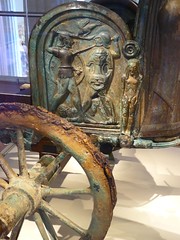
I wish this article had included a picture. I would like to have compared it to this bronze Etruscan chariot I saw at the Metropolitan Museum of Art in New York to see what changes were made in chariot design over 700 years.

"Archaeologists have dug up the skeletons of 16 horses and a two-wheeled chariot in a grave dating back to the Roman Empire in north-east Greece, the culture ministry announced.

Half of the horses were buried in pairs, whilst two human skeletons were also discovered in a dig near Lithohori, in the Kavala region.

Near to the remains of six of the horses archaeologists found a shield, weapons and various other accessories.

Ten of the horse skeletons were complete and in addition to the horses, diggers found a grave and four tombs covered with a ceramic lid, which contained four bronze coins dating back to the fourth century AD.

The chariot, dating from the first or second century AD, was "undoubtedly designed to be used in war or hunting," the ministry said.

The chariot was decorated with a frieze relief in bronze, depicting three of Hercules' labours - namely the Cerberus dog, the wild boar of Erymanthian, and the Stymphalian birds."