Wednesday, April 29, 2009

1st Century Millefiori dish found in east London


When I was in Rome last month, I saw millefiori articles for sale in shops all over the city. My friend Pat collects millefiori paperweights so, of course, we had to check out each one.

Although the technique used to create these little glass masterpieces is associated with Venice, it actually goes back to ancient Rome, as indicated by the estimated age of this dish discovered in the section of London that was originally part of Roman Londinium.

A rare Roman millefiori dish has been unearthed by archaeologists from the grave of a wealthy Londoner.

The dish, which has gone on display at the Museum of London in Docklands, was found during excavations in Prescot Street, in Aldgate, east London.

It was pieced together from its many fragments.

It is made up of hundreds of translucent blue indented glass petals, bordered with white embedded in a bright red glass background.

The dish formed part of the grave goods of the Roman Londoner whose cremated remains were uncovered in a container in a cemetery in Londinium's (the Roman name for London) eastern quarter. - BBC News
The millefiori technique involves the production of glass canes or rods, known as murrine, with multicolored patterns which are viewable only from the cut ends of the cane. A murrine rod is heated in a furnace, pulled until thin while still maintaining the cross section's design, and then cut into beads or discs when cooled.

[Image right courtesy of Murano Millefiori]

[Millefiori] canes, probably made in Italy, have been found as far away as 8th century archaeological sites in Ireland, and millefiori was used in thin slices to brilliant effect in the early 7th century Anglo-Saxon jewellery from Sutton Hoo. - Wikipedia


Friday, April 17, 2009

Second century sculpture of Roman boxer found in Jerusalem


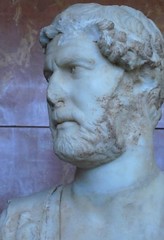
This is an interesting find from the excavations in Jerusalem. At first I thought it might be a well worn head of the Roman emperor Hadrian himself but the experts suspect it is a boxer from the shape of the ears.

Archaeologists have unearthed a marble figurine they say dates back to the second or third century C.E. during an excavation in Jerusalem's City of David.

The marble bust of a bearded man's head was discovered during the excavations that the Israel Antiquities Authority is conducting in the Givati car park in the walls around Jerusalem National Park.

Dr. Doron Ben-Ami and Yana Tchekhanovets, directors of the excavation at the site on behalf of the Israel Antiquities Authority, said that the figurine's short curly beard and head tilted to the right is indicative of Greek influence and can be dated to the time of the emperor Hadrian or shortly thereafter (second-third centuries C.E.).
According to Ben-Ami and Tchekhanovets, "The high level of finish on the figurine is extraordinary, while meticulously adhering to the tiniest of details."

They added that the pale-yellow shade of the marble may point to the eastern origin of the raw material from which the image was carved, but they are still verifying that matter.

The figure's stylistic motifs, such as its short hair style, the prominent lobes and curves of the ears, as well as the almond-shaped eyes, suggest that the object most likely portrays an athlete, probably a boxer.

Boxing was one of the most popular fields of heavy athletics in Roman culture and more than once Roman authors mention the demand by the Roman public in general, and the elite in particular, for boxing matches.- More: Haaretz.com
I had never visited the City of David website and was quite impressed with the number of multimedia elements it includes. I particularly liked the Timeline feature that provides a slider to change a picture of the modern city to resemble a view from centuries ago. They also included a nice fly-thru of a reconstruction of the ancient city. Be sure to have your computer's volume control turned down a bit, though, as the music is a little overwhelming!

Saturday, April 11, 2009

3rd century Roman Christians ate on average 30% freshwater fish


I found the following article very interesting especially since I explored the catacombs for the first time on my recent trip to Rome. My friend and I took the Archaeobus out to Appia Antica and disembarked at the Church of Saint Sebastian. While my friend waited I toured the catacombs there. Actually, the most interesting tombs were not the simple Christian niches but three pagan Roman tombs in the heart of the complex that predated most of the Christian burials. The three tombs standing side by side carved with architectural elements into the rock reminded me of a miniature Petra. The interior of two of tombs were embellished with terracotta flowers. The third tomb was decorated with delicate frescoes.

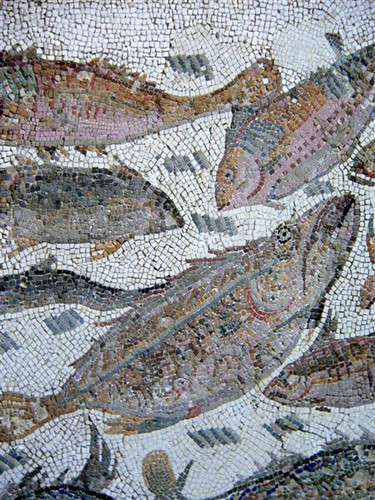
[Top Left: Roman mosaic floor, Palazzo Massimo Alle Terme, Museo Nazionale Romano, Rome, Italy. Photo courtesy of Mary Harrsch]

“The eating habits of Rome’s early Christians are more complex than has traditionally been assumed,” say Leonard Rutgers and his colleagues in The Journal of Archaeological Science. Their work was based on analysis of 22 skeletons found in the Catacombs of St Callixtus on the Appian Way, an area utilised in the 3rd to 5th centuries AD (although some of the skeletons were radiocarbon-dated to the 2nd century)..."

"...Half of the sample were taken from loculi, half from cubicula burials. Bone preservation was poor, making sexing and ageing difficult, although one person was definitely very old, between 82 and 85 at death, while another was a breast-fed baby of around 2.
Collagen, the organic portion of bone, was taken mostly from toe bones, in a few cases from fingers or limb bones.It was analysed for its carbon and nitrogen stable-isotope content: these elements are good indicators of diet. Most samples had more or less the same isotopic levels, “confirming that the people buried in the Liberian region of the catacomb formed a single population and suggesting that, by and large, these people had access to the same kind of food resources,” the team reports. Comparing the catacomb results with those from other sites in Italy and in the western Mediterranean, the higher nitrogen and lower carbon figures indicate the consumption of freshwater fish. The contribution of such fish to the diet of the early Christians in Rome ranges from 18 to 43 per cent, averaging at around 30 per cent.
Although this is surprisingly high, fish were still a supplement to an otherwise terrestrial diet, likely to have included sheep, goat and cow meat as well as cereals, fruit and vegetables..."
"...“While distancing themselves from Jewish food taboos and generally avoiding meat derived from pagan sacrifices, the early Christians are normally hypothesised to have eaten the same food as their non-Christian Roman contemporaries,” the team says. “Within the larger context of what is currently known about Roman dietary habits, the inclusion of freshwater fish therefore comes as unexpected and raises questions about the social origins of Christianity as well.”
“When Romans ate fish at all, they are normally believed to have consumed sea fish. Freshwater fish has not been considered as an essential ingredient in the classical Roman diet.” In AD301, the Emperor Diocletian’s Edict on Prices tried to fix the cost of freshwater fish at around a half to a third of its marine equivalent, so that even the poor could eat it. Roman fish probably came from the Tiber, and would have been a free or cheap source of protein." - More: TimesOnline
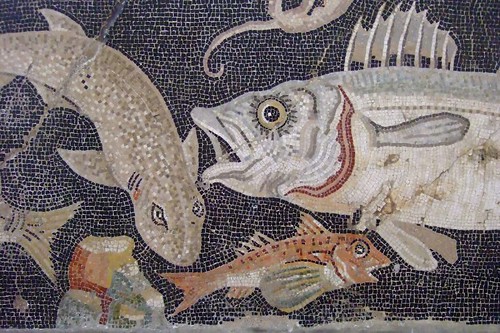
The importance of fish to the Romans is easily seen in their beautiful mosaics. Although mythical sea creatures are usually portrayed in mosicas found in bath complexes, very realistic food fish are depicted in floors of Roman tricliniums (dining rooms).
[Image: Marine Life Mosaic from House VIII Pompeii demonstrating the vermiculatum technique Roman 2nd century BCE, Museo Archaeologico di Napoli, Naples, Italy. Photo by Mary Harrsch]
If you are planning a trip to Rome and want to visit the catacombs, I see that Frommers recommends the catacombs of St. Domitilla. They expressed their opinion that the catacombs of St. Sebastian were the least satisfying. From their description, though, it sounds like the catacombs of St. Callixtus contain the most examples of funerary art since it is the site of nine pope burials and the tomb of Saint Cecilia. Frommers seemed to think their tours were cheesy, though. I remember reading their review before going to Rome but when the Archaeobus stopped at the first site of catacombs, the area looked rather unkempt. I decided to keep going and the stop at the Church of Saint Sebastian looked more inviting so I disembarked there. Our tour guide had been giving tours there for 26 years and she was quite knowledgable and didn't appear to dispense any particularly biased information. She pointed out Christian epigraphy including the fabled sign of the fish and the Greek Chiro (supposedly painted on the shields of Constantine's soldiers). Towards the end of the tour you enter a large subterranean dining room where families would come and feast to commemorate their departed loved ones. I knew feasting was part of the Roman funeral experience but I always thought it was held outside the actual burial site. Family diners carved their prayers on the walls. Although photography is not allowed inside the catacombs, visitors are welcome to photograph the interior of the church that is decorated with several beautiful paintings and sculptures.

Thursday, April 09, 2009

Art Repatriation Brings Painting Fragments Back Together

When I first read that the Getty was returning yet another piece of art to Italy I couldn't help but groan, thinking of the huge bare space I saw on my last visit where the beautiful table support of griffins attacking a doe (that was returned to Greece) once stood. But in this case, the repatriation was voluntary and for a very good cause. Apparently, scholars saw the painting in a 2008 exhibition catalogue and recognized it as part of another painting fragment that had been returned to Italy voluntarily by a private collector in New York.

The J. Paul Getty Museum said Tuesday it will send a piece of an ancient Roman wall painting back to Italy.

A 35-by-31-inch piece of a 1st century landscape fresco is being returned because it appears to belong with another fragment returned earlier by another collector, according to a museum statement.

The fragment shows two painted panels bordered in red and gold. Inside the panels are several Roman buildings in a cityscape.

The museum noticed about a year ago that the piece, which was donated by a couple in 1996, appeared to belong to the same painting as another fragment that a private collector was returning to Italy. - Mercury News.com

Monday, January 26, 2009

Celtic coins remnants of Eburones settlment in the Netherlands


I must have missed this discovery in November of a hoard of Celtic coins in the Netherlands. Fortunately, Numismaster just picked up the story, too, so it cropped up in my news alerts.

"On Nov. 13 [2008] an important find of 109 Celtic coins of the Eburones tribe found in the Netherlands was announced through the Associated Press. This is one of three important hoard finds of coins issued by this tribe. The other two finds were discovered in Belgium and Germany in areas not too distant geographically from the Netherlands...
..."Nico Roymans, the archaeologist who led the academic investigation of the find, believes the gold coins in the cache were minted by a tribe called the Eburones that [Julius] Caesar claimed to have wiped out in 53 B.C. after they conspired with other groups in an attack that killed 6,000 Roman soldiers."
The Euburones were a Germanic tribe living primarily in what in now Belgium. In 54 BC the Eburones revolted against local Roman occupation through Euburones tribal chieftains Ambiorix and Catuvoleus. Ambiorix initially offered safe passage to the Romans while other tribes elsewhere in Gaul were in revolt against the Romans. The Romans, commanded by Quintus Titurius Sabinus and Lucius Aurunculeius Cotta, agreed. The Eburones treacherously ambushed the Romans, most of whom were killed or committed suicide rather than allow themselves to be captured by the Euburones.
"This war was begun by the Eburones, under Ambiorix as chief. They claimed they had been roused to action because they were annoyed at the presence of the Romans, who were commanded by Sabinus and Lucius Cotta, lieutenants. The truth was, however, that they scorned those officers, thinking that they would not prove competent to defend their men and not expecting that Caesar would quickly make an expedition against their tribe. They accordingly came upon the soldiers unawares, expecting to take the camp without striking a blow, and, when they failed of this, had recourse to deceit.

For Ambiorix, after planting ambuscades in the most suitable spots, came to the Romans after sending a herald to arrange for a parley, and represented that he had taken part in the war against his will and was himself sorry; but against the others he advised them to be on their guard, for his countrymen would not obey him and were intending to attack the garrison at night. Consequently he made the suggestion to them that they should abandon Eburonia, since they would be in danger if they remained, and should move on as quickly as possible to some of their comrades who were wintering near by.

Upon hearing this the Romans believed him, especially as Ambiorix had received many favors from Caesar and seemed to be repaying his kindness in this way. They hastily packed up their belongings, and setting out just after nightfall, fell into the ambush, where they suffered a terrible reverse. Cotta with many others perished immediately. Sabinus was sent for by Ambiorix under the pretext of saving him, for the Gallic leader was not present at the ambush and at that time was still thought to be trustworthy. On his arrival, however, Ambiorix seized him, stripped him of his arms and clothing, and then struck him down with his javelin, uttering boastful words over him, such as these: 'How can such creatures as you wish to rule us who are so great?' This was the fate that these men suffered. The rest managed to break through to the camp from which they had set out, but when the barbarians assailed that, too, and they could neither repel them nor escape, they killed one another.

After this event some others of the neighboring tribes revolted, among them the Nervians, though Quintus [Tullius] Cicero, a brother of [the orator] Marcus [Tullius] Cicero and lieutenant of Caesar, was wintering in their territory. Ambiorix added them to his force and engaged in battle with Cicero. The contest was close, and after capturing some prisoners alive the chieftain tried to deceive him also in some manner, but being unable to do so, besieged him. Thanks to his large force and the experience which he had gained from his service with the Romans, together with information that he obtained from the individual captives, he quickly managed to enclose him with a palisade and ditch.

There were numerous battles, as was natural in such a situation, and far larger numbers of the barbarians perished, because there were more of them. They, however, by reason of the multitude of their army did not feel their loss at all, whereas the Romans, who were not numerous in the first place, kept continually growing fewer and were hemmed in without difficulty. They were unable to care for their wounds through lack of the necessary appliances, and did not have a large supply of food, because they had been besieged unexpectedly. No one came to their aid, though many were wintering at no great distance; for the barbarians guarded the roads with care and caught all who were sent out and slaughtered them before the eyes of their friends. Now when they were in danger of being captured, a Nervian who was friendly to them as the result of kindness shown him and was at this time besieged with Cicero, furnished a slave of his to send as a messenger through the lines. Because of his dress and his speech, which was that of the natives, he was able to mingle with the enemy as one of their number without attracting notice, and afterwards went his way.

In this way Caesar, who had not yet returned to Italy but was still on the way, learned of what was taking place, and turning back, he took with him the soldiers in the winter establishments through which he passed, and pressed rapidly on. Meanwhile, being afraid that Cicero, in despair of assistance, might suffer disaster or even capitulate, he sent a horseman on ahead. For he did not trust the servant of the Nervian, in spite of having received an actual proof of his actual good will, fearing that he might pity his countrymen and work the Romans some great evil; so he sent a horseman of the allies who knew the dialect of Eburones and was dressed in their garb. And in order that even he might not reveal anything, voluntarily or involuntarily, he gave him no verbal message and wrote to Cicero in Greek all that he wished to say, in order that even if the letter were captured, it should even so be meaningless to the barbarians and afford them no information. [...] Now the horseman reached the camp of the Romans, but not being able to come close up to it, he fastened the letter to a javelin, and acting as if he were hurling it against the enemy, fixed it purposely in a tower. Thus Cicero learned of the approach of Caesar, and so took courage and held out more zealously.

But the barbarians for a long time knew nothing of the assistance Caesar was bringing; for he journeyed by night, bivouacking by day in very obscure places, in order that he might fall upon them as unexpectedly as possible. But they finally grew suspicious because of the excessive cheerfulness of the besieged and sent out scouts; and learning from them that Caesar was already drawing near, they set out against him, thinking to attack him while off his guard. He learned of it in time and remained where he was that night, for the purpose of appearing to have only a few followers, to have suffered from the journey, and to fear an attack from them, and so in this manner to draw them to the higher ground. And thus it turned out; for in their contempt of him because of this move they charged up the hill, and met with so severe a defeat that they carried on the war against him no longer. -

[Cassius Dio, Roman history, 40.5-10;
tr. E. Cary]

Roymans believes the gold and silver coin hoard recently found in the Netherlands were produced by Celtic tribes further north, suggesting in his opinion the coins may represent cooperation among the various Celtic tribes in the war against Caesar's Roman legions. Roymans disclosed that both the gold and silver coins depict triple spirals on the obverse, a common Celtic symbol."
I wonder if any of these coins contained any copper? Analysis of Eburones coins found in the famous "Treasure of Ambiorix" discovered in 2000 near Heers were found to contain some copper, suggesting they were emergency coinage.

Thursday, January 15, 2009

Villa delle Vignacce excavation yields another bath complex and religious sculpture


Excavations at an ancient Roman villa and bath complex in the outskirts of Rome have unearthed a wealth of surprisingly well-preserved artifacts, including the marble head of a Greek god, archaeologists said. The site of the Villa delle Vignacce, toward Ciampino airport south of Rome, was first explored by archaeologists in 1780 who found statues that are now in the Vatican museum. But excavations began in earnest only about two years ago, revealing a residence attached to an elaborate thermal bath complex dating to the 1st century A.D. complete with hot baths, large tubs and a communal latrine.

Although dating stratigraphy at the villa has been challenging because the site was mined for building materials and decorative elements in the Middle Ages, initial studies indicate the bath complex on the north side of the villa was not originally used for that purpose but later converted to a bathing facility in the second century. Still later, in the third century, bathing was relocated once more to the recently discovered vaulted complex on the south side of the villa.

Since then, archaeologists said they had also uncovered prized artifacts including fragments of columns, floor slabs and the head of a marble statue believed to represent either the Greek divinity of Zeus Serapide or Asclepius, the god of medicine and healing.

Another discovery of note included a colored-glass mosaic of leaves and vegetation lining the inside of a vault.

The complex appeared to have been used and modified from the second
through the fifth centuries, and was just a short distance away from a
Barbaric camp in the sixth century, though its links to the camp are
unclear, said Darius Arya, an archaeologist with the American Institute of Roman Culture, which is handling the excavations.

The complex initially belonged to Quintus Servilius Pudens, a wealthy friend of Emperor Hadrian, who probably held private parties in the baths for his friends, archaeologists said.
[Image - Bust of the Emperor Hadrian found at Heraklion on Crete 127-128 CE, The Louvre, Paris, France]

At present, the Institute is examining the secondary subterranean spaces, including drainage systems and corridors for activities performed by slaves—an area of the grounds that covers at least five acres. Future explorations will reconcile the relationship between the newly discovered bath complex and the previously known bathing facilities of the sprawling villa complex, unearth the other sections of the villa (including a huge garden area), and relate the history of the villa to this area of Rome's suburbium, unknown before this project.
The institute is presently accepting applications for participants in the fourth excavation season to be conducted from June 14, 2009 through August 02, 2009.

"This season’s summer program aims to supply participants with both a chronological and diachronic approach to the study of Roman civilization. Through this dual approach those involved in the program will gain a more comprehensive historical and cultural overview of Roman civilization from its rise to power in this rich Mediterranean area, understanding how this civilization set a standard of cultural values that have had long lasting influence over the entire Western world to this day."

Thursday, December 18, 2008

Farmer uncovers pre-Roman sanctuary near Aprilia

I wonder how many artifacts the farmer managed to pass on to the black market before he was discovered!

"A farmer working his land south of Rome dug up hundreds of artifacts from a 2,600-year-old sanctuary, but ran afoul of police when he tried to sell the ancient hoard, officials said Wednesday.

After spotting fragments of pottery in soil dug up by the farmer, authorities searched his home last month and seized more than 500 artifacts, including perfume vials, cups and miniature vases used as votive objects.

The art squad of the Carabinieri paramilitary police said the farmer was placed under investigation for allegedly trafficking in antiquities. Ancient artifacts found in Italy are considered state property, and finds must be reported to authorities.

Archaeologists said they will continue to excavate the sanctuary, which dates back to the 7th-6th century B.C. and is located outside the town of Aprilia, near a small lake some 25 miles (40 kilometers) south of Rome.

The find could expand knowledge about the area's history in pre-Roman times, when it was inhabited by Latin-speaking people under the influence of the Etruscan civilization that dominated central Italy, experts said.

The pottery, some of which was imported from Greece, was offered to a deity probably connected to the lake, said Stefano De Caro, director of archaeology at the Italian Culture Ministry." - More, GMA News.TV

Gynecology exam depicted on Roman lamp

The Romans seemed to have absolutely no taboos when it came to depicting daily life on such common objects as oil lamps. I guess this is a prime example:

A group of archaeologists has found in the northern Spanish region of Leon a ceramic lamp dating from the beginning of the 1st century that shows a representation of the gynecological exam performed on a sick woman.

Archaeology professor at Madrid's Universidad Complutense Angel Morillo, told Efe that this is a "unique find without parallel in the Roman world."

Morillo on Tuesday night in Leon city will present the results of the investigation that has lasted six years during a conference entitled "From the Legions to the Barbarians: New perspectives on Roman Archaeology."

The find is of an oil lamp, "an exceptional piece that illustrates the presence of doctors in the city," and - specifically - a military hospital, the expert said.

On the lamp's surface "appears a very slender woman, possibly affected by a serious illness, like cancer, and a doctor who is performing a gynecological exam with a vaginal speculum," Morillo said.

Possibly the image is of a specific examination that one of the Roman doctors performed, he said - More: Latin American Herald Tribune
.

3rd century Roman Battlefield uncovered in northern Germany

Well, it seems that Arminius didn't have the last laugh in northern Germania after all!

[A knife case binder. Photo: C.S. Fuchs]

ARCHAEOLOGISTS say the history books about Roman legions in Europe will have to be revised following the "sensational" discovery of a battlefield in northern Germany this week.

Arrowheads, axes, catapults, spears, coins and lucky charms of the centurions of Rome

who clashed with the Hun tribesmen in the 3rd century AD have been found in a forest. The clash of arms, say experts, would have resembled those portrayed in the Russell Crowe epic Gladiator.

Six hundred artefacts have been dug up so far in what archaeologists are calling "the find of the century".

The detritus of war lies in a patch of land near Northeim, about 50 kilometres from Hanover. The spear tips and arrowheads have the DNA of their victims on them, centuries after they died in a ferocious battle.

What makes the find unique is that it shows Roman armies in action long after the last clash — the great battle of the Teutoburg Forest in AD9 when Arminius annihilated three of the seven legions of Rome — was thought to have occurred.

"Evidently the Romans and Germans fought a bloody battle in the third century AD," said archaeologist Petra Loenne. "Some 1000 Roman legionnaires may have been involved in the fight."

Intriguingly, the find includes more than 300 iron projectiles that were fired by powerful Roman torsion weapons known as scorpions, which could catapult heavy darts with a high velocity and deadly accuracy.

It had a range of 300 metres and was portrayed in the opening battle scene of Gladiator.

"The bolts were found densely clustered," said archaeologist Henning Hassmann.

Saturday, December 06, 2008

Source of ancient Fortis oil lamps and lead bullets found in Modena (Mutina)

The Big 'Brands' in Oil LampsItalian researchers have discovered the pottery center where the oil lamps that lighted the ancient Roman empire were made.

Evidence of the pottery workshops emerged in Modena, in central-northern Italy, during construction work to build a residential complex near the ancient walls of the city.

"We found a large ancient Roman dumping filled with pottery scraps. There were vases, bottles, bricks, but most of all, hundreds of oil lamps, each bearing their maker's name," Donato Labate, the archaeologist in charge of the dig, told Discovery News.

Firmalampen, or "factory lamps," were one of the first mass-produced goods in Roman times and they carried brand names clearly stamped on their clay bottoms.

The ancient dumping in Modena contained lamps by the most famous brands of the time: Strobili, Communis, Phoetaspi, Eucarpi and Fortis.

All these manufacturers had their products sold on the markets of three continents. Fortis was the trendiest of all pottery brands and its products were used up to the end of the second century A.D.

The ancient dumping contained other important objects, such as a fine terracotta statuette depicting Hercules as he captures the Erymanthian Boar, and 14 lead bullets which were probably used in the Battle of Mutina in 43 B.C. During that battle, Decimus Brutus, one of Julius Caesar's assassins, defeated the besieging Mark Antony with the help of Octavian, the future Roman Emperor Augustus.

Technorati Tags: , , , , , , , , , ,

Saturday, November 22, 2008

Roman style paintings found at suspected site of Herod's tomb

King Herod may have been buried in a crypt with lavish Roman-style wall paintings of a kind previously unseen in the Middle East, Israeli archaeologists said Wednesday. The scientists found such paintings and signs of a regal two-story mausoleum, bolstering their conviction that the ancient Jewish monarch was buried there.

Ehud Netzer, head of Jerusalem's Hebrew University excavation team, which uncovered the site of the king's winter palace in the Judean desert in 2007, said the latest finds show work and funding fit for a king.

"What we found here, spread all around, are architectural fragments that enable us to restore a monument of 25 meters high, 75 feet high, very elegant, which fits Herod's taste and status," he told The Associated Press in an interview at the hillside dig in an Israeli-controlled part of the West Bank, south of Jerusalem.

No human remains or inscriptions have been found to prove conclusively that the tomb was Herod's, but excavation continues.

Herod is known for extensive building throughout the Holy Land.

Netzer said that since finding fragments of one ornately carved sarcophagus in 2007, he and his team have found two more, suggesting the monumental tomb may have been a royal family vault.

Netzer described the winter palace, built on a largely man-made hill 2,230 feet high, as a kind of "country club," with a pool, baths, gardens fed by pools and aqueducts and a 650-seat theater.

In Herod's private box at the auditorium, diggers discovered delicate frescoes depicting windows opening on to painted landscapes, one of which shows what appears to be a southern Italian farm, said Roi Porat, one of Netzer's assistants on the digs. Just visible in the paintings, dating between 15 and 10 B.C., are a dog, bushes and what looks like a country villa.

Site surveyor Rachel Chachy-Laureys said the paintings were executed using techniques unknown in the Holy Land at the time and must have been done by artisans imported from Rome.

"There has been no other discovery of this type of painting in the Middle East, as far as we know, until now", she said.

After Herod's death in the 1st century B.C., Herodium became a stronghold for Jewish rebels fighting Roman occupation, and the palace site suffered significant battle damage before it was destroyed by Roman soldiers in A.D. 71, a year after they razed the Second Temple in Jerusalem.

The insurgents reviled the memory of Herod as a Roman puppet, and Netzer and his team believe that the violence inflicted on the first stone casket they found suggests the rebels knew it held the king's bones.

"That sarcophagus was found shattered all over the place. It seems it was taken from its place and was destroyed in a fit of rage," Porat said. "That, among other things, is what tells us it was the sarcophagus of Herod."

Technorati Tags: , , , , , , , ,

Friday, November 21, 2008

Roman gravestone found by treasure hunters in Scotland

The Roman Tombstone (Pic: National Museums of Scotland)

The first Roman tombstone found in Scotland for more than 170 years is among the rare artefacts unearthed by treasure hunters this year.

It forms part of Scotland's annual Treasure Trove, items found by archaeologists or enthusiasts which have been handed to the Crown Office.

Other pieces include a 5,000-year-old axe head, a Bronze Age sword and mysterious carved stone balls.

He said: "The most outstanding would have to be the Roman tombstone. The inscription suggests it was someone who had a military career, the equivalent of being in the elite guards."

Roman bodyguard

The red sandstone artefact was for a man called Crescens, a bodyguard for the governor who ran the province of Britain for the Roman Emperor.

It was found by amateur enthusiast Larney Cavanagh at the edge of a field near Inveresk.

The 5,000-year-old farmers axe head was unearthed at Dunragit, Stranraer, but made from stone found in the Lake District.

The Bronze Age sword was found in Lockerbie and the mysterious carved balls were discovered at Pitmilly and Newburgh in Fife.

Technorati Tags: , , , , , , , ,

Monday, November 10, 2008

Roman-era earring unearthed in Jersusalem

JERUSALEM: Archaeologists digging in East Jerusalem unearthed a perfectly-conserved 2,000-year-old gold earring inlaid with pearls and precious stones, the Israel Antiquities Authority said yesterday.
The earring is made of a coiled gold hoop and dates from the Roman period between the first century BC and the fourth century AD. It has a large inlaid pearl in its centre and two identical gold pendants, each of which is adorned with an emerald and pearl.
The rare jewel was uncovered during excavations in the ruins of a building which dates to the Byzantine period that is today located in a Palestinian neighbourhood several hundred metres from Jerusalem’s Old City.

Technorati Tags: , , , , , ,

Saturday, November 08, 2008

Ancient Apulian treasures to be returned to Italy

Ritual Water Jar (loutrophoros) with Perseus Battling the Sea Monster Greek made in Apulia South Italy 340-330 BCE TerracottaSwitzerland is returning 4,400 ancient artifacts stolen from
archaeological sites in Italy, including ceramics, figurines and bronze
daggers dating as far back as 2,000 B.C., prosecutors said Thursday.

[Left - Apulian ceramics, similar to this one depicting Perseus battling a sea monster, are among the grave goods seized in a 2001 raid on a Basel art dealer. Photo by Mary Harrsch]


The transfer will require three tractor-trailers and all but end a seven-year legal battle over the antiquities.

They
were seized in 2001 in storage rooms belonging to two Basel-based art
dealers after a tip-off from Italy, said Markus Melzl, a spokesman for
city prosecutors. The couple have since lost several court battles to
prevent the antiquities from being returned to Italy, Melzl said.

More
than half the objects were from the eastern Italian region of Apulia,
an area that was heavily influenced by ancient Greek culture, said
Guido Lassau, a Swiss archaeologist who worked on the case.

They
include richly decorated vases and so-called kraters, large vessels
that were used for mixing wine with water. The objects were stolen from
upper-class tombs dating from the fifth to third centuries B.C.,
according to Lassau.

One item that looks like a ceramic mask
modeled on a woman's face retains the original water-soluble painting
from about 300 B.C.

"They're very well preserved because they
spent the last 2,000 years in a virtual time capsule until they were
plundered by grave robbers," Lassau told The Associated Press. "But the
tragic thing is that a lot of the archaeological information was lost
when they were removed."

Other items belong to the pre-Etruscan
Villanova culture of northern Italy, and some of the bronze figures
appear to have originated on the island of Sardinia.

The oldest are bronze daggers thought to be about 4,000 years old, said Lassau.


Technorati Tags: , , , , , , , ,

Friday, November 07, 2008

Excavation of ancient Constantinople yields Neolithic finds

(Left) The Turkish minister of culture and tourism, Ertugrul Gunay, examines the excavation work and archaeological finds at the site of the Marmaray project in Yenikapi, Istanbul. Sinan Gul / Anadolu Ajansi

32 wooden ships, Stone Age skeletons, coins, amphorae and even a basket full of ancient cherries have been uncovered in an area that is thought to have been the first Byzantine port of the ancient city of Constantinople.Dating from the time of the Roman emperor Theodosius I, in the fourth century AD, the finds are an unprecedented glimpse into the ancient trade and maritime life of one of the world’s longest-inhabited cities.

Nautical gear, such as stone anchors with wooden poles and ropes, have been perfectly preserved in the depths of the murky water, while entire merchant vessels from various centuries have been uncovered, some filled with ancient merchandise, such as oil and wine amphorae. Fifteen ships thought to have sunk in a strong storm in 1,000 AD were discovered at the eastern end of the harbour, revealing a high-traffic port that connected the ancient granaries of Alexandria to the vineyards of northern Greece...the geological make-up of the site has allowed objects that would normally disintegrate to be preserved. They include a woman’s shoe with an ancient Greek inscription: “Use it in health, lady, be in beauty and happiness and wear it.”The site also bears relics of continued Byzantine presence after the harbour had been filled in. A Byzantine tannery and charnel house were discovered at the western end of the excavation, as well as human skulls – perhaps those of executed criminals – thrown into a well.

In August, Dr Karamut and his team came across four ancient skeletons buried in graves six metres below sea level. The two adults, aged approximately 35, and two children under two, are thought to have lived during the Neolithic age, around 6,000-6,500 BC. The objects found with them, particularly ceramic pieces, have led Dr Karamut and his colleagues to conclude there was an ancient settlement in Yenikapi whose inhabitants lived on animal grazing and farming. Researchers have also linked the findings to the remains of an ancient settlement in Çatalhöyük, a Neolithic site in southern Anatolia which was excavated in the 1960s. The similarity between the sites suggests that settlers in the Anatolian planes migrated to Istanbul’s shores some 8,000 years ago. - MoreTechnorati Tags: , , , , , , , ,

Sunday, November 02, 2008

6,000 gold Roman coins from age of Diocletian found in Wales

A deposit of almost 6,000 ancient Roman coins was unearthed in a farmer’s field by a metal detecting enthusiast.

A present-day value is yet to be put on the coins, found buried in two pots and compared by one expert to an early single European currency.

The pots’ combined contents of 5,913 copper-alloy coins from the early fourth century were uncovered over two days in April near Sully, in the Vale of Glamorgan.

Most of the coins were minted in London, Trier and Lyon, but some came from more distant imperial outposts in what is now Croatia and Syria.

National Museum Wales numismatist Edward Besly said the Emperor Diocletian reformed the Roman currency around 295AD, although some of the coins belonged to an earlier denomination.

He said: “They are the same standard, same design.

Technorati Tags: , , , , , , , , , , ,

Saturday, October 18, 2008

Buried Roman neighborhood of the dead uncovered

A dig has turned up the tomb of a nobleman who led Rome's legions in the second century A.D.Workers renovating a rugby stadium have uncovered a vast complex of tombs beneath Rome that mimic the houses, blocks and streets of a real city, according to officials, who have unveiled a series of new finds.

A dig has turned up the tomb of a nobleman who led Rome's legions in the second century A.D.

Culture Ministry officials said Thursday that medieval pottery shards in the city of the dead, or necropolis, show the area may have been inhabited by the living during the Dark Ages after being used for centuries for burials during the Roman period.

It is not yet clear who was buried in the ancient cemetery, but archaeologists at the still partially excavated site believe at least some of the dead were freed slaves of Greek origin.

Caligula's Murder Scene Unearthed

http://internetservices.readingeagle.com/blog/moviehouse/caligula.jpgArchaeologists restoring the imperial residences on the Palatine Hill, in the heart of ancient Rome, believe they have discovered the underground passageway in which the despotic Emperor Caligula was murdered by his own guards.

[Left: Actor Malcolm McDowell as "Caligula"]

The hill, which his honeycombed with ruins of palaces and villas, has also yielded frescoes and black-and-white mosaics in the first century B.C. home of a patrician, the ministry said in a statement.

Technorati Tags: , , , , , ,

Fish Sauce Confirms Pliny's Date for Vesuvius Eruption


Remains of rotten fish entrails have helped establish the precise dating of Pompeii's destruction , according to Italian researchers who have analyzed the town's last batch of garum, a pungent, fish-based seasoning.

Frozen in time by the catastrophic eruption that covered Pompeii and nearby towns nearly 2,000 years ago with nine to 20 feet of hot ash and pumice, the desiccated remains were found at the bottom of seven jars.

The find revealed that the last Pompeian garum was made entirely with bogues (known as boops boops), a

Mediterranean fish species that abounded in the area in the summer months of July and early August.

"Analysis of their contents basically confirmed that Mount Vesuvius most likely erupted on 24 August 79 A.D., as reported by the Roman historian Pliny the Younger in his account on the eruption," Annamaria Ciarallo, director of Pompeii's Applied Research Laboratory told Discovery News.

The vessels were unearthed several years ago in the house of Aulus Umbricius Scaurus, Pompeii's most famous garum producer.- More

Technorati Tags: , , , , , , , ,

Thursday, October 02, 2008

Sicilian tomb found inside sixth century Roman house

Archeologist Roger Wilson pulls out the day amphora from its 1,500 year hiding place - photo courtesy of Roger WilsonUBC archaeologists have dug up a mystery worthy of Indiana Jones, one that includes a tomb, skeletons and burial rites with both Christian and pagan elements.

This summer, Prof. Roger Wilson led excavations at Kaukana, an ancient Roman village located near Punta Secca, a small town in the south-eastern province of Ragusa in Sicily.

Combing through the sand-buried site, the 15-member team made a series of startling discoveries. Central to the mystery was finding a tomb inside a room in a house dating from the sixth century AD.

Wilson explains that tombs during this period are normally found only in cemeteries outside the built-up area of a town, or around the apse of a church. And since the building was substantial with mortared walls and internal plaster, this would have been likely a tomb for the wealthy.

“It’s extremely unusual to find an elite burial set inside a house in the middle of a settlement, even as late as the sixth century,” says Wilson, who heads UBC’s Department of Classical, Near Eastern and Religious Studies.

Once the cover was lifted off the tomb, one team member spent 10 days sieving the contents with great care. Two skeletons were found. One was of a woman between the ages of 25 and 30, with teeth in excellent condition and no signs of arthritis.

“She was in pretty good nick, so we know this wasn’t a peasant working in the field,” says Wilson.

The other skeleton was a child of indeterminate sex between the ages of five and seven. The position of their bones showed that the woman had been laid to rest first. The tomb was then re-opened to bury the child and the woman’s spinal column was pushed to one side. A hole in the stone slab covering the tomb allowed visitors to pour libations for the dead.

“This shows that the long-established, originally pagan, rite of offering libations to the dead clearly continued into early Byzantine times,” observes Wilson.

Yet, the presence of a Christian cross on a lamp found in the room and on the underside of a grave slab suggests that the deceased were Christian. As well, the skeletons were wrapped in plaster, a practice believed to be Christian for preserving the body for resurrection.

“It is the first plaster burial recorded in Sicily, although the practice is known from Christian communities in North Africa,” says Wilson.

What also intrigued the archaeologists was learning that the tomb was opened one further time, an intrusion that disturbed the bones of the child and caused its skull to be placed upside down. Wilson says he wondered whether it was grave robbers in search of expensive jewelry or other loot.
“But the tomb was tidied up again afterwards.”

Around the tomb was plentiful evidence of periodic feasting in honour of the dead. The archaeologists found cooking pots, glass and several large clay containers (amphorae), of which one is virtually intact. These would have been used to carry oil and wine to the site. The team also found the remains of two hearths where meals had been prepared.

As well, the room was designed with niches along one wall. Wilson says a knife, seafood, and fragments of stemmed goblets and other glass vessels were left on these shelves, “as though placed there after the last party.”


Technorati Tags: , , , , , , , , , ,