I found the following article very interesting especially since I explored the catacombs for the first time on my recent trip to Rome. My friend and I took the Archaeobus out to Appia Antica and disembarked at the Church of Saint Sebastian. While my friend waited I toured the catacombs there. Actually, the most interesting tombs were not the simple Christian niches but three pagan Roman tombs in the heart of the complex that predated most of the Christian burials. The three tombs standing side by side carved with architectural elements into the rock reminded me of a miniature Petra. The interior of two of tombs were embellished with terracotta flowers. The third tomb was decorated with delicate frescoes.
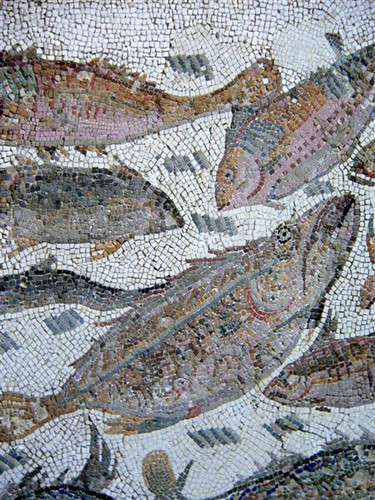
[Top Left: Roman mosaic floor, Palazzo Massimo Alle Terme, Museo Nazionale Romano, Rome, Italy. Photo courtesy of Mary Harrsch]
“The eating habits of Rome’s early Christians are more complex than has traditionally been assumed,” say Leonard Rutgers and his colleagues in The Journal of Archaeological Science. Their work was based on analysis of 22 skeletons found in the Catacombs of St Callixtus on the Appian Way, an area utilised in the 3rd to 5th centuries AD (although some of the skeletons were radiocarbon-dated to the 2nd century)..."
"...Half of the sample were taken from loculi, half from cubicula burials. Bone preservation was poor, making sexing and ageing difficult, although one person was definitely very old, between 82 and 85 at death, while another was a breast-fed baby of around 2.
Collagen, the organic portion of bone, was taken mostly from toe bones, in a few cases from fingers or limb bones.It was analysed for its carbon and nitrogen stable-isotope content: these elements are good indicators of diet. Most samples had more or less the same isotopic levels, “confirming that the people buried in the Liberian region of the catacomb formed a single population and suggesting that, by and large, these people had access to the same kind of food resources,” the team reports. Comparing the catacomb results with those from other sites in Italy and in the western Mediterranean, the higher nitrogen and lower carbon figures indicate the consumption of freshwater fish. The contribution of such fish to the diet of the early Christians in Rome ranges from 18 to 43 per cent, averaging at around 30 per cent.
Although this is surprisingly high, fish were still a supplement to an otherwise terrestrial diet, likely to have included sheep, goat and cow meat as well as cereals, fruit and vegetables..."
"...“While distancing themselves from Jewish food taboos and generally avoiding meat derived from pagan sacrifices, the early Christians are normally hypothesised to have eaten the same food as their non-Christian Roman contemporaries,” the team says. “Within the larger context of what is currently known about Roman dietary habits, the inclusion of freshwater fish therefore comes as unexpected and raises questions about the social origins of Christianity as well.”
“When Romans ate fish at all, they are normally believed to have consumed sea fish. Freshwater fish has not been considered as an essential ingredient in the classical Roman diet.” In AD301, the Emperor Diocletian’s Edict on Prices tried to fix the cost of freshwater fish at around a half to a third of its marine equivalent, so that even the poor could eat it. Roman fish probably came from the Tiber, and would have been a free or cheap source of protein." - More: TimesOnline
The importance of fish to the Romans is easily seen in their beautiful mosaics. Although mythical sea creatures are usually portrayed in mosicas found in bath complexes, very realistic food fish
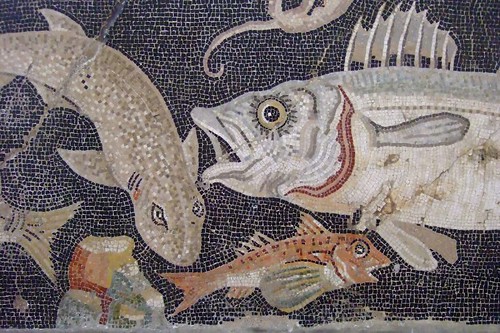 are depicted in floors of Roman tricliniums (dining rooms).
[Image: Marine Life Mosaic from House VIII Pompeii demonstrating the vermiculatum technique Roman 2nd century BCE, Museo Archaeologico di Napoli, Naples, Italy. Photo by Mary Harrsch]
If you are planning a trip to Rome and want to visit the catacombs, I see that Frommers recommends the catacombs of St. Domitilla. They expressed their opinion that the catacombs of St. Sebastian were the least satisfying. From their description, though, it sounds like the catacombs of St. Callixtus contain the most examples of funerary art since it is the site of nine pope burials and the tomb of Saint Cecilia. Frommers seemed to think their tours were cheesy, though. I remember reading their review before going to Rome but when the Archaeobus stopped at the first site of catacombs, the area looked rather unkempt. I decided to keep going and the stop at the Church of Saint Sebastian looked more inviting so I disembarked there. Our tour guide had been giving tours there for 26 years and she was quite knowledgable and didn't appear to dispense any particularly biased information. She pointed out Christian epigraphy including the fabled sign of the fish and the Greek Chiro (supposedly painted on the shields of Constantine's soldiers). Towards the end of the tour you enter a large subterranean dining room where families would come and feast to commemorate their departed loved ones. I knew feasting was part of the Roman funeral experience but I always thought it was held outside the actual burial site. Family diners carved their prayers on the walls. Although photography is not allowed inside the catacombs, visitors are welcome to photograph the interior of the church that is decorated with several beautiful paintings and sculptures.


 Peel and chop up some firm peaches