Friday, February 26, 2010

Ulysses-adorned amphitheater found near Fiumicino airport

Somehow with all the bustle that always accompanies the approaching holidays I somehow missed seeing this notice of a marvelous find of a "mini-Colosseum" near Rome's Fiumicino airport reported a few months ago.  When I visited Ostia in March 2009, I remember reading that much more of the ancient port remained unexcavated because it lay under the Fiumicino airport. 

[Image of Ulysses sculpture courtesy of the University of Southhampton]

This small amphitheater, however, is considered part of the ancient Roman port of Portus that actually succeeded Ostia as the Roman Empire's primary port at the mouth of the Tiber River in the second century CE. 

Apparently, the site was originally discovered in the 1860s but has remained largely undisturbed since then.  Now, researchers have been able to employ 3-D geophysics, computer visualization, environmental analysis and digital recording as well as excavation to reveal the details of what became one of  the largest maritime infrastructures of the ancient world.

"With the help of ground penetrating radar, the archaeologists have uncovered luxuriously decorated rooms, a colonnaded garden, a finely carved marble head, possibly depicting the Greek hero Ulysses, and a well-preserved toilet, designed to be used by three people at a time.

"The toilet belonged to the palace. It is located between the amphitheater and a porticoed garden. It is really an impressive building, with marbled floor and walls," said Simon Keay, project director and leading expert in Roman archaeology at the University of Southampton.

The researchers are now analyzing the dirt from the toilet -- basically ancient human waste -- to build a picture of the diet of the people who frequented the site." - More: Discovery News 

Daily Life in the Roman City: Rome, Pompeii, and Ostia   Mayfair Games Ostia The Harbor of Rome   Roman Amphitheaters (Watts Library)   Look Around a Roman Amphitheater (Virtual History Tours)   The Roman Games: Historical Sources in Translation (Blackwell Sourcebooks in Ancient History)   The Story of the Roman Amphitheatre

Palace of Tarquinius Superbus unearthed in Gabii

When I heard that Italian archaeologists think they have unearthed the palace of the notorious son of the last king of Rome, I felt a rush of excitement.  The Tarquin dynasty holds such a colorful place in early Roman history, especially considering all the lore surrounding the fateful rape of Lucretia, that the discovery of the actual palace that may have been near the site of the notorious desecration  is like the Roman equivalent of Schliemann's discovery of Troy.

[Image - Tarquinius and Lucretia by Titian, 1571.  Courtesy of Wikimedia Commons]

Archaeologists say the richly decorated monumental roof was dismantled and they hope to reconstruct it later this spring. Archaeologist Marco Fabbri of Rome's Tor Vergata University, directed the excavation.

"Fabbri and colleagues from Rome's Archaeological Superintendency believe that the residence was furiously demolished, probably during the Roman revolt in 510 B.C. that ultimately led to the foundation of the Roman Republic.  The ongoing excavation has so far unearthed three, disconnected rooms which most likely opened onto a porticoed area.  Under the building's exceptionally well-preserved floor slabs, eight round cells contained the remains of five stillborn babies.

'We hope to unearth the rest of the residence this spring. In particular, we are looking to piece together the richly decorated roof,' Fabbri said.

A terracotta fragment of the roof has already been found. It features the image of the Minotaur, an emblem of the Tarquins.

'It's a strong piece of evidence to support the hypothesis that the edifice was built for the Tarquin family,' Fabbri said." - Discovery News
 The Rapes of Lucretia: A Myth and Its Transformations   Etruscan Civilization: A Cultural History   Etruscan Life and Afterlife: A Handbook of Etruscan Studies   Etruscan Myths (The Legendary Past)   Etruscan Roman Remains by Leland, Charles (BETRROM)

Tuesday, February 02, 2010

East Asian Remains Found in 1st century CE Roman cemetery

A research team working in a 1st -2nd century CE Roman necropolis near the ancient town of Vagnari in southern Italy have unearthed a skeleton of a man with East Asian ancestry, according to DNA analysis.  When I was researching an article on the Han Dynasty for Heritage Key, I read that one of the important achievements of the period was the development of trade with the Roman Empire in the 2nd century CE. But the age of the remains and the possibility that there are more than one individual in the cemetery with East Asian descent makes it appear that there could have been a substantial group of East Asians in Vagnari before history tells us a formal delegation from the Han Dynasty had even made "First Contact". 

Vagnari was actually part of the emperor's estate during this time with its inhabitants engaged in tile production and iron working.

"So far the evidence suggests that Vagnari was a settlement of artisans and lower status individuals. The most likely location for the house of the imperial procurator who would have managed the estate is up the hill near the top of the plateau now called San Felice where a building provisionally interpreted as a villa is being excavated by a Canadian team directed by Hans vanderLeest (Mount Allison University) and Myles McCallum (St Mary’s University, Halifax)." - The Vagnari Project  

What seems puzzling is that if this man or even more than one of the 73 burials unearthed in Vagnari were slaves from China, how did the Roman emperor acquire them?  We don't know of any campaigns by the Romans that far east during that time.  Were they presented as a gift to him by a trade delegation? 


It will be interesting to see if any East Asian artifacts turn up as the excavation progresses.  Although the slaves could have been without significant possessions I can't imagine them living out their lives without fashioning some amulet or talisman to remind them of their former homeland, especially since the Romans did not discourage foreign religions.


The research team hope ongoing excavations will provide clues to globalization, human mobility, identity, and diversity in Roman Italy.

"This multi-faceted research demonstrates that human skeletal remains can provide another layer of evidence in conjunction with archaeological and historical information," says Tracey Prowse, Assistant Professor of Anthropology, initially of McMaster University (Hamilton, Ontario) and, since 2006, of Southern  Illinois University Carbondale, the lead author on the study. . - DNA testing on 2,000-year-old bones in Italy reveal East Asian ancestry

  Comparison between Roman and Han Empires: Military of ancient Rome, Culture of ancient Rome, Huo Qubing, Wei Qing, Emperor Wu of Han, Roman mythology, ... Roman law, Government of the Han Dynasty   The Establishment of the Han Empire and Imperial China (Greenwood Guides to Historic Events of the Ancient World)   The Early Chinese Empires: Qin and Han (History of Imperial China)

Friday, January 08, 2010

Roman era tombs unearthed in southern Syria


Archaeologists have been busy in southern Syria.  Wafa al-Audi, head of Bosra's Antiquities Department reports that five tombs dating back to the Byzantine era have been found in Daraa.  One yielded copper bracelets as well as one made of iron.

[Image: Roman ruins north of the citadel in present-day Basra.  Courtesy of Wikimedia Commons.]

Four more Byzantine-era tombs were found in Jedia.  They, too, contained bracelets, coins and bronze shards.  Skeletal remains of a 20-year-old man were found in yet another Roman tomb unearthed in Selmine.


In a continuing excavation of the Nabataean Cathedral in Bosra, a French team has unearthed remains of a private bath in Trajan's Palace.

I'm afraid the article in DNA did not include any images of the artifacts recovered.

Cosmos Global Documentaries IN THE LAND OF THE NABATEANS Arabia's Mystic Traders  Roman Syria and the Near East   Studies In The History Of The Roman Province Of Syria (1915)   Soldiers, Cities, and Civilians in Roman Syria  Archaeology of the Bronze Age, Hellenistic, and Roman Remains at an Ancient Town on the Euphrates River: Excavations at Tell Es-Sweyhat, Syria Volume 2 (Oriental Institute Publications)

Thursday, October 22, 2009

Hadrian's Athenaeum latest "Metro" discovery in Rome

Following a grand stairway made with sheets of granite andantique yellow marble, Archaeologists trying to locate a relatively "sterile" area of the Piazza Venezia to construct a subway station for the new Metro C line in Rome have uncovered what they think is Emperor Hadrian's "Athenaeum" -- an auditorium ancient writers say he built at his own expense on his return from Palestine around A.D. 135. Hadrian, an avid fan of Greek theater and literature sponsored plays, speeches and political debates in the covered rectangular structure.

The amphitheater is just one of a number of significant archaeological finds that have been discovered during excavation for the new Metro line. Other discoveries include the Greek gymnasium that the Emperor Nero had built near his baths, and a section of a Roman canal built to drain the marshy land Rome was built upon.

Monday, September 28, 2009

2nd century civilian Roman settlement unearthed near Mainz

It looks like more evidence of civilian Roman settlements in ancient Germania have been discovered near Mainz by U.S. Army Corps of Engineers working on an expansion to the Weisbaden Army Air Field.A team of archaeology students and experts believe they have unearthed remnants of a Roman settlement from the second or third century near the construction site of an Army housing project.

The team, from nearby Mainz University, discovered a Roman coin, pieces of pottery, roof tiles, decorated bricks and 23 pieces of raw lead. The students also believe they have found the wall outlines of a building.

"If it’s from the second century A.D., it would be a civilian building and we didn’t expect this. We expected only military buildings," said Dr. Guntram Schwitalla, a district archaeologist in Hessen.

- More: Stars and Stripes

Ancient Port of Theodosius and 34 Byzantine Ships unearthed in Bosporous Tunnel Project


It looks like we'll have an opportunity to study examples of some of the first ancient ships built using the "skeleton approach" method of construction. Thirty-four intact vessels have been recovered from the ancient port of Theodosius during the construction of the Bosporous Tunnel project began five years ago to connect European and Asian sections of Istanbul.

[Image - reconstruction of a Byzantine ship courtesy of Agiasofia.com]


It [the port of Theodosius] was originally built at the end of the 4th century AD by Emperor Theodosius I when Istanbul -- then known as Constantinople -- was the capital of the eastern Roman Empire. The port's harbor silted over centuries ago, and eventually disappeared beneath subsequent layers of civilization.

The Yenikapi dig has uncovered an ancient armada: 34 Byzantine ships ranging from dating between the 7th and 11th centuries AD.

The largest of the ships is believed to have once carried wheat from Egypt to Constantinople.

Scattered around the ship are shards of pottery, animal bones, and thousand-year-old clamshells.

Historians say the new discoveries include the first examples of ships being built using the beginnings of the "skeleton approach" to constructing the vessel's hull. Pulak says that marked a revolutionary change which transformed shipbuilding from "mostly an art form to a science."

"The earlier methods of building depended on verbal transference of the method from master shipbuilders to apprentices," he explained. "The development of the latter method ... allowed for the speedy communication of new shipbuilding ideas that could be transmitted on paper. It is the beginning of engineering. Ships could be preconceived and pre-designed."

In addition to finding the timbers of thousand-year-old jetties and docks, which still jut up in straight rows at the bottom of the mammoth pit, archaeologists have uncovered the remnants of a pre-historic human settlement.

"The first man, about 8,400 years ago, came and started to settle here," Yilmaz said. "There was no Bosphorus [then]. The Bosphorus was a river valley... the people who settled here walked across the Bosphorus." - CNN.com

Monday, August 31, 2009

First Saudi in space opens up the Kingdom to western archaeologists


How exciting to read that Saudi Arabia, after decades of discouraging excavations of pre-Islamic civilizations, has begun to allow foreign archaeologists to explore largely untouched sites. I was also intrigued to learn that Madain Saleh, Saudi Arabia's first UNESCO World Heritage Site is now open to the public.

[Image - Nabatean tombs at Madain Saleh, Saudi Arabia's first UNESCO heritage site, resemble those of Petra in Jordan over 450 miles away. Image courtesy of Wikimedia Commons.]

The ancient city, once known as Hegra, was built by the Nabateans and its tombs resemble those found in Petra, 450 miles away. The UNESCO site encompasses 131 tombs over about 13 kilometers. Roman archaeologists were particularly excited when an inscription referring to the Roman emperor Marcus Aurelius was discovered there in 2000.

Prince Sultan bin Salman, the first Saudi to venture into space aboard the U.S. space shuttle Discovery in 1985 and now secretary general of the governmental Saudi Commission for Tourism and Antiquities, is leading the effort. Small bronze statues of Hercules and Apollo on display at the King Saud University in Riyadh hint at the remains awaiting researchers in the desert sands.

Will Fragments of Augustan Equestrian Statue Found in Germany Lead to Insight on Turmoil after Varus Disaster?


A beautiful horse head with traces of gilt has been retrieved from a well near Waldgrimes in central Germany. Archaeologists speculate that the horse was part of an equestrian statue bearing the emperor Augustus that was ritually destroyed by Germanic tribesmen after their victory over Roman legions at Teutoburg Vald in 9 C.E. The rider's foot was also recovered.

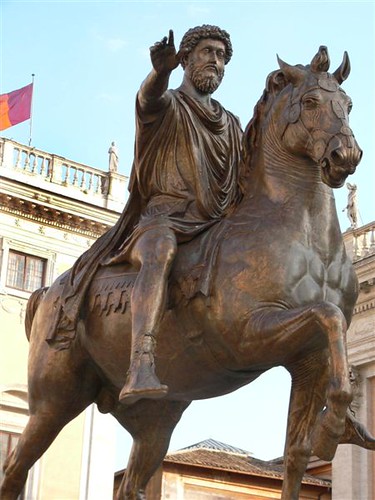
It would be wonderful if enough fragments could be found to reconstruct the work. There is only one other equestrian statue of Augustus known in the world at this time. Sadly, equestrian statues contained so much bronze that they were prized targets of medieval recyclers so few Roman period equestrian statues survive intact. It is said that the famous equestrian statue of Marcus Aurelius at the Capitoline Museum in Rome only survived because it was thought to be Constantine I, revered by early Christians for making Christianity the official religion of the empire. Judging from the picture provided by the Science Ministry of Hessen (above left), the Augustan statue must have been as breathtaking as the Aurelian statue in Rome (right). The horse's bridle depicts figures of Mars, the Roman god of war, and Nike, personification of victory.

Previous excavations at Waldgrimes have yielded a Roman forum, lead waterpipes and a retail center. The statue may have been the centerpiece of a cult temple of Augustus. Such a temple was erected in Lugdunum by Drusus as a transitory step to making Gaul a Roman province following suppression of a revolt over a Roman census there. As a symbol of Romanization, it would have naturally been a target following news of the successful ambush by Arminius.

Panic swept through Roman settlements in Germania and Gaul.

"After the defeat of Varus there was panic throughout the Roman population living in Gaul and Germany. Most of the forts established by Drusus and Tiberius in Germany were abandoned immediately after the disaster. All but one of the Roman garrisons stationed in Northern Germany was destroyed, with only the garrison at Aliso holding out. Dio describes the events which surrounded Aliso. Aliso has been tentatively identified as the base Haltern. Haltern, a Roman legionary base in Germany illustrates the panic that spread through the Romans in Germany. Haltern, founded in 5 BC, is situated about 54 km from Vetera on the north bank of the Lippe River, where the river has its confluence with the Stever River. Haltern may have served as the wintering quarters for Varus and his legions in the winter 9 AD. The fort supported a large number of troops and had all the logistical and administrative support that a large force of soldiers would require to function. The amount of housing for officers is unusually high at Haltern implying that the post served as an administrative hub for the Roman army deployed east of the Rhine River. Dio attributes the Romans success at Haltern to German ignorance of siege warfare and Roman employment of archers. The archers held the Germans off, inflicting heavy losses on the Germans.

Nevertheless the Romans soon ran out of supplies and had to make an escape attempt. Using a rainstorm and darkness as cover the Romans slipped out and met up with Roman forces to the west. Archeological evidence from Haltern shows that it was hastily abandoned around 9 AD as shown by the tremendous amount of buried hordes throughout the fort. Romans fleeing to the Rhine, not wanting to be slowed down with material goods, buried several hordes around the fort in anticipation of retrieving them again. These hordes consist primarily of weapons and coinage. Other Roman bases on the Lippe were similarly abandoned: Anreppen, Oberaden, and Holsterhausen. " - Rome’s Bloody Nose: The Pannonian Revolt, Teutoburg Forest and the Formation of Roman Frontiers by Nolan Doyle, Western Oregon University.

We've all heard of Augustus' response - rending his clothes and crying out "Varus, give me back my legions!" But Augustus was not just being melodramatic. Cassius Dio writes, "... there were no more men available in reserve. The Roman armies had reached the point of breaking, between the rebellions in Pannonia and Germany the losses could not be easily replaced anymore. Augustus had to resort to conscriptions of men and nobody wanted to be conscripted. Augustus made the men draw lots with twenty percent of those under the age of thirty-five and ten percent of those older conscripted into the army. When people still were not excited enough to be conscripted Augustus had several men executed. Augustus also called up veterans and conscripted freedmen and put them into service. " - Rome’s Bloody Nose: The Pannonian Revolt, Teutoburg Forest and the Formation of Roman Frontiers by Nolan Doyle, Western Oregon University.

For a graphic view of the battle of Teutoburg Forest, check out these videos on YouTube, excerpts from the History Channel series "Decisive Battles."

Hopefully, we'll learn even more about this tumultuous period with continued excavations.

Thursday, August 06, 2009

Vespasian's Villa Found?


It looks like there's a real possibility the villa of the Roman emperor Vespasian has been found! Vespasian is one of those "good" emperors that rose from the ranks to claim the purple. He even took a freedwoman for a mistress and, although unable to marry her because of his social status, maintained a relationship with her throughout his lifetime. Their relationship is the subject of one of my favorite books by English author, Lindsey Davis, entitled "Course of Honor".

[Image - Fragmentary Colossal Bust of the Roman Emperor Vespasian, Museo Archaeologico di Napoli, Naples, Italy. Photo by Mary Harrsch]

Suetonius tells us how Vespasian, far from wealthy as a young man, was viewed by the common people of Rome:

"...he got by lot the province of Africa, which he governed with great reputation, excepting that once, in an insurrection at Adrumetum, he was pelted with turnips. It is certain that he returned thence nothing richer; for his credit was so low, that he was obliged to mortgage his whole property to his brother, and was reduced to the necessity of dealing in mules, for the support of his rank; for which reason he was commonly called "the Muleteer."

He didn't make many points with the emperor Nero either since he fell asleep during the emperor's musical performances.

"Caius Caesar, being enraged at his not taking care to have the streets kept clean, ordered the soldiers to fill the bosom of his gown with dirt, some persons at that time construed it into a sign that the government, being trampled under foot and deserted in some civil commotion, would fall under his protection, and as it were into his lap. - - C. Suetonius Tranquillus, The Lives of the Twelve Caesars.

Of course the Romans were very sensitive to perceived omens and many more omens were related that pointed to Vespasian's eventual exalted position:

He dreamt in Achaia that the good fortune of himself and his family would begin when Nero had a tooth drawn; and it happened that the day after, a surgeon coming into the hall, showed him a tooth which he had just extracted from Nero. In Judaea, upon his consulting the oracle of the divinity at Carmel [740], the answer was so encouraging as to assure him of success in anything he projected, however great or important it might be. And when Josephus [741], one of the noble prisoners, was put in chains, he confidently affirmed that he should be released in a very short time by the same Vespasian, but he would be emperor first [742]. Some omens were likewise mentioned in the news from Rome, and among others, that Nero, towards the close of his days, was commanded in a dream to carry Jupiter's sacred chariot out of the sanctuary where it stood, to Vespasian's house, and conduct it thence into the circus. Also not long afterwards, as Galba was going to the election, in which he was created consul for the second time, a statue of the Divine Julius [743] turned towards the east. And in the field of Bedriacum [744], before the battle began, two eagles engaged in the sight of the army; and one of them being beaten, a third came from the east, and drove away the conqueror. - C. Suetonius Tranquillus, The Lives of the Twelve Caesars.

Italian archeologists may have uncovered the summer villa of the Roman Emperor Vespasian near his birthplace in the mountains northeast of Rome, La Stampa newspaper reported. Four years of digs led by archeologist Filippo Coarelli of the University of Perugia have uncovered an ornate villa with marble quarried in North Africa and ornate mosaic floors, Stampa said. While no inscription has been found that says the villa belonged to the emperor, the location, size and quality of the structure suggest it was, Coarelli said. - More: Bloomberg.com


Read more about him: