"Archaeologists at the University of Lecce have discovered that the modern town, with its 15th-century walls, sits on the ruins of the port that was the first landfall in Italy made by the semi-mythical wanderer of the ancient world, Aeneas. According to Virgil's epic, he fled Troy as the Greeks destroyed it and made his laborious way westwards finally to found a "new Troy", the imperial city of Rome.
In the third book of the Aeneid, according to John Dryden's 17th-century translation, the poet describes the hero's discovery of Italy thus:
"... And now the rising morn with rosy light
Adorns the skies, and puts the stars to flight;
When we from far, like bluish mists, descry
The hills, and then the plains, of Italy ...
The gentle gales their flagging force renew,
And now the happy harbour is in view.
Minerva's temple then salutes our sight,
Plac'd, as a landmark, on the mountain's height ..."
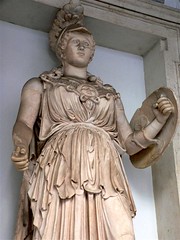
Minerva's temple is the key: the head of the Archaeology Department at Lecce University has found clinching evidence of the existence of a temple of Minerva, exactly where the poet describes it. "There is no doubt," Professor Francesco d'Andria said. "We have found fragments of a female divinity, and many iron weapons given to the goddess as offerings. In this temple a warrior goddess was worshipped. Minerva was worshipped."

