Showing posts with label Italy. Show all posts

Friday, February 26, 2010

Ulysses-adorned amphitheater found near Fiumicino airport

Somehow with all the bustle that always accompanies the approaching holidays I somehow missed seeing this notice of a marvelous find of a "mini-Colosseum" near Rome's Fiumicino airport reported a few months ago.  When I visited Ostia in March 2009, I remember reading that much more of the ancient port remained unexcavated because it lay under the Fiumicino airport. 

[Image of Ulysses sculpture courtesy of the University of Southhampton]

This small amphitheater, however, is considered part of the ancient Roman port of Portus that actually succeeded Ostia as the Roman Empire's primary port at the mouth of the Tiber River in the second century CE. 

Apparently, the site was originally discovered in the 1860s but has remained largely undisturbed since then.  Now, researchers have been able to employ 3-D geophysics, computer visualization, environmental analysis and digital recording as well as excavation to reveal the details of what became one of  the largest maritime infrastructures of the ancient world.

"With the help of ground penetrating radar, the archaeologists have uncovered luxuriously decorated rooms, a colonnaded garden, a finely carved marble head, possibly depicting the Greek hero Ulysses, and a well-preserved toilet, designed to be used by three people at a time.

"The toilet belonged to the palace. It is located between the amphitheater and a porticoed garden. It is really an impressive building, with marbled floor and walls," said Simon Keay, project director and leading expert in Roman archaeology at the University of Southampton.

The researchers are now analyzing the dirt from the toilet -- basically ancient human waste -- to build a picture of the diet of the people who frequented the site." - More: Discovery News 

Daily Life in the Roman City: Rome, Pompeii, and Ostia   Mayfair Games Ostia The Harbor of Rome   Roman Amphitheaters (Watts Library)   Look Around a Roman Amphitheater (Virtual History Tours)   The Roman Games: Historical Sources in Translation (Blackwell Sourcebooks in Ancient History)   The Story of the Roman Amphitheatre

Palace of Tarquinius Superbus unearthed in Gabii

When I heard that Italian archaeologists think they have unearthed the palace of the notorious son of the last king of Rome, I felt a rush of excitement.  The Tarquin dynasty holds such a colorful place in early Roman history, especially considering all the lore surrounding the fateful rape of Lucretia, that the discovery of the actual palace that may have been near the site of the notorious desecration  is like the Roman equivalent of Schliemann's discovery of Troy.

[Image - Tarquinius and Lucretia by Titian, 1571.  Courtesy of Wikimedia Commons]

Archaeologists say the richly decorated monumental roof was dismantled and they hope to reconstruct it later this spring. Archaeologist Marco Fabbri of Rome's Tor Vergata University, directed the excavation.

"Fabbri and colleagues from Rome's Archaeological Superintendency believe that the residence was furiously demolished, probably during the Roman revolt in 510 B.C. that ultimately led to the foundation of the Roman Republic.  The ongoing excavation has so far unearthed three, disconnected rooms which most likely opened onto a porticoed area.  Under the building's exceptionally well-preserved floor slabs, eight round cells contained the remains of five stillborn babies.

'We hope to unearth the rest of the residence this spring. In particular, we are looking to piece together the richly decorated roof,' Fabbri said.

A terracotta fragment of the roof has already been found. It features the image of the Minotaur, an emblem of the Tarquins.

'It's a strong piece of evidence to support the hypothesis that the edifice was built for the Tarquin family,' Fabbri said." - Discovery News
 The Rapes of Lucretia: A Myth and Its Transformations   Etruscan Civilization: A Cultural History   Etruscan Life and Afterlife: A Handbook of Etruscan Studies   Etruscan Myths (The Legendary Past)   Etruscan Roman Remains by Leland, Charles (BETRROM)

Tuesday, February 02, 2010

East Asian Remains Found in 1st century CE Roman cemetery

A research team working in a 1st -2nd century CE Roman necropolis near the ancient town of Vagnari in southern Italy have unearthed a skeleton of a man with East Asian ancestry, according to DNA analysis.  When I was researching an article on the Han Dynasty for Heritage Key, I read that one of the important achievements of the period was the development of trade with the Roman Empire in the 2nd century CE. But the age of the remains and the possibility that there are more than one individual in the cemetery with East Asian descent makes it appear that there could have been a substantial group of East Asians in Vagnari before history tells us a formal delegation from the Han Dynasty had even made "First Contact". 

Vagnari was actually part of the emperor's estate during this time with its inhabitants engaged in tile production and iron working.

"So far the evidence suggests that Vagnari was a settlement of artisans and lower status individuals. The most likely location for the house of the imperial procurator who would have managed the estate is up the hill near the top of the plateau now called San Felice where a building provisionally interpreted as a villa is being excavated by a Canadian team directed by Hans vanderLeest (Mount Allison University) and Myles McCallum (St Mary’s University, Halifax)." - The Vagnari Project  

What seems puzzling is that if this man or even more than one of the 73 burials unearthed in Vagnari were slaves from China, how did the Roman emperor acquire them?  We don't know of any campaigns by the Romans that far east during that time.  Were they presented as a gift to him by a trade delegation? 


It will be interesting to see if any East Asian artifacts turn up as the excavation progresses.  Although the slaves could have been without significant possessions I can't imagine them living out their lives without fashioning some amulet or talisman to remind them of their former homeland, especially since the Romans did not discourage foreign religions.


The research team hope ongoing excavations will provide clues to globalization, human mobility, identity, and diversity in Roman Italy.

"This multi-faceted research demonstrates that human skeletal remains can provide another layer of evidence in conjunction with archaeological and historical information," says Tracey Prowse, Assistant Professor of Anthropology, initially of McMaster University (Hamilton, Ontario) and, since 2006, of Southern  Illinois University Carbondale, the lead author on the study. . - DNA testing on 2,000-year-old bones in Italy reveal East Asian ancestry

  Comparison between Roman and Han Empires: Military of ancient Rome, Culture of ancient Rome, Huo Qubing, Wei Qing, Emperor Wu of Han, Roman mythology, ... Roman law, Government of the Han Dynasty   The Establishment of the Han Empire and Imperial China (Greenwood Guides to Historic Events of the Ancient World)   The Early Chinese Empires: Qin and Han (History of Imperial China)

Thursday, August 06, 2009

Vespasian's Villa Found?


It looks like there's a real possibility the villa of the Roman emperor Vespasian has been found! Vespasian is one of those "good" emperors that rose from the ranks to claim the purple. He even took a freedwoman for a mistress and, although unable to marry her because of his social status, maintained a relationship with her throughout his lifetime. Their relationship is the subject of one of my favorite books by English author, Lindsey Davis, entitled "Course of Honor".

[Image - Fragmentary Colossal Bust of the Roman Emperor Vespasian, Museo Archaeologico di Napoli, Naples, Italy. Photo by Mary Harrsch]

Suetonius tells us how Vespasian, far from wealthy as a young man, was viewed by the common people of Rome:

"...he got by lot the province of Africa, which he governed with great reputation, excepting that once, in an insurrection at Adrumetum, he was pelted with turnips. It is certain that he returned thence nothing richer; for his credit was so low, that he was obliged to mortgage his whole property to his brother, and was reduced to the necessity of dealing in mules, for the support of his rank; for which reason he was commonly called "the Muleteer."

He didn't make many points with the emperor Nero either since he fell asleep during the emperor's musical performances.

"Caius Caesar, being enraged at his not taking care to have the streets kept clean, ordered the soldiers to fill the bosom of his gown with dirt, some persons at that time construed it into a sign that the government, being trampled under foot and deserted in some civil commotion, would fall under his protection, and as it were into his lap. - - C. Suetonius Tranquillus, The Lives of the Twelve Caesars.

Of course the Romans were very sensitive to perceived omens and many more omens were related that pointed to Vespasian's eventual exalted position:

He dreamt in Achaia that the good fortune of himself and his family would begin when Nero had a tooth drawn; and it happened that the day after, a surgeon coming into the hall, showed him a tooth which he had just extracted from Nero. In Judaea, upon his consulting the oracle of the divinity at Carmel [740], the answer was so encouraging as to assure him of success in anything he projected, however great or important it might be. And when Josephus [741], one of the noble prisoners, was put in chains, he confidently affirmed that he should be released in a very short time by the same Vespasian, but he would be emperor first [742]. Some omens were likewise mentioned in the news from Rome, and among others, that Nero, towards the close of his days, was commanded in a dream to carry Jupiter's sacred chariot out of the sanctuary where it stood, to Vespasian's house, and conduct it thence into the circus. Also not long afterwards, as Galba was going to the election, in which he was created consul for the second time, a statue of the Divine Julius [743] turned towards the east. And in the field of Bedriacum [744], before the battle began, two eagles engaged in the sight of the army; and one of them being beaten, a third came from the east, and drove away the conqueror. - C. Suetonius Tranquillus, The Lives of the Twelve Caesars.

Italian archeologists may have uncovered the summer villa of the Roman Emperor Vespasian near his birthplace in the mountains northeast of Rome, La Stampa newspaper reported. Four years of digs led by archeologist Filippo Coarelli of the University of Perugia have uncovered an ornate villa with marble quarried in North Africa and ornate mosaic floors, Stampa said. While no inscription has been found that says the villa belonged to the emperor, the location, size and quality of the structure suggest it was, Coarelli said. - More: Bloomberg.com


Read more about him:


Saturday, August 01, 2009

Skeleton of Early Bronze Age Warrior Found in Beach Tomb near Rome


This find is especially interesting because it predates Roman, Etruscan and even proto-Villanovan cultures.

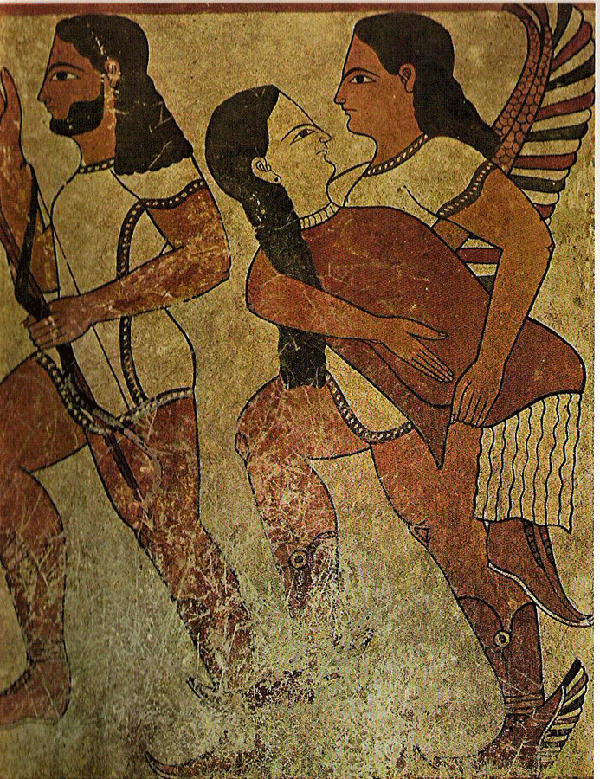
[Image - Villanovan ceramic head Italy 6th century BCE. Photographed at the Musee du Louvre, Paris France. Photo by Mary Harrsch.]

If we use the migration theories of Italian scholar, Massimo Pallottino, we can speculate that this warrior spoke one of three Indo-European languages inherited from Asiatic ancestors who migrated into the area during the early Bronze Age, bringing kiln-fired pottery and domestic horses to the Italian peninsula.

Three waves of Indo-European language speakers, speaking closely related languages, arrived in small groups over time across the Adriatic sea and moved inland.[6] The first occurred in the Middle Neolithic starting with the Square-necked Pottery Culture and prevailed for the remaining Neolithic and the Proto- and earlier Apennine. The Latin language evolved ultimately from their speech, in Italy. The second wave is associated with Mycenaean civilization of the Late Bronze Age and brought the ancestors of the Italic language speakers into central and south Italy. They prevailed during the remainder of the Apennine. The third wave came with the Proto-Villanovan Culture and is ultimately responsible for the Venetic language speakers. - More: Answers.com

From sites like Colle della Capriola excavated in 1958 just 5 km south of Bolsena in central Italy, researchers have discovered that people of this period lived in pole-supported wattle-and-daub huts with thatched roofs built upon rock-cut foundations and encircled with defensive stone walls. They ate wheat, barley, beans and peas and raised cattle, pigs, sheep and goats.

We could even go so far as to suggest he probably was a member of the J Haplogroup carrying the J2 (M172 subgroup) y-chromosome. According to the Genographic Project
, descendants of this group that originated in the Mesopotamian Fertile Crescent 15,000 - 10,000 years ago made their way into the Italian peninsula where they pioneered the Neolithic revolution, in which hunter-gatherer populations became settled agriculturists. Almost 20% of the men still living in Italy today carry this genetic marker.


ARCHAEOLOGISTS have found the skeleton of a warrior from up to 5,000 years ago floating in a tomb filled with sea water on a beach near Rome, Italy's art squad said Friday.

The bones - believed to date from the 3rd millennium BC - were discovered in May as art hunters were carrying out routine checks of the region's archaeological areas, Carabinieri art squad official Raffaele Mancino said.

Archaeologists believe the warrior was likely killed by an arrow, part of which was found among his ribs, Mancino said. There was also a hole in the back of the skull, and six vases and two daggers were found buried nearby.

The tomb of the warrior, nicknamed "Nello" after the archaeologist who found him, could be part of a wider necropolis lying just a few steps from the sea, Mancino told a news conference. - More: Fraser Coast Chronicle

Tuesday, June 30, 2009

Lasers reveal icon of St. Paul in Catacombs of Saint Thekla


The Vatican seems to be making a lot of coincidental discoveries surrounding Paul the Apostle in Rome right now. First, bones that DNA tests date to the 1st or 2nd century found in the reputed burial site of St. Paul and now a fresco in the Catacombs of St Thekla.


The fresco, which dates back to the 4th Century AD, was discovered during restoration work at the Catacomb of Saint Thekla but was kept secret for ten days.

During that time experts carefully removed centuries of grime from the fresco with a laser, before the news was officially announced through the Vatican's official newspaper L'Osservatore Romano.

A photograph of the icon shows the thin face of a bearded man with large eyes, sunken nose and face on a red background surrounded with a yellow circle – the classic image of St Paul.

The image was found in the Catacomb of St Thekla, close to the Basilica of St Paul Outside the Walls in Rome, which is said to be built on the site where he was buried.

St Thekla was a follower of St Paul who lived in Rome and who was put to death under the Emperor Diocletian at the beginning of the 4th Century and who was subsequently made a saint but little else is known of her.

Barbara Mazzei, the director of the work at the Catacomb, said: "We had been working in the Catacomb for some time and it is full of frescoes.

"However the pictures are all covered with limestone which was covering up much of the artwork and so to remove it and clean it up we had to use fine lasers.

"The result was exceptional because from underneath all the dirt and grime we saw for the first time in 1600 years the face of Saint Paul in a very good condition.

"It was easy to see that it was Saint Paul because the style matched the iconography that we know existed at around the 4th Century – that is the thin face and the dark beard. - More: Telegraph.co.uk


Learn more about it:

Wednesday, April 29, 2009

1st Century Millefiori dish found in east London


When I was in Rome last month, I saw millefiori articles for sale in shops all over the city. My friend Pat collects millefiori paperweights so, of course, we had to check out each one.

Although the technique used to create these little glass masterpieces is associated with Venice, it actually goes back to ancient Rome, as indicated by the estimated age of this dish discovered in the section of London that was originally part of Roman Londinium.

A rare Roman millefiori dish has been unearthed by archaeologists from the grave of a wealthy Londoner.

The dish, which has gone on display at the Museum of London in Docklands, was found during excavations in Prescot Street, in Aldgate, east London.

It was pieced together from its many fragments.

It is made up of hundreds of translucent blue indented glass petals, bordered with white embedded in a bright red glass background.

The dish formed part of the grave goods of the Roman Londoner whose cremated remains were uncovered in a container in a cemetery in Londinium's (the Roman name for London) eastern quarter. - BBC News
The millefiori technique involves the production of glass canes or rods, known as murrine, with multicolored patterns which are viewable only from the cut ends of the cane. A murrine rod is heated in a furnace, pulled until thin while still maintaining the cross section's design, and then cut into beads or discs when cooled.

[Image right courtesy of Murano Millefiori]

[Millefiori] canes, probably made in Italy, have been found as far away as 8th century archaeological sites in Ireland, and millefiori was used in thin slices to brilliant effect in the early 7th century Anglo-Saxon jewellery from Sutton Hoo. - Wikipedia


Thursday, January 15, 2009

Villa delle Vignacce excavation yields another bath complex and religious sculpture


Excavations at an ancient Roman villa and bath complex in the outskirts of Rome have unearthed a wealth of surprisingly well-preserved artifacts, including the marble head of a Greek god, archaeologists said. The site of the Villa delle Vignacce, toward Ciampino airport south of Rome, was first explored by archaeologists in 1780 who found statues that are now in the Vatican museum. But excavations began in earnest only about two years ago, revealing a residence attached to an elaborate thermal bath complex dating to the 1st century A.D. complete with hot baths, large tubs and a communal latrine.

Although dating stratigraphy at the villa has been challenging because the site was mined for building materials and decorative elements in the Middle Ages, initial studies indicate the bath complex on the north side of the villa was not originally used for that purpose but later converted to a bathing facility in the second century. Still later, in the third century, bathing was relocated once more to the recently discovered vaulted complex on the south side of the villa.

Since then, archaeologists said they had also uncovered prized artifacts including fragments of columns, floor slabs and the head of a marble statue believed to represent either the Greek divinity of Zeus Serapide or Asclepius, the god of medicine and healing.

Another discovery of note included a colored-glass mosaic of leaves and vegetation lining the inside of a vault.

The complex appeared to have been used and modified from the second
through the fifth centuries, and was just a short distance away from a
Barbaric camp in the sixth century, though its links to the camp are
unclear, said Darius Arya, an archaeologist with the American Institute of Roman Culture, which is handling the excavations.

The complex initially belonged to Quintus Servilius Pudens, a wealthy friend of Emperor Hadrian, who probably held private parties in the baths for his friends, archaeologists said.
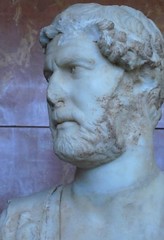
[Image - Bust of the Emperor Hadrian found at Heraklion on Crete 127-128 CE, The Louvre, Paris, France]

At present, the Institute is examining the secondary subterranean spaces, including drainage systems and corridors for activities performed by slaves—an area of the grounds that covers at least five acres. Future explorations will reconcile the relationship between the newly discovered bath complex and the previously known bathing facilities of the sprawling villa complex, unearth the other sections of the villa (including a huge garden area), and relate the history of the villa to this area of Rome's suburbium, unknown before this project.
The institute is presently accepting applications for participants in the fourth excavation season to be conducted from June 14, 2009 through August 02, 2009.

"This season’s summer program aims to supply participants with both a chronological and diachronic approach to the study of Roman civilization. Through this dual approach those involved in the program will gain a more comprehensive historical and cultural overview of Roman civilization from its rise to power in this rich Mediterranean area, understanding how this civilization set a standard of cultural values that have had long lasting influence over the entire Western world to this day."

Thursday, December 18, 2008

Farmer uncovers pre-Roman sanctuary near Aprilia

I wonder how many artifacts the farmer managed to pass on to the black market before he was discovered!

"A farmer working his land south of Rome dug up hundreds of artifacts from a 2,600-year-old sanctuary, but ran afoul of police when he tried to sell the ancient hoard, officials said Wednesday.

After spotting fragments of pottery in soil dug up by the farmer, authorities searched his home last month and seized more than 500 artifacts, including perfume vials, cups and miniature vases used as votive objects.

The art squad of the Carabinieri paramilitary police said the farmer was placed under investigation for allegedly trafficking in antiquities. Ancient artifacts found in Italy are considered state property, and finds must be reported to authorities.

Archaeologists said they will continue to excavate the sanctuary, which dates back to the 7th-6th century B.C. and is located outside the town of Aprilia, near a small lake some 25 miles (40 kilometers) south of Rome.

The find could expand knowledge about the area's history in pre-Roman times, when it was inhabited by Latin-speaking people under the influence of the Etruscan civilization that dominated central Italy, experts said.

The pottery, some of which was imported from Greece, was offered to a deity probably connected to the lake, said Stefano De Caro, director of archaeology at the Italian Culture Ministry." - More, GMA News.TV

Saturday, October 18, 2008

Buried Roman neighborhood of the dead uncovered

A dig has turned up the tomb of a nobleman who led Rome's legions in the second century A.D.Workers renovating a rugby stadium have uncovered a vast complex of tombs beneath Rome that mimic the houses, blocks and streets of a real city, according to officials, who have unveiled a series of new finds.

A dig has turned up the tomb of a nobleman who led Rome's legions in the second century A.D.

Culture Ministry officials said Thursday that medieval pottery shards in the city of the dead, or necropolis, show the area may have been inhabited by the living during the Dark Ages after being used for centuries for burials during the Roman period.

It is not yet clear who was buried in the ancient cemetery, but archaeologists at the still partially excavated site believe at least some of the dead were freed slaves of Greek origin.

Friday, July 11, 2008

Etruscan tomb uncovered in Perugia


"An ancient Etruscan tomb has resurfaced after centuries underground during the course of building work in the central Italian city of Perugia.

The tomb, which has been preserved in excellent condition, contains
seven funerary urns, the municipal archaeology department said. It is in
the shape of a square and was covered by a sheet of travertine marble,
which had apparently remained untouched since being laid centuries ago.
The tomb is split into two halves by a pillar and there are two benches
running along each side. The funerary urns, which were placed on the
benches, were marked with brightly coloured mythological and religious
motifs. A preliminary study suggests that writing on the side of the
urns probably refers to a family that was called the Aneis. In addition
to the urns, the tomb also housed the remains of a bronze bed and
various pottery shards. The site was discovered during digging work for
a new roundabout in the Strassacapponi neighbourhood on the outskirts of
the Umbrian town."

Monday, June 02, 2008

Thousand-year-old Lombard warrior discovered


"Italian archaeologists have discovered a perfectly preserved skeleton of a 1400-year-old Lombard warrior, buried with his horse.

The skeleton, which was found in a park at Testona, near Turin, is of a 25-year-old Lombard who died of a fever. Unusually, his horse was buried alongside him.

"This is a very rare find," said Gabriella Pantò, the archaeologist leading the dig. "We have not seen many precedents in Italy. We have seen horses' heads buried with warriors, but this find shows the area is vitally important," she added.

The Lombards were a nomadic tribe of Germans who settled near the Danube and launched an attack on Italy in the sixth century.

The dig revealed a Lombard camp had settled at Testona, and the skeleton of a dog was also found nearby. The invaders had built an aqueduct and irrigation system and a series of small wooden huts, without any foundations.

The warrior was also buried with a treasure chest being x-rayed by archaeologists. In addition, a small bag held a pair of pincers, a bronze belt buckle and some armour.

He wore a ring on his left index finger and also had both a knife and a "scramasax", a short sword designed for close combat."

Friday, August 17, 2007

Intact 2,000-year-old Etruscan tomb discoverd in Civitella Paganico


Archaelogists have discovered a more than 2,000-year-old Etruscan tomb perfectly preserved in the hills of Tuscany with a treasure trove of artifacts inside, including urns that hold the remains of about 30 people.

The tomb, in the Tuscan town of Civitella Paganico, probably dates from between the 1st and 3rd centuries B.C., when Etruscan power was in decline, Andrea Marcocci, who led digging at the site, told Reuters.

"It's quite rare to find a tomb intact like this," said Marcocci, who had suspected one might exist in the area after work on a nearby road scattered pieces of artifacts.

Inside the tomb, a narrow corridor led to a small burial chamber, about 2 meters long and 1.79 meters wide, he said. It housed about 80 objects including vases and mirrors in bronze and ceramic. Urns holding human remains were also found."

Learn Etruscan phrases!