ekathimerini.com | Drill aids digs in Thessaloniki: "Archaeologists are ready to begin work on the largest-ever excavation site in this city's historic center using the so-called "metro-mouse," the giant drill already used to dig tunnels under the city of Athens.
As the drill moves ahead, it is expected to help unearth finds that will illuminate the history and topography of the city's Hellenistic and Roman periods.
The greatest archaeological interest lies in the site of the six metro stations along the ancient Via Egnatia, where monuments and archaeological exploration point to the existence of a rich store of artifacts.
Potential sites were mapped as part of Attiko Metro's plan for the tunnels, and the Culture Ministry signed a memorandum of cooperation with the construction firm this week."
Friday, August 04, 2006


Thursday, July 20, 2006
Roman emperor Augustus' birthplace believed found

South Florida Sun-Sentinel: "A team of archaeologists announced Wednesday they have uncovered part of what they believe is the birthplace of Rome's first emperor Augustus.
Leading archaeologist Clementina Panella said the team has dug up part of a corridor and other fragments under Rome's Palatine Hill, which she described as 'a very ancient aristocratic house.'
Panella said that she could not yet be certain that the house was where Augustus was born in 63 B.C., but added that historical cross-checks and other findings nearby have showed that the emperor was particularly fond of the area, she said.
Excavations on the Palatine in recent decades have turned up wonders such as another renewed Augustus' house, including two rooms with stunning frescoes of masked figures and pine branches."
Wednesday, July 19, 2006
Dig unearths picture of ancient Norfolk
EDP24: "It has already provided a series of fascinating snapshots of early life in a Norfolk village.
And now an annual dig at Sedgeford, near Hunstanton, is providing more pieces of the jigsaw, as archaeologists slowly build up a complete picture of the life of the community.
The main focus of the 11th season of summer excavations by the award-winning Sedgeford Historical and Archaeological Research Project (SHARP) is the site of an Iron Age farm, which is thought to have been taken over by the Romans following their invasion.
The dig, which started earlier this month, has already uncovered plenty of Roman pottery and part of what is believed to be a fine drinking vessel, indicating that there was a domestic settlement in the area as well.
SHARP, based in a field known locally as Boneyard, began in 1996 and has grown to be the country's largest project for volunteer archaeologists from around the world.
Discoveries to date include more than 270 skeletons unearthed from a Saxon cemetery, a hoard of Iron Age coins concealed in a cow's leg bone and the long lost end of a torc."
Villa d'Este to go for Euro prize
Although I haven't personally seen many other spectacular European gardens, I can certainly vouch for the breathtaking beauty of Ville d'Este. As I said in my travel journal, if there is a heaven on earth, surely Ville d'Este must be it!
ANSA.it - News in English - Villa d'Este to go for Euro prize: "Villa D'Este near Rome is set to vie with European rivals for the laurel of the continent's most beautiful garden .
The 16th-century gardens, grounds, fountains and fancy waterworks of this Renaissance jewel at Tivoli have beaten 100 other great Italian gardens to qualify for the competition .
'This is a tribute to the great work of the villa workers as well as the contribution art authorities have made to help us restore the site,' Tivoli cultural heritage superintendent Anna Maria Affanni said .
'We are very confident about the European competition, even though we know we'll have stiff competition from the great gardens of England, France and Germany,' she said .
The European Great Garden competition was launched this year .
Villa d'Este recently underwent a major facelift .
Its remarkable fountains had been only partially working due to the polluted state of the river Aniene, which provides the water .
The water system has now been purified and the fountains have been restored .
The spectacular fountain garden was created by the great architect and landscape gardener Pirro Ligorio for Cardinal Ippolito II D'Este (1509-72), a rich Renaissance prince, collector and patron of the arts ."
Friday, July 07, 2006
Perthshire adventurer invites others to follow in Hannibal's footsteps for charity
News Scotland: "a Perthshire adventurer is looking for volunteers to help recreate one of the most famous journeys of all time.
David Fox-Pitt hopes to lead a small army over the Alps following in the footsteps of the warlord, Hannibal, and all in the name of charity.
More than 2,000 years ago, the legendary Hannibal led some50,000 men and dozens of elephants through the Alps to take on Rome, his mortal enemy.
From his home in Perthshire, David Fox-Pitt is planning to recreate that momentous journey.
But rather than an army or elephants David is looking for just 200 people to go with him and take on the challenge for charity.
He said: 'Hannibal had this amazing experience, taking 90,000 people over from Spain to attack the Romans. We're going to take 200 people out there. There will be three stages, bronze, siver, gold and platinum and the idea is to test people to see how far they can go.'"
You're not done Roman 'til you've cycled with Hadrian

Bike For All .: "He was the first Roman emperor to sport a beard and he ordered the construction of a stone frontier marker to sear the northern extent of the Roman Empire into the minds of the Picts. And now, as well as a wall named after him, there's a Sustrans cycleway.
100+ people will celebrate the opening of the 120-mile Hadrian's Cycleway between the Cumbrian Coast and the North Sea later this month. The trail opening ride on 19th to 22nd July is a sell-out but you can still join in the fun on day rides, see below.
Hadrian's Cycleway is on Route 72 of the National Cycle Network and takes in some of England's most wild and dramatic countryside, offering magnificent coastal views, breathtaking countryside, Roman forts and museums, and attractive market towns.
Hadrian's Cycleway has been developed by Sustrans, in partnership with local authorities including Northumberland and Cumbria County Councils, Hadrian's Wall Tourism Partnership, One NorthEast, Northumberland National Park Authority, the Countryside Agency and tourism organisations. The Hadrian's Cycleway map is available from Sustrans. The full 172-mile route will open in 2007. Right now there's a 120-mile signed route."
Thursday, June 29, 2006
The Brandon Sun: Online Edition
The Brandon Sun: Online Edition: "A rare silver coin celebrating one of the most famous murders of antiquity was handed over to Greek Culture Ministry officials, after a groundbreaking deal that allowed its repatriation from Britain.
The tiny coin, a denarius issued in 42 B.C. by Brutus, the chief assassin of Julius Caesar, is one of only 58 in the world. Greek authorities said it was illegally excavated in Greece and sold last year by two Greek suspected smugglers to London's Classical Numismatic Group Inc.
The coin was issued by a mobile military mint used by Brutus to pay his soldiers during the wars that followed Caesar's assassination in 44 B.C. by a group of his friends - immortalized in Shakespeare's play, Julius Caesar.
Decorated with the head of Brutus on one side and a pair of daggers flanking a cap on the other, the denarius carries the inscription Eid Mar - short for the Ides of March, or March 15, the date of Caesar's murder. "
Bulgaria's Pironkova serves up surprise at Wimbledon (SETimes.com)
Bulgaria's Pironkova serves up surprise at Wimbledon (SETimes.com): "Albanian and Italian archaeologists will start excavation work this week at the ancient Roman amphitheatre in Durres, Albania, with the goal of uncovering the entire structure. The dig is part of a 25,000-euro project to establish an archaeological park at the site."
Treasures pulled from a briny tomb - World - The Washington Times, America's Newspaper
Treasures pulled from a briny tomb - World - The Washington Times, America's Newspaper: " Egyptian authorities have now approved the exploration of the ruins of another city buried in the Mediterranean, this one a Roman city discovered by an excavation team 20 miles east of the Suez Canal on Egypt's northern coast.
Reuters news agency reports that archaeologists have found buildings, bathing chambers, a fortress, ancient coins, bronze vases and pieces of pottery dating from the Roman era between 30 B.C. and A.D. 337. The excavators found four bridges belonging to a submerged castle first discovered in 1910. "
Reuters news agency reports that archaeologists have found buildings, bathing chambers, a fortress, ancient coins, bronze vases and pieces of pottery dating from the Roman era between 30 B.C. and A.D. 337. The excavators found four bridges belonging to a submerged castle first discovered in 1910. "
Friday, June 16, 2006
Man Leads Archaeologists to Etruscan "Tomb of the Roaring Lions"

Chron.com "A suspected tomb raider turned police informant has led archaeologists to what experts described Friday as the oldest known frescoed burial chamber in Europe.
The tomb, located on a hilly wheat field north of Rome, belonged to a warrior prince from the nearby Etruscan town of Veio, said archaeologists who took journalists on a tour of the site.
Dating from around 690 B.C., the underground burial chamber is decorated with roaring lions and migratory birds. Experts are hailing it as the earliest example of the funerary decorations that would later become common in the Greek and Roman world.
'This princely tomb is unique and it marks the origin of Western painting,' said Culture Minister Francesco Rutelli.
Besides the frescoes, archaeologists have uncovered decorated vases imported from Greece, a sword and metal spits used to roast meat for the prince's table. A two-wheeled bronze chariot was found standing in front of the rounded archway that leads into the burial chamber.
The recovery of elegant broaches, a wool spindle and other objects usually used by females suggests that at least one woman, possibly the prince's wife, was buried in the tomb, said Francesca Boitani, the lead archaeologist on the dig.
The urns containing the cremated remains of the tomb's owners, normally placed in one of the chamber's niches, are believed to have been taken by looters, Boitani said.
The images of birds and fang-baring felines remain the highlight of what experts are calling "The Tomb of the Roaring Lions."
Although decorated prehistoric caves predate by millennia the Etruscan tomb, experts say it is the oldest example in the Western world of a specially built funerary chamber decorated with mural paintings.
"Prehistoric paintings are something else," Boitani said. "Here we see used for the first time the techniques described in ancient texts and used in Western civilization in the following centuries."
Mural paintings have been found in some burial chambers in Turkey, but those date back to the 6th century B.C., while the Etruscan tomb is at least a century older, said Giovanni Colonna, an expert on the Etruscan civilization at Rome's La Sapienza University.
The architecture of the tomb, the style of the paintings and the images of lions _ an animal that didn't roam central Italy _ show the builders were influenced by art coming from Greece, Egypt and Asian kingdoms, Colonna said.
Although the same art is used on Greek vases of the time, no decorated tombs from that period have been found in Greece or elsewhere in Europe, he said.
The images in the Etruscan tomb were outlined in black and red with paints produced from minerals and archaeologist believe they were fixed on the wall using a compound created by crushing ancient fossils found in the area.
The birds are symbols of the passage into the afterlife, while the lions "represent the horror for what lies beyond life," said Anna Maria Moretti, the superintendent for antiquities in areas around Rome."
Dayan is accused in antiquities plunder
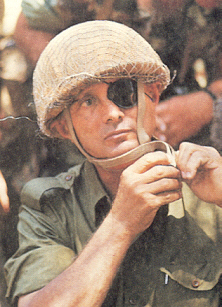
Dayan is accused in antiquities plunder: "Stunning military victories made Israeli general Moshe Dayan an iconic figure on the international stage, but his reputation for looting antiquities is little known outside the country where his myth was born.
Across three decades until his death in 1981, Dayan, of the trademark eye patch, established a vast collection of antiquities acquired through illicit excavations. He also traded in archaeological finds in Israel and abroad, antiquities experts say.
Dayan's extensive collection, which he housed in his Tel Aviv-area home, included pottery, stone heads, ossuaries, Byzantine gravestones and Roman sarcophagi, antiquities experts said."
Thursday, June 15, 2006
Museum to Reunite Venus Statue With Head - Forbes.com
Forbes.com: "For the first time in possibly 170 years, a Roman marble statue of Venus will be reunited with its head as both are coming to the Michael C. Carlos Museum at Emory University, where conservators will piece them back together.
The museum bought the charmingly prudish portrait of the goddess of love, whom the Greeks called Aphrodite and the Romans Venus, for $968,000 at a Sotheby's auction in New York on June 6. A private collector in Houston, Texas, agreed to sell to those who purchased the body at the auction the head as well, which was last documented attached to the body in 1836. The head sold for about $50,000.
The 4-foot-6-inch statue is a marble copy from the late 1st century A.D. of an earlier Greek bronze sculpture."
Christy's to Auction Lansdowne Hermaphroditius
Bloomberg.com: Culture: "Recent high-profile court cases involving patrimony laws, accusations of theft and smuggling may have cast a shadow over the field of antique art, but they have not quelled the urge to buy and sell. An antiquities auction at Sotheby's New York last week tallied $4.6 million, demonstrating that the market for Greek vases, Roman marble busts and Egyptian bronzes continues to be robust.
An upcoming Christie's sale features the Roman marble Lansdowne Hermaphroditus, a dual-gendered statue of an effeminate youth with wavy hair, pubescent female breasts and teenage male genitalia. Valued at as much as $500,000, the Hermaphroditus is among 291 lots that the auction house expects to gross as much as $9 million.
Ownership of the Hermaphroditus goes back to the 18th century, when British statesman William Petty Fitzmaurice decorated his Berkeley Square home with ancient sculpture. Christie's catalog says Fitzmaurice paid 40 pounds for the 2nd- century statue in 1775."
Friday, June 02, 2006
Roman villa discovered near Cheddar
The Weston Mercury - Roman gem discovery: "TWO newly qualified archaeology graduates say they have uncovered a massive Roman villa complex in the Mendip Hills.
The Weston-based graduates used specialist geophysics equipment to reveal what are thought to be two 60m buildings forming a prestigious courtyard villa with a separate bath building.
The buildings probably belonged to a rich landowner from the second or third century AD.
Limited excavation work at the site near Cheddar has thrown up patterned wall plaster and ancient cooking equipment and could hide a treasure of mosaic tiles and other artefacts."
Wednesday, May 31, 2006
Ancient Female Skeleton Found in Rome
Ancient Female Skeleton Found in Rome: "Archaeologists said Tuesday they have dug up a woman skeleton dating to the 10th century B.C. in an ancient necropolis in the heart of Rome.
The well-preserved skeleton appears to be that of a woman aged about 30, said Anna De Santis, one of the archaeologists who took part in the excavations under the Caesar's Forum, part of the sprawling complex of the Imperial Forums in central Rome.
An amber necklace and four pins were also found near the 5.25 foot-long skeleton, she said."
"Alessandro Delfino, another archaeologist who took part in the excavations, said Monday's discovery highlighted a "social change" in the funerary habits of the people who dwelled in the area, from incinerating to burying the dead.
Experts have said the necropolis was destined for high-ranking personalities _ such as warriors and ancient priests _ heading the tribes and clans that lived in small villages scattered on hills near the area that later spawned one of the world's greatest civilizations."
Thursday, May 25, 2006
Is Boudicca buried in Birmingham?

BBC NEWS: "The burial ground of Queen Boudicca could be next to a burger restaurant in Birmingham, it has been claimed.
An excavation is to take place at the site in Kings Norton after evidence it has Roman remains buried there.
Queen Boudicca, who led ancient tribes in battle against the Romans, died in 62 AD, possibly in the Midlands.
Dr Simon Esmonde Cleary, an archaeology expert from Birmingham University, was sceptical about the Boudicca claims.
He said: "The short answer is we don't know where the battle took place, anybody's guess is as good as anyone else's.
"The last time we had Boudicca was in what is now Hertfordshire. We know the Roman Army was coming down from Wales."
He said the battle could have taken place anywhere in between."
Tuesday, May 23, 2006
SUR in EnglisSixth century human remains and artefacts found at Arroyo Vaquero burial ground
SUR in English: "Phoenicians, Carthaginians, Romans and Muslims have all left their mark on Estepona. A small part of the municipality?s history lies at Arroyo Vaquero, the site of a Roman settlement. It is two decades since the first remains of a Roman villa were discovered at the site surrounded by several tombs. At the time the land was placed under a protection order so that urban development did not encroach on the town?s cultural heritage. All excavations on the land were brought to a standstill until a developer bought it with a view to building on it. It was when construction work started that more archaeological remains appeared.
The most recent finds consist of about 50 tombs with human remains dating from the sixth to the seventh century AD. Among the artefacts are Visigoth jars made of pottery, rings, a buckle and several Roman coins from the fourth and fifth century. ?The remains are in very poor condition due to the ravages of time and the characteristics of the land, but the utensils are unique?, said the municipal archaeologist, Ildefonso Navarro. Recent excavation work on the Palaeo-Christian necropolis started six weeks ago. When the first part ends the Town Hall will send a report on the remains found to the Andalusian Government. Then a provincial commission will be set up by the regional Department of Culture to determine whether the burial ground is to be preserved or whether the items are to be removed from the site and put on display in a museum.
The councillor for Culture, Asunción López, said: ?If nothing more important appears the site will be developed and the green area where the Roman villa stood will be used for displaying the remains?."
Egypt to excavate submerged Roman city
Kuwaittimes.net: "The Egyptian authorities have given the go ahead for the underwater exploration of what appears to be a Roman city submerged in the Mediterranean, Egypt's top archaeologist said yesterday. Zahi Hawass said in a statement that an excavation team had found the ruins of the Roman city 35 km east of the Suez Canal on Egypt's north coast. Archaeologists had found buildings, bathrooms, ruins of a Roman fortress, ancient coins, bronze vases and pieces of pottery that all date back to the Roman era, the statement said. Egypt's Roman era lasted from 30 BC to 337 AD. The excavation team also found four bridges that belonged to a submerged castle, part of which had been discovered on the Mediterranean coastline in 1910. The statement said evidence indicated that part of the site was on the coast and part of it submerged in the sea. The area marked Egypt's eastern border during the Roman era."
Thursday, May 18, 2006
Budapest Celebrates Ancient Pannonian Roots

The Budapest Sun Online: "IT looked like a scene from The Gladiator, as thousands of spectators joined with the colorful, authentically costumed Roman citizens marching in procession, through the streets of ancient Aquincum, some three kilometers north of Obuda, on the morning of May 6.
The occasion for the gathering was to celebrate the 1,900th anniversary of the Emperor Trajan's elevation, in 106 AD, of the ancient Roman settlement of Aquincum to the rank of capital of the colony of Pannonia.
With its strategic location on the east-west and north-south trajectory, and its rich natural resources, the colony flourished to such an extent that Trajan's successor, the Emperor Hadrian soon decreed Aquincum the Capital of 'Lower Pannonia, Colonia Splendidissima.'
As was wont in ancient times, the celebrants gathered in the Roman Forum of Aquincum, around the tall, distinguished patrician figure of the Macro Magister Budorum, the Highest Governor of Buda the master of ceremonies, played by an actor of the Vidám Színpad (Comedy Theater). He looked perfect in the part, in his purple toga, thonged leather sandals, and a freshly braided laurel wreath on his head.
He set the scene perfectly, literally becoming the personage he was playing, as did the three squadrons of gladiators (including two females), the belligerent Celts - a group of tall, slim, blond young men, their faces painted with blue war paint, their hair streaked with clay, all wearing plaid homespun.
Other peoples of the Empire - Thracians, Parthians, Scythians, and Germans - gathered for the inaugural rites offered by the 'high priest and vestal virgins.' A horse-drawn chariot carrying the gods Jupiter, Hera, Pallas Athena, Cupid, and Bacchus, along with singers and comedians, reenacted the ancient rituals celebrating the coming of spring, from the days when Aquincum was a living, throbbing Roman provincial capital.
After the required sacrificial offerings had been made, the crowd, led by the governor general, proceeded from the forum, following an ancient pathway along the remains of the aqueducts, through freshly sprouted green underbrush and woods, the verdant greenery hiding the 20th century's ugly concrete high-rise houses between which our path led, to the Civic Amphitheater for the high point of the celebrations, the gladiatorial games.
The spectacularly clad gladiators of the "Familia Gladitoria Pannonia" set the pace of the procession, marching to the stern voice of their towering Commander: "uno, duo, tres, kvatro, uno, duo, tres, kvatro," the only thing to bring one back to our 21st century was this slight Hungarian twist to the Latin pronunciation of quattro. The credibility of the setting, characters, and sounds plunged us back into the first century AD, into the living reality of ancient Pannonia."
Ancient Etruscans are unlikely the ancestors of modern Tuscans, study finds

Ancient Etruscans are unlikely the ancestors of modern Tuscans, study finds: "For the first time, Stanford researchers have used novel statistical computer modeling to simulate demographic processes affecting the population of Tuscany over a 2,500-year time span. Rigorous tests used by the researchers have ruled out a genetic link between ancient Etruscans, the early inhabitants of central Italy, and the region's modern day residents.
The findings suggest that something either suddenly wiped out the Etruscans or the group represented a social elite that had little in common with the people who became the true ancestors of Tuscans, said Joanna Mountain, assistant professor of anthropological sciences.
'Very often, we assume the most simple explanation for something,' said Mountain, an expert in anthropological genetics. 'So when you find in a particular location the archeological remains of people, the simplest explanation is that those people are ancestral to whoever is living there now. How often do you get a chance to check that? Very rarely.'
The research advances the field of anthropological genetics by moving beyond simple storytelling about an ancient people to rigorous testing, using genetic data analysis, of a set of anthropological hypotheses, Mountain said.
The findings are documented in 'Serial Coalescent Simulations Suggest a Weak Genealogical Relationship Between Etruscans and Modern Tuscans,' published May 15 in the online version of Proceedings of the National Academy of Sciences. Uma Ramakrishnan, a former Stanford postdoctoral fellow, and Elise M. S. Belle and Guido Barbujani of the University of Ferrara in Italy co-authored the paper with Mountain."
Subscribe to:
Posts (Atom)