Thursday, January 26, 2006

Unearthing history in the heart of ancient Rome. by Derek Wilson. Wanted in Rome


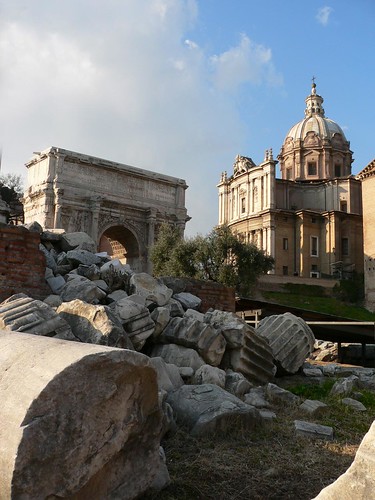
Unearthing history in the heart of ancient Rome. by Derek Wilson. Wanted in Rome: A cremation tomb that has been identified as going back to the 11th or 10th century BC, long before Romulus and Remus appeared on the scene has been uncovered in the Roman forum.

"Looking down into the forums from Via dei Fori Imperiali on the way to Piazza Venezia, the well-tomb, a perfectly circular hole in the ground, lies just to the right of the senate house in the Forum of Caesar. This forum was the first to be built, carved out of a former saddle between the Quirinale and Capitoline hills in 46 BC, and is thus on top of the tomb, which is suspected to be the first trace of a whole yet undiscovered ancient necropolis in the area.
Speaking to reporters, a jubilant Eugenio La Rocca, head of the Rome council?s cultural heritage department, dated the tomb to somewhere between the Bronze Age and the early Iron Age. ?It was a real surprise to find rich furnishings inside it,? he exclaimed. The findings included a funeral urn and eight hand-worked, patterned vases in terracotta. They contained tiny bronze miniatures of weapons, and elsewhere what seemed t o be the bones of a bird, placed there, La Rocca presumed, to accompany the deceased on his journey to the beyond, as was the custom. The riches were found after first rolling back the tomb?s cover, a weighty round slab of tufa, and then removing its seal, a container in the stylised shape of a hut, a model akin to real huts found much later on the Palatine Hill.
La Rocca and the director of the dig, Roberto Meneghini, both deduced that such a rich tomb must have been that of the head of a clan, a patriarch ruling over one of the scattered groups of families, or settlements, that had gathered around a fording point on the Tiber when the future Rome was still only a wild place of heavily wooded, isolated hills interspersed by tricky marshes."

Thursday, January 19, 2006

Roman artifacts thought to come from 1929 dig

"The discovery of Roman artifacts, possibly from JRR Tolkien's dig at the Lydney Park Estate, is proving far from an open and shut case. An early 20th century suitcase containing ancient pottery has been handed to the county council after it was found at a quarry near the Severnside town.

County archaeologist Jan Wills said the finds were a mystery. She said: 'It looks as if it could belong to Lydney Park. I'm in contact with them as we believe it was found on estate land.'

It is thought the case could relate to the dig around the Roman temple site on the estate in 1929 by eminent archaeologist Sir Mortimer Wheeler. One of his assistants was The Lord of the Rings writer Tolkien."

Ancient 'Cyclops' wall collapses

ANSA.it: "Part of a massive wall started in around 600 BC around the central Italian town of Amelia collapsed on Wednesday morning for reasons still unclear .

The so-called Polygonal walls around Amelia are famous not only for their age but also their size. Built out of huge polygonal stones, they are 8-10 metres high and about 3.5 metres thick .

The 800-metre long wall, which now has a breach in the section to the right of the old city gate, has always impressed archaeologists for the skill with which it was built .

According to local legend, it was constructed by the Cyclops, the one-eyed monster encountered by Greek hero Ulysses .

Amelia was founded by Umbri king Amero who gave it his name .
"

Roman era rock tombs unearthed near Develi in Turkey

An archaeological exploration of the Adana region in Turkey originally launched by Cukurova University in 2002, has uncovered a wealth of ancient settlements in the area once known as Cappadocia.

"Among the archaeological finds in Develi are numerous tumuli, ancient settlements, wine production facilities where famous Cappadocia wines were produced, underground cities, sacred places and Roman-era rock tombs."

Thursday, January 05, 2006

Alexander, Piece by Piece


I was so excited to read about the effort to recreate the famous Alexander and Darius mosaic. It is one of my favorite mosaics and I would have loved to have seen it in situ in the House of the Faun when I was in Pompeii this Spring. I hope it won't be too many years before I get a chance to return to Pompeii and see both the original in the Archaeological Museum of Naples as well as this new one.

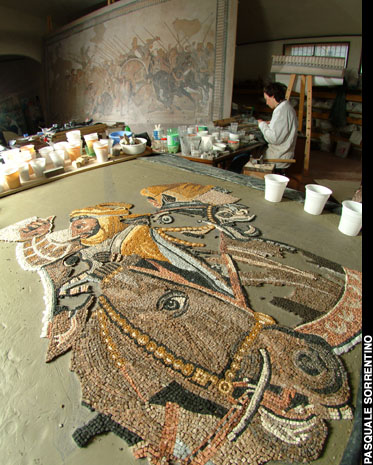
Alexander, Piece by Piece: "In 2003, a team of artists from the International Center for the Study and Teaching of Mosaic (CISIM) in Ravenna, Italy, made an ambitious proposal to the archaeological superintendent of Pompeii: create an exact copy of the Alexander Mosaic and install it in its original home. More than two years, 16,000 hours of work, and $216,000 later, the most famous mosaic to survive from the ancient Roman world once again adorns Pompeii's House of the Faun.

One of the iconic images of the great Macedonian leader, the mosaic depicts a confrontation between Alexander and the Persian king Darius in the fourth century B.C. Since 1843, the mosaic has hung on the wall of the National Archaeological Museum in Naples, safe from the feet of Pompeii's two million plus yearly visitors, as well as from the rain and sun that have damaged the whole site. So why bring Alexander back to Pompeii? The House of the Faun was once Pompeii's biggest and most impressive urban villa, filled with simple but elegant decorations designed to demonstrate the vast wealth of the house's owners. But today, although the sheer size of the house is still clear, the brightly colored paintings and mosaics, the gleaming marble and bronze statues, the fountains, and the hustle and bustle of a palatial villa are gone. Superintendent Pietro Giovanni Guzzo wants to change that. 'I want visitors to have the impression that they are entering the same luxurious house in which the ancient Pompeian owners lived before it was destroyed by the eruption of Mount Vesuvius in A.D. 79.'"

Ancient Roman Lighthouse May Have Been Destroyed by Tsunami


Turkish Daily News - Traces of tsunami in ancient city of Patara - Dec 27, 2005: "Archaeologists claim that an ancient lighthouse located in the ancient city of Patara on Antalya's Mediterranean coast might have been destroyed by a tsunami that hit the region in ancient times.

The ruins of the lighthouse were discovered two years ago during excavations that are still under way in Patara.

Professor Havva ??kan I??k, head of Akdeniz University's archaeology department, which is conducting studies in the ancient city, said they believed the lighthouse was destroyed by a tsunami since a human skeleton was found among the ruins.

I?ek said the skeleton could belong to a lighthouse keeper who was trying to escape a tsunami but was crushed under the lighthouse's stone blocks.

A bronze inscription the team discovered indicated that the lighthouse was built by the Roman Emperor Nero between A.D. 64 and 65."

Roman arrowhead among artifacts found in Temple Mount rubble

Arutz Sheva - Israel National News: "Archaeologists have discovered hundreds of coins and artifacts in Temple Mount rubble removed by Arabs who are building a huge underground mosque. Among the finds are a seal that was used to close sacks of silver at the time of the prophet Jeremiah, shortly before the destruction of the First Temple. The seal bears a name that suggest the owner may have been a brother of a priest named in Jeremiah's writings, according to Bar Ilan University Prof. Gabriel Barkai.

Also found was an iron arrowhead with a shaft used by the Romans in their attack on the Second Temple almost 2,000 years ago. Other finds date back to the Middle Ages and 'testify to large attendance at the Temple Mount during the Christian conquest and rule during the 11th to 15th centuries,' Prof. Barkai added."

Tuesday, January 03, 2006

Cache of Bronze Age Tools uncovered near Somerset

Edinburgh Evening News - UK - Legal history as mum faces killing charge: "Archaeologists have uncovered hundreds of Bronze Age tools at a construction site in Somerset. Some 800 pieces were found at the former hunting site that was in use 4000 years ago."

Mole family uncovers Roman villa

CBBC Newsround | UK | Mole family uncovers Roman villa: "A group of busy moles has been credited with helping archaeologists find a Roman villa in Gloucestershire.

Fragments of ancient tiles from the villa were found in molehills and are believed to have been pushed above ground by the creatures' burrowing.

The discovery was made in the Cotswold village of Withington where several other Roman villas have recently been uncovered."

Wednesday, December 28, 2005

'Paradise' found in Brooklyn Museum


'Paradise' found in Brooklyn Museum: During the reign of the first Roman emperor Augustus, Carthage, once Rome's greatest enemy, became the capital of the Roman African Proconsularis. Important as a port and an invaluable source of grain and trade goods, Carthage became the home of very wealthy Roman citizens, including a large population of wealthy Roman Jews.

In the late 19th century, a captain in the occupying French army, Ernest de Prudhomme built a villa in the town of Hammam-Lif, a small town on the peninsula about 50 kilometers from Tunis. Wishing to add a new garden to his villa, Prudhomme instead discovered the remains of a Jewish synagogue of the Roman period, with beautiful mosaics of natural, personal, and religious themes inlaid in the floors, perfectly preserved beneath the villa?s yard.

This synagogue must have been a lovely place, if the mosaics in 'Tree of Paradise: Jewish Mosaics from the Roman Empire' are any indication. The floor of the main sanctuary must have looked like a Garden of Eden with menorahs. The mosaic panels overflow with roosters, partridges, ducks, lions, hyenas, fish, vines, flowers and date palms (the Tree of Paradise).

"In 1905, the Brooklyn Museum received 21 of these mosaics excavated in the North African ruins of the first Roman-era synagogue to be uncovered in modern times.

Now on exhibit until June 4, 2006, these mosaics are as fresh-looking as the day they were made -- mosaics keep well -- about 1,500 years ago in the city of Naro, not terribly far from the ancient stronghold of Carthage, in Tunisia. An inscription on one in Latin indicates they were donated to the synagogue by Julia of Naro. These mosaics are evidence that, although the Roman empire continued a policy of non-tolerance towards Jews throughout this period, in some places around the Mediterranean, Jewish people prospered.

Tuesday, December 27, 2005

Italy Offering "Loans" of Antiquities to Replace Works Without Provenance in American Museums

New York Times: "When Italian cultural officials faced off in Rome last month with Philippe de Montebello, the director of the Metropolitan Museum of Art, they were gambling that they could make headway on a cause that had stymied them for three decades: getting the Met to give up a krater, or vase, by the fifth-century artist Euphronios, that they say was looted from an Etruscan tomb north of Rome.

On the face of things, it hardly seemed likely that the Met would suddenly consider returning an object that had been a prized mainstay of its Greek and Roman galleries for so many years.

But the Italians had seized on a new strategy: an offer to replace that work - and others they hope to get back from the museum - with loans of equal or similar value. The museum might even be able to hold on to some of the disputed objects as long-term loans, they suggested.

The strategy is part of a broader offensive to crack down on stolen antiquities. Italy has gained additional clout - at least in terms of public awareness - from the current criminal trial of Marion True, a former curator at the J. Paul Getty Museum in Los Angeles, and of antiquities dealers with ties to top American museums."

The article goes on to say that several years ago Italy denied a Getty Museum request for the loan of a group of bronzes from the Naples Archaeological Museum that would have been featured when the newly expanded Getty Villa reopens January 28. I was sad to read this as I am anticipating a visit to the Getty Villa and I would have been thrilled to see the bronzes from the Naples Archaeological Museum since I didn't have time to visit that museum when I explored Pompeii last spring.

Friday, December 23, 2005

Romans may have learned from Chinese Great Wall

The construction of the Roman Limes was quite possibly influenced by the concept of the Great Wall in China, though the two great buildings of the world are far away from each other, said archaeologists and historians.

Although there is no evidence that the two constructions had any direct connections, indirect influence from the Great Wall on the Roman Limes is certain, said Visy Zsolt, a professor with the Department of Ancient History and Archaeology of the University of Pecs in Hungary.

The Roman Limes are Europe's largest archaeological monument, consisting of sections of the border line of the Roman Empire at its greatest extent in the 2nd century AD.

All together, the Limes stretch over 5,000 kilometers from the Atlantic coast of northern Britain, through Europe to the Black Sea, and from there to the Red Sea and across North Africa to the Atlantic coast.

Vestiges include the remains of the ramparts, walls and ditches, close to 900 watchtowers, 60 forts, and civilian settlements which accommodated tradesmen, craftsmen and others who served in the military.

Visy noted that there are a lot of similarities between the Roman Limes and the Great Wall. Both empires wanted to launch a strong barrier against "barbarians" and to prevent their invasions. In doing so, the Han Dynasty (226 BC-220 AD) built a continuous wall, but Rome built a wall only in special cases.

"It was an important point in both systems to build a military road along the limes, as well as a row of beacon towers in a strict sequence. Also the military centers and bigger forts are similar in the Roman and in the Chinese constructions," Visy said.

Archaeologists have found almost the same methods were used for providing signs at the Great Wall and the Roman Limes.

Visy said another factor that should not be neglected is that the western most sector of the Great Wall was built in the last decades of the 2nd century BC, during the strong rule of Emperor Wu of the Han Dynasty.

The trade connections between the two empires were quite intensive in the first century and at least in the first half of the second one. "It is worth noting that the north line of the Silk Road was opened also at the beginning of the 1st century AD," Visy said.

Tuesday, December 13, 2005

Hill near Evros holds story of Plotinopolis

ekathimerini.com | Hill near Evros holds story of Plotinopolis: "Ever since the 1960s, the site where the hill of Aghia Petra rises between the Evros and Erythrpotamos rivers has been identified with the city of Plotinopolis. The Roman Emperor Trajan (AD 98-117) founded the city 2 kilometers from the Evros in honor of his wife Plotina.

In 1965, soldiers digging a trench in the area discovered a beaten gold bust of Septimus Severus, the Roman emperor who reigned from AD 193 to 211. That find is now in the Komotini Museum. In 1977, Georgios Bakalis and Dimantis Triantofyllos began systematic excavations, bringing to light new finds including mosaic floors.

Since Mathaios Koutsoumanis undertook the dig in 1996, he has unearthed many impressive finds, including the remains of mosaics from a large building complex, ceramics, coins (the most remarkable of which depicts Antiochus II of Syria), and inscriptions which show that the site was in use from the second to the sixth century AD."

Roman forts had a woman's touch.

Roman forts had a woman's touch. 13/12/2005. ABC News Online: "In a unique study, Dr Penelope Allison of the Australian National University has been analysing patterns of objects found throughout the forts that support the presence of women.

'The distribution of lost and abandoned objects, tells us quite a lot of about where people go and how they use a space,' she says.

Using computer software, she has mapped the distribution of over 30,000 artefacts.

She found objects used by women, such as hairpins, beads, perfume bottles and spindle wheels scattered in buildings and along the streets of the forts.

'They all tend to group together in different parts of the fort,' she says.

The location of these objects suggest women often played an active life in the fort, says Allison, which might be better described as a functioning town with a market rather than a sterile male-only province.

She says women were well and truly integrated into the forts, playing 'helpful' non-combatant roles of wives, mothers, craftspeople and traders."

Tuesday, December 06, 2005

Prison cells unearthed in Tiberias


Haaretz : "A bit of what prisoners suffered in ancient times can be seen as of yesterday at the archaeological dig in the old city of Tiberias. Excavations of the basilica compound in the eastern part of the old city recently unearthed two small chambers believed to have served as holding cells for prisoners awaiting trial.

The cells are located below the level of the main administrative building, the basilica. That fact bolsters the theory that they served as holding cells, where crowded prisoners waited to be called for trial. Each cell measures 1.8 by 2.7 meters, and is 2.07 meters high. Its walls are extremely thick, with the outer wall (1.1 meters thick) containing two narrow openings onto the city square. The slits presumably provided ventilation, and one also served as a food portal.

Narrow benches run along the length of the cells uncovered. One can only imagine what the prisoners experienced as they waited in the blazing heat of the Tiberias' summer. Some might have languished there for months, waiting for the governor to arrive, in the event of a complicated trial."

Five Untouched Sarcophagi Found Near Rome


"Italian archaeologists have found a remarkable trove of five untouched Roman sarcophagi in a burial vault outside Rome .

"It's really rare to find so many sarcophagi that have never been profaned or even opened - as can be seen by the intact lead clasps on their edges," said the head of the dig, Stefano Musco .

He said the sarcophagi dated from the II century AD and probably contained the remains of the wealthy residents of a villa that once stood in the area - now a building site on Rome's north-eastern outskirts .

All the sarcophagi are marble and all decorated, leading archaeologists to suppose they could have been made for a prominent aristocratic family .

One of them is much smaller than the others and believed to contain the remains of a small child.

The largest sarcophagus is decorated with lion's head masks and a central relief showing a reclining couple - a motif that dates back to Etruscan times .

Rome anthropologist Paola Catalano said she hoped the skeletons and funerary objects would provide information on burial rites and the lifestyles and social position of the dead, "even though the acidity of the terrain and rainwater has already corroded the marble."

Ancient Roman brickworks uncovered near Ronta


ANSA.it : "An Ancient Roman brickworks in near perfect condition has been discovered in Emilia Romagna .

The complex, the largest anywhere in the region and one of the biggest in Italy, was unearthed near a canal in the central Italian town of Ronta .

'This is a truly extraordinary find,' said a culture ministry spokesman. 'It is so well preserved that with minimal restoration it would still work perfectly today.'"

So far, archaeologists have uncovered two large rectangular ovens for baking bricks, a tiled floor that was once part of a production vat, a large terracotta tub and the remains of the walls .

The largest oven-room is 4.2 by 5 metres and has a hole in the centre showing the cavern underneath for lighting the fires. This had two-metre-high walls supporting a layer where the bricks were laid to bake .

Experts say that the room was extended on three occasions, presumably coinciding with a period of general expansion for the brickworks .

The brazier in the second oven-room, which is 3.8 by 3 metres, is constructed from a series of arches and small walls, allowing larger pieces to be placed directly over the flames .

The walls of the room are made of soft clay tiles that were gradually baked solid by the heat .

The complex, which dates back to the 2nd century BC, is the second oldest brickworks uncovered in Emilia Romagna. An earlier structure in Ca Turci Cesenatico has been dated back to the end of the 3rd century BC, which was when the Roman first occupied the area."

Tuesday, November 29, 2005

Ancient Roman Anchors Found in Israel

Newsday.com: "Ancient wooden anchors preserved by natural salt for more than 2,000 years have been discovered on the receding shores of the Dead Sea, Israel TV reported Monday.

Archaeologist David Mevorach told the TV station that one anchor dated back 2,500 years -- the oldest ever found. Another anchor was 2,000 years old, he said. They were built from acacia wood for Roman ships, he said. "

Friday, November 18, 2005

Archaeologists find western world's oldest map


"The oldest map of anywhere in the western world, dating from about 500 BC, has been unearthed in southern Italy. Known as the Soleto Map, the depiction of Apulia, the heel of Italy's 'boot', is on a piece of black-glazed terracotta vase about the size of a postage stamp.

It was found in a dig led by the Belgian archaeologist Thierry van Compernolle, of Montpellier University, two years ago. But its existence was kept secret until more research was carried out.

'The map offers, to date, for the Mediterranean, and more generally for western civilisation, the oldest map of a real space,' the university said recently.

Its engraved place names are indicated by points, just as on maps today, and are written in ancient Greek.

The sea on the western side, Taras (Taranto), today's Gulf of Taranto, is named in Greek. But the rest of the map is in Messapian, the ancient tongue of the local tribes, although the script is ancient Greek."

Friday, November 04, 2005

A Roman soldier?s story

"His name was Papas the Son of Cillis. He lived nearly 2,000 years ago, and it?s likely he would be mighty surprised at what James Russell has learned about his life.

Mr. Russell knows that Papas was an Anatolian who enlisted as an auxiliary in the Roman legions, serving in outposts of the empire for 25 mostly peaceful years. The auxiliaries were second-class soldiers who were natives of distant provinces that the Romans had conquered; Roman citizens served as prestigious legionaries.

Toward the end of his enlistment, Papas? regiment was sent to Judaea to help put down an uprising by the Jews. When he was honorably discharged, he was given Roman citizenship, as were all auxiliaries.

Papas returned home to his province to live out his life with his four children, who also were granted Roman citizenship, which would have set them on the path of upward social and political mobility.

Mr. Russell, an archaeologist and professor emeritus in the department of classics at the University of British Columbia, speaks about Papas as if he were an old friend. And, indeed, it must seem that way. The scholar has spent perhaps a decade tracing the life of the ancient Anatolian from information inscribed in Latin on a fragment of a bronze tablet, which was found in the rugged hills of Southern Turkey. Mr. Russell was given the fragment by farmers who uncovered it not far from his main archaeological site, the coastal Romano-Byzantine city of Anemurium.

The archaeologist worked backward from the substantial number of facts recorded on the tablet, including the date it was issued and the names of the emperor and the consuls for that year.

Also inscribed are Papas? native province and the names of the commanding officers of his regiment, as well as the names of members of his family, including his children.

?Emperor Trajan was mounting a campaign in the East. We know from stone inscriptions where his regiment was. We can trace its movements from Syria to Egypt to Judaea,"
Mr. Russell said.

It seemed straightforward enough until Mr. Russell remarked that he had discovered the regiment had been in Egypt from hieroglyphics on two papyri. ?Our kind of scholarship is sort of serendipitous,? he remarked.

Becoming an auxiliary in the Roman legions was a good job for a young man with wanderlust; the auxiliaries were shipped out to defend the empire?s frontiers. They quickly learned to speak ? and even read and write ? Latin. With those skills, an auxiliary could rise to the rank of sergeant. Papas gave at least two of his children Roman names, probably in honor of favorite centurions
."