UK museums, treasure hunters agree code of conduct | Reuters.com: "Museums, metal detectorists and archaeologists in England and Wales on Tuesday agreed a code of conduct to try to protect the country's buried treasures from being plundered by the unscrupulous or the unaware.
The voluntary code follows the massive looting of the Roman-Celtic temple at Wanborough in Surrey in the mid-1980s and with customs officers seizing increasing numbers of undeclared historical artefacts being smuggled out of the country.
'This code represents a major step forward,' Mike Heyworth of the Council for British Archaeology told reporters at the British Museum.
'Most detectorists are only interested in finding and preserving local antiquity ... and make a positive contribution to our historical knowledge,' he said. ' There are just a few illicit detectorists motivated solely by profit.'
In recent years amateur metal detectorists have unearthed, declared and been rewarded for some invaluable ancient artefacts like the Ringlemere Gold Cup, the Winchester Hoard of Iron Age jewelry and the bronze Roman Staffordshire Moorlands Pan.
Under the code, detectorists must get permission to search, join a recognized detectorists club, log the precise location of any find and report it to the landowner -- who has a share in any valuation -- and the portable antiquities scheme."
I hope this code of conduct works. I know when I was in Britain recently I purchased a certified 4th century Roman military cloak brooch from an established antiques center in York so I hope it was properly recorded and offered for sale legally.
Wednesday, May 03, 2006


A large Roman-era villa is discovered
A large Roman-era villa is discovered: "Italian archeologists have reportedly discovered the remains of a huge Roman villa near Florence -- the first ever in the popular tourist area.
'Villas like these were fully fledged factories for the production of wine, olive oil, meat, corn and other products,' said archaeologist Fausto Berti, who led the dig at Montelupo Fiorentino.
'We`ve found big animal pens, warehouses and even a workshop for making ceramic vases. The owners were self-sufficient,' he told the Italian news service ANSA.
The 500-meter-square villa has fully equipped baths with all the areas Romans used to produce various levels of heat, warm water and steam -- and a cooling area.
The Montelupo villa is open to the public during weekends but reservations are required."
'Villas like these were fully fledged factories for the production of wine, olive oil, meat, corn and other products,' said archaeologist Fausto Berti, who led the dig at Montelupo Fiorentino.
'We`ve found big animal pens, warehouses and even a workshop for making ceramic vases. The owners were self-sufficient,' he told the Italian news service ANSA.
The 500-meter-square villa has fully equipped baths with all the areas Romans used to produce various levels of heat, warm water and steam -- and a cooling area.
The Montelupo villa is open to the public during weekends but reservations are required."
Tuesday, April 25, 2006
Archaeologists dig Roman dogs
icSurreyOnline : "BONES of dozens of dogs offered to the gods in Roman times and unearthed in Ewell 30 years ago is an archeological find that has triggered further investigation.
Leading archaeologists are in the village recovering the secrets of lost Roman shrines.
The team of excavators, digging at Hatch Furlong on the Ewell bypass, is being led by Harvey Sheldon of Birkbeck College, University of London, and Jon Cotton of the Museum of London and president of the Epsom and Ewell Local History and Archaeology Society.
The first finds were made in the 1840s in a series of deep ritual shafts cut down into the chalk.
But today's archaeologists will be seeking to uncover more of a stone building and a further deep shaft found in 1977. Shafts like these have been found containing pottery vessels, coins and the bones of many dogs.
Ewell lies on Stane Street - the main Roman road from London to Chichester - and the discoveries in and around Hatch Furlong suggest that a religious complex once existed on the higher ground over-looking the settlement."
Leading archaeologists are in the village recovering the secrets of lost Roman shrines.
The team of excavators, digging at Hatch Furlong on the Ewell bypass, is being led by Harvey Sheldon of Birkbeck College, University of London, and Jon Cotton of the Museum of London and president of the Epsom and Ewell Local History and Archaeology Society.
The first finds were made in the 1840s in a series of deep ritual shafts cut down into the chalk.
But today's archaeologists will be seeking to uncover more of a stone building and a further deep shaft found in 1977. Shafts like these have been found containing pottery vessels, coins and the bones of many dogs.
Ewell lies on Stane Street - the main Roman road from London to Chichester - and the discoveries in and around Hatch Furlong suggest that a religious complex once existed on the higher ground over-looking the settlement."
Archaeologists uncover Iberian shrine and necropolis near La Vila Joiosa
Typically Spanish Spain News: "Archaeologists have found the remains of a 1st century BC Iberian shrine and necropolis on the outskirts of La Vila Joiosa.
The find is near the 19th century cliff-top Torreón Doctor José María Esquerdo, where a team of Spanish and French archaeologists are working together on the investigations. The dig is led by Pierre Ronillard, the director of the Maison René Gionouves Institute for Archaeological Investigation in France, and Jesús Moratalla, archaeology professor at Alicante University.
Archaeologists from the Casa de Velázquez and the Centre for Scientific Investigation in France are also involved, as is the Town Hall archaeologist, professor Antonio Espinosa, who said ?the fact that there are at least two large cemeteries here means that this Iberian city must have been very important in its time.?"
The find is near the 19th century cliff-top Torreón Doctor José María Esquerdo, where a team of Spanish and French archaeologists are working together on the investigations. The dig is led by Pierre Ronillard, the director of the Maison René Gionouves Institute for Archaeological Investigation in France, and Jesús Moratalla, archaeology professor at Alicante University.
Archaeologists from the Casa de Velázquez and the Centre for Scientific Investigation in France are also involved, as is the Town Hall archaeologist, professor Antonio Espinosa, who said ?the fact that there are at least two large cemeteries here means that this Iberian city must have been very important in its time.?"
New Home for the Ara Pacis Opens in Rome
New York Times: "Since Rome was not built in a day, it is perhaps unsurprising that a plan to house Caesar Augustus's Ara Pacis, or altar of peace, in a  new museum has taken 10 years to be realized. But even now, as work continues on the $24 million glass and travertine marble structure, which stands between a busy highway overlooking the River Tiber and the Mausoleum of Augustus, Rome's mayor, Walter Veltroni, went ahead with its scheduled inauguration on Friday because April 21 was, at least in theory, the city's 2,759th birthday.
new museum has taken 10 years to be realized. But even now, as work continues on the $24 million glass and travertine marble structure, which stands between a busy highway overlooking the River Tiber and the Mausoleum of Augustus, Rome's mayor, Walter Veltroni, went ahead with its scheduled inauguration on Friday because April 21 was, at least in theory, the city's 2,759th birthday.The Ara Pacis was commissioned by the Roman Senate in 13 B.C. and inaugurated in 9 B.C. to honor Augustus for "pacifying" Gaul and Spain. In one frieze, the emperor appears in a procession with priests, loyal aides and family members. Other reliefs identify him with the heroic Aeneas and with Romulus and Remus, the city's mythical founders. Carvings of cattle, swans, insects, flowers and fruit underline the message that, under Augustus, Romans enjoyed peace and prosperity.
The altar, which was placed in the Campus Martius, or the field of war, was probably destroyed after Rome fell to the Barbarians. But early last century, parts were traced to museums in Florence and Rome (as well as the Louvre in Paris) and other pieces were found in excavations. In the late 1930's, Mussolini ordered the altar's reconstruction and installed it in a building designed by Vittorio Ballio Morpurgo beside the Tiber. However, few people ever visited the Ara Pacis in its previous crumbling home."
I look forward to seeing the altar in its new naturally lighted enclosure when I next visit Rome.Monday, April 17, 2006
Ancient Roman holiday villa found
ANSA.it: "Archaeologists have discovered a 2nd-century seaside villa where two important senators of ancient Rome are believed to have passed their summers .
The remains of the luxury residence turned up recently in Torvaianica, a coastal resort south of Rome, when the local council started digging trenches for a new sewerage system .
Historians knew from written sources that the villa of Titus Flavius Claudanius and Titus Flavius Sallustius was somewhere in the area but the precise location had long been forgotten .
The two senators belonged to an imperial dynasty and, as befitted their rank, the villa was constructed on a grand scale. It covers about a hectare and includes a large area given over to relaxation, including a gymnasium, hot and cold baths and various swimming pools .
'We're uncovering a vast complex, in which we've found all sorts of vessels and ceramics which have been taken away to be catalogued,' said head archaeologist Filippo Avilia ."
The remains of the luxury residence turned up recently in Torvaianica, a coastal resort south of Rome, when the local council started digging trenches for a new sewerage system .
Historians knew from written sources that the villa of Titus Flavius Claudanius and Titus Flavius Sallustius was somewhere in the area but the precise location had long been forgotten .
The two senators belonged to an imperial dynasty and, as befitted their rank, the villa was constructed on a grand scale. It covers about a hectare and includes a large area given over to relaxation, including a gymnasium, hot and cold baths and various swimming pools .
'We're uncovering a vast complex, in which we've found all sorts of vessels and ceramics which have been taken away to be catalogued,' said head archaeologist Filippo Avilia ."
Monday, March 27, 2006
Statue reveals Roman lady with her make-up still on - World - Times Online
Times Online: "BRITISH and Italian archaeologists have recovered for the first time a painted Roman statue with its colours preserved.
The head of a female Amazon warrior, shown exclusively to The Times, was retrieved this week from the debris of a collapsed escarpment at Herculaneum, the seaside resort for the rich and powerful of ancient Rome that was destroyed by the eruption of Mount Vesuvius in AD79.
Domenico Camardo, the archaeologist who dug the head from the volcanic rock, said that when a workman first alerted him to the discovery, he ?hardly dared hope? that the bust would be intact. ?Only the back of the head was visible, and I was afraid the face would have crumbled,? he said.
The nose and mouth were missing, but the hair, pupils and eyelashes were ?as pristine as they were when Herculaneum was overwhelmed by the eruption?, Monica Martelli Castaldi, the restorer of the team, said.
?Those eyes are alive, looking at us from 2,000 years ago,? she said. ?To find this much pigment is very, very special.? Although it had been known that Roman statues were painted, only faint traces of pigment had been found before now. It had also been assumed that classical statues were painted brightly. In fact, the colouring on the head is a delicate shade of orange-red, which, although faded, indicates that classical colouring was subtle and sophisticated, Jane Thompson, the project manager, said."
The head of a female Amazon warrior, shown exclusively to The Times, was retrieved this week from the debris of a collapsed escarpment at Herculaneum, the seaside resort for the rich and powerful of ancient Rome that was destroyed by the eruption of Mount Vesuvius in AD79.
Domenico Camardo, the archaeologist who dug the head from the volcanic rock, said that when a workman first alerted him to the discovery, he ?hardly dared hope? that the bust would be intact. ?Only the back of the head was visible, and I was afraid the face would have crumbled,? he said.
The nose and mouth were missing, but the hair, pupils and eyelashes were ?as pristine as they were when Herculaneum was overwhelmed by the eruption?, Monica Martelli Castaldi, the restorer of the team, said.
?Those eyes are alive, looking at us from 2,000 years ago,? she said. ?To find this much pigment is very, very special.? Although it had been known that Roman statues were painted, only faint traces of pigment had been found before now. It had also been assumed that classical statues were painted brightly. In fact, the colouring on the head is a delicate shade of orange-red, which, although faded, indicates that classical colouring was subtle and sophisticated, Jane Thompson, the project manager, said."
Wednesday, March 22, 2006
Isotope studies of Roman coins will be used to map origins
An archaeologist at the University of Liverpool is examining more than 1,000 Roman silver coins from museums around the world in order to establish their true economic value.

Dr Matthew Ponting, from the University's School of Archaeology, Classics and Egyptology, is investigating the chemical composition of the coins to further understanding of how and where they were made. Dr Ponting believes that analysis of the coins will also shed more light on the political and economic issues of the Roman Empire.
Dr Ponting and his colleague Professor Kevin Butcher from the American University of Beirut, are using unique analysis techniques to examine the make-up of the coins and establish their silver content. The analysis will also identify particular chemical elements which will help the archaeologists establish where and how the coins were made.
Dr Ponting said: "For the first time we are able to use a combination of chemical and isotopic analysis on these coins. Chemical analysis will give useful trace element 'finger prints' telling us about the type of ores exploited and the technology used in smelting and refining the metal."
The team is analysing the coins by drilling a small hole in their outer edge to get beneath the treated surface and investigate their different layers.
Dr Ponting added: "By measuring the isotopes of lead in the coins it is often possible to ascertain where that metal came from. This is done by comparing the isotopic 'signature' of the silver coin, with isotopic 'signatures' of known Roman silver mining regions. In this way I hope to be able to investigate where Rome was getting its silver from."
Carving of 'northern god' found

BBC NEWS | UK | England | Tyne : "A 2000-year-old carving of a so-called 'northern god', adopted by the Romans for protection and good luck, has been uncovered in Northumberland.
The 40cm high figure, holding a shield in one hand and spear or sword in the other, was discovered near Chesters Fort on Hadrian's Wall.
Experts say the find is exciting as it helps shed light on how people used local idols for protection.
The carving is thought to be that of Cocidius, a Romano-British warrior god."
Rare pre-Greek site to be explored
ANSA.it : "A very rare example of surviving pre-Greek settlement in southern Italy is to be excavated and explored. The site, at Molpa in the hills above Palinuro south of Naples, is believed to contain the remains of a large village of the Enotrians, the earliest known inhabitants of Calabria and southern Campania. The Greeks who settled across southern Italy from 700BC to create Magna Graecia had an idealised vision of the Enotrians ('wine lovers') as coming from the Eden-like land of Arcadia .
In reality, they probably came from eastern Europe and moved down into a large swathe of southern Italy from 1000 BC .
Most histories of Italy, based on ancient Greek texts, portray southern Italy as virgin territory .
Recent discoveries about the Enotrians have exploded this myth .
A dig at another Enotrian site, in Campania, has uncovered evidence that the Greek colonists owed their wealth to exploiting prosperous native villages. The settlement, on a hill called Timpone della Motta, had a large necropolis and a monumental sanctuary .
The finds from huts, graves and the sanctuary of the Enotrians point to the organized production of bronze cauldrons, decorated pots made on the potter's wheel, olive oil and wine long before the arrival of the Greeks. The Greek colony that came later, Sybaris, became a byword for sensual excess and has given us the word sybaritic. One of the last kings of the Enotrians, Italo or Italos, is said to have changed his kingdom's name from Enotria to Italia - the name eventually adopted for the whole peninsula ."
In reality, they probably came from eastern Europe and moved down into a large swathe of southern Italy from 1000 BC .
Most histories of Italy, based on ancient Greek texts, portray southern Italy as virgin territory .
Recent discoveries about the Enotrians have exploded this myth .
A dig at another Enotrian site, in Campania, has uncovered evidence that the Greek colonists owed their wealth to exploiting prosperous native villages. The settlement, on a hill called Timpone della Motta, had a large necropolis and a monumental sanctuary .
The finds from huts, graves and the sanctuary of the Enotrians point to the organized production of bronze cauldrons, decorated pots made on the potter's wheel, olive oil and wine long before the arrival of the Greeks. The Greek colony that came later, Sybaris, became a byword for sensual excess and has given us the word sybaritic. One of the last kings of the Enotrians, Italo or Italos, is said to have changed his kingdom's name from Enotria to Italia - the name eventually adopted for the whole peninsula ."
Bangladesh discovers ancient fort city that may have linked India and Rome
Bangladesh discovers ancient fort city: "Archaeologists in Bangladesh say they have uncovered part of a fortified citadel dating back to 450 B.C. that could have been a stopping off point along an ancient trade route.
So far, a moat round the citadel has been uncovered along with parts of an ancient road at Wari, 85 km (53 miles) northeast of the capital Dhaka.
'The citadel and a raft of artifacts may help redefine history of India,' said Sufi Mostafizur Rahman, head of the department of archaeology at Jahangirnagar University, near Dhaka.
'The well-planned road with even manholes proves that the citadel was managed by a very efficient administration,' Mostafizur added.
'I am confident further excavation will lead us to residue of a palace,' he said.
Archaeologists have been excavating the ancient roads and unearthing artifacts for several years. Tests by a Dutch university revealed the objects dated to around 450 B.C.
Artefacts found in the 600 x 600 meter (1,800 x 1,800 ft) include metal coins, metallic chisels, terracotta missiles, rouletted and knobbed pottery, stone hammers and bangles. Ornaments suggested Buddhism dominated life in the urban centers. Mostafizur said the citadel was believed to be a part of Harappan civilization and a prime trade center might have flourished there, possibly serving as a link between contemporary South Asian and Roman civilizations."
So far, a moat round the citadel has been uncovered along with parts of an ancient road at Wari, 85 km (53 miles) northeast of the capital Dhaka.
'The citadel and a raft of artifacts may help redefine history of India,' said Sufi Mostafizur Rahman, head of the department of archaeology at Jahangirnagar University, near Dhaka.
'The well-planned road with even manholes proves that the citadel was managed by a very efficient administration,' Mostafizur added.
'I am confident further excavation will lead us to residue of a palace,' he said.
Archaeologists have been excavating the ancient roads and unearthing artifacts for several years. Tests by a Dutch university revealed the objects dated to around 450 B.C.
Artefacts found in the 600 x 600 meter (1,800 x 1,800 ft) include metal coins, metallic chisels, terracotta missiles, rouletted and knobbed pottery, stone hammers and bangles. Ornaments suggested Buddhism dominated life in the urban centers. Mostafizur said the citadel was believed to be a part of Harappan civilization and a prime trade center might have flourished there, possibly serving as a link between contemporary South Asian and Roman civilizations."
Wednesday, March 01, 2006
Tracing an ancient India-Rome trading route
The Hindu : Kerala / Thiruvananthapuram News: 'Even though archaeological excavations at two Roman-era ports in Egypt and at Pattanam on the Malabar coast have yielded strong evidence of sustained trade between India and the Roman empire, further research is required before it can be stated with finality that Pattanam is indeed the port of `Muziris' described in the `Periplus Maris Erythraei' written in the first century by a sea-faring, Greek-speaking Egyptian merchant,' said classical archaeologist and visiting fellow of Southampton University, Roberta Tambor in her paper`From Egypt to the Malabar Coast: Rome's Oriental Trade' presented to the Kerala Council for Historical Research.
Excavations at Myos Hormos and Berenike two ancient ports on the Red Sea have yielded fragments of Indian-made pottery. At one of these sites, a large vessel found intact even contained 7.5 kg of black pepper; the variety grown along the Malabar coast.
Teak planks that could have been part of ships, pieces of Indian-made cotton that could have been part of a sail and even pieces of embroidered cloth were found at these sites. Moreover, the excavations also yielded coins -- one of King Rudrasena the third, that has been dated to the fourth century -- and pots with Tamil-Brahmi inscriptions, she said.
Pattanam, on the other hand, has yielded amphora (holding vessels) of Roman make and those made elsewhere in the Persian Gulf."
Excavations at Myos Hormos and Berenike two ancient ports on the Red Sea have yielded fragments of Indian-made pottery. At one of these sites, a large vessel found intact even contained 7.5 kg of black pepper; the variety grown along the Malabar coast.
Teak planks that could have been part of ships, pieces of Indian-made cotton that could have been part of a sail and even pieces of embroidered cloth were found at these sites. Moreover, the excavations also yielded coins -- one of King Rudrasena the third, that has been dated to the fourth century -- and pots with Tamil-Brahmi inscriptions, she said.
Pattanam, on the other hand, has yielded amphora (holding vessels) of Roman make and those made elsewhere in the Persian Gulf."
Tuesday, February 28, 2006
Phoenician temple found in Sicily

ANSA.it : "An ancient Phoenician temple unearthed in Sicily is 'unique' in the West, the head of the Italian dig team claims .
'You have to go all the way to Amrit in Syria to find a similar one,' said Lorenzo Nigro of the Rome University team .
The temple came to light last year after a portion of a lagoon surrounding the Phoenician city of Motya (present-day Mozia) was drained .
The pool began to fill up again and a fresh-water spring was found - a fact Nigro believes proves it was used as a holy place.
'The Phoenicians placed their cities on the coast near water springs, which for them meant that there was a divine presence there.' Digs at the site, on the westernmost tip of Sicily near Marsala, have brought to light the ruins of a 'monumental' temple including columns of a type used by the Phoenicians on Cyprus - as well as fragments of an obelisk .
'The similarity with the Temple of the Obelisks at Byblos, Lebanon, is clear,' Nigro said .
Nigro believes the pool flanking the temple was used for water rituals and offerings to Baal, the Phoenician god of the sea and the underworld .
However, other Italian archaeologists do not agree with him .
'The pool is without doubt merely a dock used for repairing ships,' said Sebastiano Tusa of Naples University, head of marine archaeology for the Sicilian regional government .
Motya - whose name means 'wool-spinning centre' - was founded in the 8th century BC, about a century after the foundation of the most famous Phoenician colony in the ancient world, Carthage in Tunisia ."
Thursday, February 23, 2006
G-String-Clad Gladiator Found

Somehow I missed this interesting little tidbit a couple of months ago.
Discovery Channel: "Divers exploring a river near a former Roman Empire fort and settlement in Britain have found a piece of pottery that depicts the backside of a rather buff gladiator wielding a whip and wearing nothing but a G-string, according to British researchers.
The image represents the first known depiction of a gladiator in such revealing attire. It adds to the evidence that ancient Romans viewed gladiators not only as fearless warriors, but also as sex symbols.
Philippa Walton, who analyzed the object and is a finds liaison officer for the Cambridgeshire County Council, described the artifact to Discovery News. 'The find is a small shard of pottery possibly from a drinking beaker made in Britain in the 3rd century A.D.,' Walton said. 'It depicts a man wearing a G-string and possibly holding a whip and is likely therefore to represent a gladiator.'
"A lot of film stars and celebrities like to show a bit of bum, so the Romans were no doubt the same or worse," Rolfe Hutchinson told Discovery News. He discovered the object with diving partner Bob Middlemass. "After all, they were the celebrities of the day."
The ancient Romans may have relished such dramatic displays of beefcake and power, but they also could be quite practical.
Near the site of the pottery shard, Hutchinson and Middlemass also found a copper razor handle, dating to approximately the same period. The handle was modeled into the shape of a Roman soldier leg and foot, the two-inch-high foot wearing a heavy wool sock stuffed into a sandal."
Fair fight: research shows gladiators played by rules
World - smh.com.au: "GLADIATORS of the Roman arena fought according to their own brutal version of the Queensberry Rules, new research suggests.
Forensic tests on the remains of 67 gladiators from a cemetery in Turkey show the fighters stuck to strict rules of combat, just as modern boxers must follow the Queensberry guidelines, introduced in 1867.
 Savage violence and mutilation, typical of battlefields at the time, was not the order of the day in the arena. Death for the vanquished was relatively swift and merciful.
Forensic tests on the remains of 67 gladiators from a cemetery in Turkey show the fighters stuck to strict rules of combat, just as modern boxers must follow the Queensberry guidelines, introduced in 1867.
Savage violence and mutilation, typical of battlefields at the time, was not the order of the day in the arena. Death for the vanquished was relatively swift and merciful. The research also challenges the view of some experts that gladiatorial combat was a form of spectacular martial art that only rarely ended in death, as the fighters seldom fought until one of them died.
The latest evidence shows wounded participants were often given the coup-de-grace by a backstage executioner, delivered with a hammer blow to the head.
Although most gladiators wore helmets, 10 had died of a squarish hammer-like injury to the side of the head.It is likely these injuries were inflicted after the fight - possibly by a backstage executioner who struck the doomed victim's head, as has been suggested in artworks and literature."
I found this latest conclusion a bit puzzling. The Discovery Channel produced a program about the excavation at Ephesus and the scientist interviewed attributed the small square head wounds apparently delivered when the victim was not wearing a helmet to a trident used on a hapless retiarius whose opponent had killed him with his own weapon. They even showed how the holes matched the penetration pattern of an ancient trident. Of course, it does make one wonder when they find ten of such victims in one dig. Maybe that ludus had a very poor retiarius trainer!
Wednesday, February 15, 2006
Hadrian's Villa yields Staircase and Sphinx in Tivoli
 Having just visited Hadrian's Villa last spring, I found this article particularly interesting. Hadrian's sprawling complex covers at least 250 acres and may encompass over 650 acres, much of it as yet unexcavated. I wonder what other fantastic discoveries await?
ABC News: "A theatrical mask is seen during a presentation to the press of new findings from a dig at Hadrian's Villa in Tivoli, near Rome, Tuesday, Feb. 7, 2006. Archeologist who have been digging for more than a year at the villa got their reward, unearthing a monumental staircase, a statue of an athlete and what appears to be a headless sphinx. The findings were presented Tuesday by government officials, who described them as extremely important for understanding the layout of the ruins. The staircase is believed to be the original entrance to the villa, which was build for the Roman emperor in the 2nd century A.D. So far, 15 steps, each 27 feet wide, have been identified and archaeologists did not rule out uncovering more." (AP Photo/Riccardo De Luca)
For more on Hadrian's Villa see this article.
Trove of Teutonic weapons uncovered in Krusne Hory region
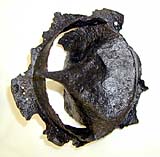
Trove of Teutonic weapons uncovered in Krusne Hory region - 09-02-2006 - Radio Prague: "It's not unusual in this country [Czechoslovakia] to come across weapons caches dating back to the Second World War. But, finding a pile of javelin tips, parts of shields and a sword dating back to the 2nd century A.D., doesn't happen every day.
'It is a remarkable find but not because of individual items but because of the number of items found,' archaeologist Lenka Onderkova explained. 'Germanic tribes regularly buried important warriors together with their swords, or spears, or bits of broken shield, but in this case what's unusual is the high number of items found at a single site. The number of objects found - and their variety in this case - is what makes this find important.'
'The only similar such find took place in Eastern Bohemia in the 1950s. But, it was not without controversy. To this day it has been a matter of debate whether that find was a destroyed burial site, or a place for sacrifice. There they found far less: for example just four spears compared to the eleven at Krusne Hory. The latest find could be truly unique.'
The Krusne Hory find certainly includes more items: twenty-two separate pieces including shield handles, pike tips, and an iron sword of typical Teutonic design. But, the find could have revealed more: archaeologists were reportedly upset - understandably- by the fact that the local who made the discovery not only removed the items from the area, but waited so ong to report his find. That complicated matters. Viewing the site and seeing the original positioning of the items, could have been invaluable, likely revealing more about the items' long-dead owners and the circumstances of their burial, than the weapons do on their own. Given the delay, archaeologists were no longer able to decipher, for example, why the items were originally placed in such a shallow grave.
On one thing specialists do agree: found at high altitude, far from the nearest settlement or the nearest river, this must have been a ritual burial site. A final, quiet resting place for Teutonic warriors."
Unfinished Maxentius Villa Puzzles Archaeologists
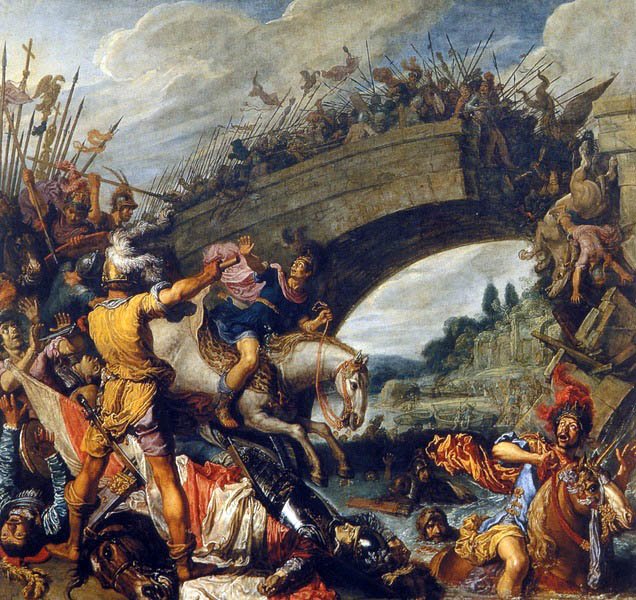
"Historians have long assumed that the reviled Roman emperor Maxentius lived part-time at an 80-acre suburban villa complex until he was killed by his rival Constantine at the Battle of the Milvian Bridge in A.D. 312.
But a University of Colorado-led archaeology team has uncovered evidence that the villa's main hall was never occupied.
Instead, it appears to have been abandoned before completion, said CU archaeologist Diane Conlin, co-director of the Maxentius project, a five-year excavation that began last summer.
'Maxentius builds a lot in Rome during his extremely short reign,' Conlin said. 'And the pattern - up to our project - is that Constantine either finishes the buildings and takes them over, or he demolishes them and builds something new.
'But this (villa) stands outside that pattern of behavior,' she said. 'Instead of being finished or demolished, it was abandoned.'
Marcus Aurelius Valerius Maxentius ruled Rome from A.D. 306 to 312, a time when the empire was in 'a holding pattern at the end of its period of greatness,' said CU historian Noel Lenski. Maxentius, son of the emperor Maximian, was in his 20s when he took power.
At the villa complex about two miles south of Rome's center and just outside the city's defensive walls, Maxentius built a chariot course with grandstand seating for 30,000 and monuments to his only son, Romulus. The boy was 9 when he drowned in the Tiber River, the same fate Maxentius met at the Milvian Bridge.
The day after that battle, Maxentius' armor-clad body was fished from the Tiber mud by Constantine's troops. His head was lopped off and displayed as 'an emblem of victory and conquest,' Conlin said.
Constantine reportedly had a vision of God the night before the battle and converted to Christianity on the spot.
But Maxentius was a pagan. Archaeologists wonder if his villa project on the Via Appia - the first and most well-known ancient Roman road - was an attempt to strengthen ties with Christians, Conlin said.
"One major question that we hope to answer is why Maxentius built this grand villa complex outside the defensive walls of the city when he had full control of pre-existing imperial palaces located in the heart of the capital," she said.
Limited investigations of the villa site were conducted in 1825 and again in the 1960s. Italian archaeologists exposed exterior walls but didn't dig into the interior of the large main hall, or basilica, Conlin said.
CU archaeologists and their colleagues sank two trenches in the main hall during a five-week field season last summer. Two more trenches will be opened in the basilica this summer. Twenty students from CU and Kalamazoo College in Michigan joined in the 2005 work.
After digging through modern garbage deposits and cemented chunks of architectural debris, the team reached the ancient basilica and found "a bare skeleton of brick and concrete," Conlin said.
A finished basilica from the period would feature stone mosaics on the floor and decorative marble slabs on the walls. The researchers found 800 pounds of marble fragments, but no piece was bigger than 12 inches by 6 inches. Instead of mosaic floors, they found only a brick subfloor.
"It seems like no one ever lived there," Lenski said. "It was 85 to 90 percent completed. It was the finishing touches that were left off."
The marble fragments suggest that bigger slabs had been installed but were later hauled away."
Thursday, February 02, 2006
Met to return antiquities looted from Etruscan tomb
"New York's Metropolitan Museum of Art today offered to return 20 artifacts in its collection to Italy, which says the ancient art was looted.
The disputed items include a 2,500-year-old vase painted by the Greek artist Euphronios, a 15-piece set of Hellenistic silver and four ancient pots.
The Euphronios vase is ``one of the finest existing examples of an Attic krater,'' a vessel used to mix wine with water, the Met's Web site says, referring to the museum's vase from Athens. It depicts a Trojan War scene from the Iliad in which Zeus's dead son, Sarpedon, is carried off the battlefield.
The talks with the Met are part of a broader push by Italian authorities to seize antiquities they say were illegally excavated or exported, including items at the J. Paul Getty Museum in Los Angeles, the Museum of Fine Arts in Boston, the Princeton University Art Museum in New Jersey, the Cleveland Museum of Art and others.
The disputed items include a 2,500-year-old vase painted by the Greek artist Euphronios, a 15-piece set of Hellenistic silver and four ancient pots.
The Euphronios vase is ``one of the finest existing examples of an Attic krater,'' a vessel used to mix wine with water, the Met's Web site says, referring to the museum's vase from Athens. It depicts a Trojan War scene from the Iliad in which Zeus's dead son, Sarpedon, is carried off the battlefield.
The talks with the Met are part of a broader push by Italian authorities to seize antiquities they say were illegally excavated or exported, including items at the J. Paul Getty Museum in Los Angeles, the Museum of Fine Arts in Boston, the Princeton University Art Museum in New Jersey, the Cleveland Museum of Art and others.
The Italian evidence for the Met's allegedly looted pots comes largely from the trial of Roman art dealer Giacomo Medici, who was convicted in December 2004 of smuggling objects that are now at the Met, Getty and other museums, Fiorilli said. Medici, 67, denies the charges and is free while appealing his conviction and 10-year prison sentence.
Prosecutors charge that Medici bought the Euphronios krater from tomb robbers who had excavated the pot in Cerveteri, near Rome."
Archaeologists unearth ancient Cretan tomb - Feb 2, 2006
CNN.com:A well-preserved underground tomb belonging to a prominent Roman-era family has been unearthed on the island of Crete, archaeologists said Wednesday.
The large first or second century A.D. structure beside one of the main gates to the walled city of Aptera was looted during Christian times, archaeologist Vanna Niniou-Kindeli said.
It still yielded a wealth of finds, including 10-inch pottery statuettes of the ancient Greek love deity Eros, glass and pottery vases and lamps.
Built of large stone blocks, the grave is reached by a flight of steps. It has an antechamber and a main room measuring three by two yards that was the site of four burials.
'These must have been highly important citizens, probably among the city's wealthiest, who had contributed to the common good of the city,' Niniou-Kindeli said. 'In return, they were buried in a prominent position so that whoever entered the city saw the grave.'
Archaeologists also discovered a small burial ground of newborns dating to the 4th century B.C., just outside the city walls."
The large first or second century A.D. structure beside one of the main gates to the walled city of Aptera was looted during Christian times, archaeologist Vanna Niniou-Kindeli said.
It still yielded a wealth of finds, including 10-inch pottery statuettes of the ancient Greek love deity Eros, glass and pottery vases and lamps.
Built of large stone blocks, the grave is reached by a flight of steps. It has an antechamber and a main room measuring three by two yards that was the site of four burials.
'These must have been highly important citizens, probably among the city's wealthiest, who had contributed to the common good of the city,' Niniou-Kindeli said. 'In return, they were buried in a prominent position so that whoever entered the city saw the grave.'
Archaeologists also discovered a small burial ground of newborns dating to the 4th century B.C., just outside the city walls."
Subscribe to:
Posts (Atom)