MSNBC - What lies beneath in PompeiiLast month, a team of archaeologists from Italy's Basilicata University uncovered the remains of a structure built by the Samnites, a mountain warrior people who conquered, inhabited, built up and ruled Pompeii before Roman chariots wheeled into town.
The diggers were looking for something else -- remains of Pompeii's harbor. Instead, they found a pre-Roman temple wall, clay offerings to the Samnite goddess of love, and a basin and terracotta pipes indicating the site of a ritual bath.
The Basilicata researchers were digging below Pompeii's surface because the focus of excavations had changed. For the past 250 years, most excavation has concentrated on the Roman city that was suspended in ash and stone by the eruption of Vesuvius in A.D. 79.
Until the 1990s, local officials believed constant discoveries from the Roman era were needed to keep Pompeii in the news and to preserve its spot as Italy's most popular tourist attraction.
But current administrators say this approach has become counterproductive, pointing out that they can barely afford to maintain the scores of monuments already exposed along Pompeii's lava-stone streets.
Pompeii's archaeological superintendent, Pietro Giovanni Guzzo, in office for a decade, decreed an end to the expansion of digs outward. He says digging down not only allows him to spend money on preserving the already exposed parts of Pompeii, but also is scientifically rewarding.
"By searching vertically, one uncovers the full history of the city. The surface Roman part is only part of the story," Guzzo said.
Wednesday, July 28, 2004


Monday, July 26, 2004
Polish excavation in Syria sheds new light on cult of Mithrae
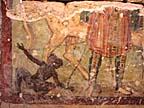 Polish excavation in Syria sheds new light on ancient cult: "Archaeologists used to believe the cult of Mithrae was born in the Middle East, that it had its roots in the Persian Zoroastrian cult and later spread to Europe. But a major archaeological discovery of a cave in Syria seems to suggest the opposite.
The small village of Hurrarte lies stranded in the middle of the Syrian desert. It is here that a few years ago a Polish excavation team unearthed a cave from underneath a Byzantine church. Its walls were covered with paintings dating to the Roman period - paintings such as a god cutting the throat of a bull, monsters being defeated by a beam of light and lions protecting the entrance.
These paintings appear to validate the theory that the cult of the god Mithrae existed in the Syrian desert.
'It is one of the rare examples of the worship of the god Mithare in the Middle East, it shows that this divinity is not linked to the Persian Zoroastre cult,' says archaeologist Michel Gawlikowski, director of the polish team, in a recent lecture at the American University of Beirut's Museum of Archaeology.
'Mithrae is always represented as a young male who is cutting the throat of a bull. He is here to revitalize nature and his worshippers, and not to impose a code of justice upon his followers, as was the case in Persian cults. Mithrae was mentioned in a Latin poem dating from the 1st century and it seems that this religion was made up by a Roman thinker who has merged Persian religion with the Hellenistic one and invented a new mythology,' says Gawlikowski."
Tuesday, July 20, 2004
Archaeologists uncover Roman bridge
"The ruins of the bridge, which would have once crossed the River Tynein Corbridge, Northumberland is being excavated by an archaeology team from the Tyne and Wear Museum. With the help of volunteers and trainees, who started work on the excavation two weeks ago, the team has already uncovered the spectacular scale and decoration of the bridge, which would have carried the main Roman road from London to Scotland.
Tyne and Wear Museums keeper of archaeology Margaret Snape said: "This is a very exciting project giving us the opportunity to uncover and display a spectacular example of Roman architecture and engineering. "
Tyne and Wear Museums keeper of archaeology Margaret Snape said: "This is a very exciting project giving us the opportunity to uncover and display a spectacular example of Roman architecture and engineering. "
Etruscan Exhibit Explores Ancient Cosmopolitan Society
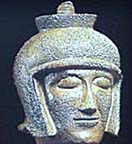 ETRUSCAN PROSPERITY was based on trade and the production of metals. To use a modern word, they were cosmopolitan. They had contacts throughout the Mediterranean. Consequently the Treasures from Tusacany exhibition is by no means only one of Etruscan art and artefacts. It reflects this cosmopolitan culture. There are Greek and Roman objects and Etruscan objects adapted from Greek and Roman originals. One of the most beautiful things here, for instance, is a vase painted by the great Athenian painter Polygnotus. When they bought abroad, the Etruscans clearly bought at the top end of the market. But they were no mere copyists. Their jewellery is exquisite. There are rings, earrings and necklaces in gold, worked with astonishing delicacy. They were masters in working bronze casting and there are also beautifully carved ivory plaques used for decoration. One of these shows two men reclining, enjoying a drink. Feasting was important, and it seems to have included men and women equally. The Etruscans lived in cities, but this is a landscape that has supported sophisticated urban life continuously for almost 3,000 years. You can’t dig up Florence to look for traces of its first inhabitants. The great majority of the precious objects on view here come from tombs, therefore, and so we see all this from the curious perspective of the rituals of death.
Monday, July 19, 2004
Livia Augusta regains her head
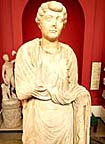 Caesar's wife statue made whole again: "A caesar's wife may have to be above reproach, but one of them lost her head centuries ago."
The head was found late in the 19th century by Sir Arthur Evans of Knossos fame. He swapped a top hat for two marble heads from a shrine to the cult of Augustus, at what is now a village but was once the important Roman city of Narona.
"In the 1990s, archaeologists of Croatia's national museum in Split re-excavated the site and found many statues, including the rest of Livia, from the wealthy shrine, which was deliberately destroyed when the area became Christian."
Thursday, July 15, 2004
Recreating Pompey for Modern Eyes
 Recreating Pompey for Modern Eyes: "In 55 B.C.E., Romans applauded the debut of the world's first modern entertainment complex, a mammoth structure constructed by Gnaeus Pompeius Magnus--better known as Pompey the Great, military conqueror and rival to Julius Caesar. The showy consul named the theater for himself. Today, using archaeology, three-dimensional modeling, virtual reality technology, and digital research, architecture experts are slowly raising the curtain on the Theater of Pompey. 'It's shockingly enormous,' says James Packer, a Northwestern University professor. 'The scale is just astonishing.'
Crowds of between twenty-five and forty thousand people flocked to see the latest spectacles played out on the 260-foot-wide stage. Modern sports fans would recognize the curved stadium seating, the barrel vaults, the VIP balconies--everything but the lack of advertising--and feel right at home.
Packer is directing the excavation of the theater as part of a research project begun in 1996 with Richard Beacham of the University of Warwick (U.K.). In 2002 Packer joined with archaeologist Cristina Gagliardo, architect Dario Silenzi, and engineer Massimo Aristide Giannelli to undertake the first excavation of the theater since 1865."
See also: The Theater of Pompey Project
Wednesday, July 14, 2004
Patara a gem of Roman ruins on Turkey's Turquoise Coast
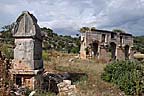 "Patara is a small village on the south-west Aegean coast of Turkey, known as the Turquoise Coast, and is famous for having one of the longest beaches in the Mediterranean. Its 18km of sand provides plenty of raw material for armies of children to build metropoli of sandcastles, as well as a nesting place for turtles, which between June and August emerge at night to lay their eggs in the sands.
Patara is said to be the birthplace of Apollo and, when the Roman empire was at its height, it was one of the most important harbours in the western Mediterranean, sheltering ships from all over the ancient world. You can still find the remains of merchants' bath-houses, their roofs open to the skies. Fallen Porphyry columns lie beside the largest avenue that the Romans ever built.
Most atmospheric of all, though, is Patara's Roman amphitheatre. Once it seated 10,000 citizens, now half of it lies buried under an enormous sand dune. Shelley could have had this place in mind when he wrote his famous sonnet, Ozymandias - 'Round the decay/Of that colossal wreck, boundless and bare/The lone and level sands stretch far away'."
Roman Fort still visible at The Dip near Felixstowe
"Felixstowe has a rich Roman history - and the remains of a shore fort at The Dip, where seaweed-topped rocks can still be glimpsed at low tide.
The fort was built in 296 AD. It was of oblong construction and stood on low cliffs on a coastline which at that time was mainly saltmarsh and pocked with inlets. Its promontory was eventually eroded and it collapsed into the sea.
It housed about 100 soldiers whose route across the peninsula was a rough track - the forerunner of the A14 - and there have been a number of finds of coins and other items in the area over the years."
The fort was built in 296 AD. It was of oblong construction and stood on low cliffs on a coastline which at that time was mainly saltmarsh and pocked with inlets. Its promontory was eventually eroded and it collapsed into the sea.
It housed about 100 soldiers whose route across the peninsula was a rough track - the forerunner of the A14 - and there have been a number of finds of coins and other items in the area over the years."
Monday, July 12, 2004
Rare 3rd Century Roman Cup to be Auctioned
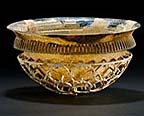 "About 1,700 years ago, one of the Roman empire's wealthier citizens commissioned an extraordinary piece of craftsmanship from a glassmaker working somewhere in the eastern Mediterranean. Months of painstaking work turned a single thick piece of colourless glass into a delicate 4in-high cup connected by slender bridges to a surrounding network cage. Just one mistake by the craftsman at any stage would have destroyed this fragile masterpiece.
The cage-cup was probably not a drinking vessel but was instead used as a hanging lamp filled with clear oil and placed high up in one of the rooms of its owner's home, where it cast an intricate shadow on to the walls."
Friday, July 09, 2004
Remains of Samnite Temple Unearthed in Pompeii
"The discovery in Pompeii of a pre-Roman temple is being hailed as evidence that the city was sophisticated and thriving 300 years before Vesuvius erupted. The temple is said to be of Mephitis, a female deity worshipped by the Samnites, a mysterious ancient people who preceded the Romans in Pompeii.
The temple complex includes a sanctuary where it is thought girls from good families worked briefly in 'sacred prostitution' as a rite of passage to full womanhood."
The temple complex includes a sanctuary where it is thought girls from good families worked briefly in 'sacred prostitution' as a rite of passage to full womanhood."
Time Team Find Remains of Roman Era Child in Worksop
"A TWO-thousand-year-old child's skeleton has been found in a 'time team' dig at Worksop - hailed as one of the most significant archaeological finds in the region for years.
The child was still adorned with bangles and bracelets, and is believed to be from a high-ranking Iron Age tribe which flourished during the Roman occupation.
"It is impossible to say at this stage if it was a boy or a girl or what the cause of death was," said Ursilla Spence, senior archaeologist for Nottinghamshire County Council. "But we do know this was a 'high status' burial because of the objects that were buried with the body."
Also clear is the Roman influence on the burial - the Romans would have buried children and old people close to their homes so they could still be 'part of the family'.
The dig has discovered that the tribe living on the site probably had close links with the Romans and traded in what would have been the luxury goods of the period.
Remains of an imposing entrance to the compound have been unearthed - but the experts have been baffled by evidence that suggests the area was later cleared and abandoned."
The child was still adorned with bangles and bracelets, and is believed to be from a high-ranking Iron Age tribe which flourished during the Roman occupation.
"It is impossible to say at this stage if it was a boy or a girl or what the cause of death was," said Ursilla Spence, senior archaeologist for Nottinghamshire County Council. "But we do know this was a 'high status' burial because of the objects that were buried with the body."
Also clear is the Roman influence on the burial - the Romans would have buried children and old people close to their homes so they could still be 'part of the family'.
The dig has discovered that the tribe living on the site probably had close links with the Romans and traded in what would have been the luxury goods of the period.
Remains of an imposing entrance to the compound have been unearthed - but the experts have been baffled by evidence that suggests the area was later cleared and abandoned."
Tuesday, July 06, 2004
Florida State Professor Hunts for Roman-era Pirate Ships
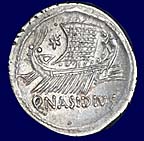 Florida State professor hoping to find Roman-era pirate ships: "When the Roman Empire got tired of pirates terrorizing shipping lanes and nearly bringing the known world's trade to a halt, it went after them hard.
With 120,000 men and 270 ships it reportedly took the Roman general Pompey just 40 days to locate and wipe out the ships and crews that were preying on shipping.
It has taken much, much longer for modern scientists to again find the pirates of the Mediterranean.
But Cheryl Ward, an anthropology professor at Florida State University, hopes she's on the verge of rediscovering the ships of the pirates, a thorn in the side of the Romans 2,100 years ago who now may help provide a unique window on what the larger world looked like in late antiquity.
Ward and her colleagues are hoping to paint a picture of a different class of people from those we know lots about - adding to what we know about the Roman Empire. Much of our knowledge comes from what the educated, wealthy Romans left us in the way of writing and artifacts.
But the pirates were the underclass - the rest of the story."
See also: The Rough Cilicia Maritime Survery Project
Friday, July 02, 2004
Roman Lead Sarcophagus Returned to Syria
: "A decorated fragment of a lead sarcophagus (or coffin) dating from the Roman period has been returned to the Syrian National Museum, thanks to the efforts of experts at Newcastle University's Museum of Antiquities.
The small fragment, which was brought into the University's Museum of Antiquities by a Newcastle resident, dates to the period between the 2nd century BC and the 2nd century AD.
Months of detective work followed, which eventually led to the island city of Aradus on the Ile d'Arwad, off the coast of Syria, a site with a complex Phoenician and Roman history."
The small fragment, which was brought into the University's Museum of Antiquities by a Newcastle resident, dates to the period between the 2nd century BC and the 2nd century AD.
Months of detective work followed, which eventually led to the island city of Aradus on the Ile d'Arwad, off the coast of Syria, a site with a complex Phoenician and Roman history."
Plundered Byzantine antiquities to be returned to Cyprus
Plundered antiquities head home: "HUNDREDS of Byzantine icons, mosaics, and artifacts valued at $52.4 million plundered from Cyprus almost 30 years ago and smuggled to Germany by thieves to sell on the black market will be returned, a German judge has ruled.
The artifacts, recovered during a sting operation in 1997, were looted from Greek Orthodox churches and museums in northern Cyprus in the chaos during the 1974 Turkish invasion of the island, Judge Hanreich said.
They include religious icons, wall paintings and ceiling mosaics - invaluable examples of early Christian art."
The artifacts, recovered during a sting operation in 1997, were looted from Greek Orthodox churches and museums in northern Cyprus in the chaos during the 1974 Turkish invasion of the island, Judge Hanreich said.
They include religious icons, wall paintings and ceiling mosaics - invaluable examples of early Christian art."
Tuesday, June 29, 2004
Portchester Castle Reveals Roman Origins
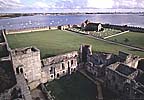 "Archaeologists working at Portchester Castle believe they have discovered evidence that it was once a Roman trading port.
Topographic and geophysical surveys of the ancient site have revealed a number of previously uncharted structures dating from Roman, Saxon and medieval times. "
In the outer bailey features were discovered that relate to the Roman, Saxon and medieval periods of the site. Between the inner and outer ditches possible remnants of the Roman fort and a number of medieval and post-medieval structural features were detected.
Portchester’s outer defences incorporate the well-preserved remains of a Roman fort. It is thought to have been established between AD 285 and 290 by Marcus Aurelius Carausius who was instructed by the Emperor Diocletian to clear the seas of pirates.
Roman Villa Unearthed in Shillingstone
"Archaeologists yesterday revealed they have unearthed a huge Roman villa and may have even identified who owned it. They believe the villa, in the heart of the Dorset countryside, was owned by a rich and important native Roman called Anicetus.
He was mentioned by Roman historian Tacitus who said that he possibly donated money to the Roman army.
The luxury residence was erected in the fourth century and fell into disrepair when the Romans left Britain in the fifth century. The two-storey villa was well built and included a bath house, central heating and mosaic floors."
I do hope they at least remove the mosaics before covering the site with new construction. It's always a pity when a mjor site cannot be preserved in situ.
He was mentioned by Roman historian Tacitus who said that he possibly donated money to the Roman army.
The luxury residence was erected in the fourth century and fell into disrepair when the Romans left Britain in the fifth century. The two-storey villa was well built and included a bath house, central heating and mosaic floors."
I do hope they at least remove the mosaics before covering the site with new construction. It's always a pity when a mjor site cannot be preserved in situ.
Monday, June 28, 2004
Byzantium 1200
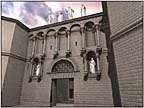 OLD GOLDEN GATE: "After the Theodosian land walls had been built, the wall of Constantine quickly fell in ruins. The only part of it that is known to have survived for a longer time is the old main or Golden Gate, that survived until the ottoman time and was destroyed by a earthquake only in 1509. The medieval name (H)exakionion means 'with six columns'; it suggests that the gate was similar to the Golden Gate of Diocletian's palace in Split and had a upper storey decorated with six columns and niches in between on the outer side. In the last centuries of the Byzantine Empire, this upper storey apparently was used as a funerary chapel, and parts of the building decorated with frescoes. "
I found this spectacular website while checking a reference for Constantine. The 3D architectural renderings of the structures of Byzantium reflect thousands of hours of research and design. I was also impressed by the digital portraits of Constantine and Justinian. I have written to the artist to ask if he would share information about the software and techniques used to create them. Their eyes and skin are so life-like. Justinian even has the stubble of a beard.
Pentecost brings rose petals to the Pantheon
 "Every year during the Pentecost Mass, two or three firemen climb the huge lead-covered rings of the Pantheon's dome with huge sacks of rose petals, which they empty over the edge of the oculus to shower slowly, spectacularly down into the rotunda."
This image sounds so beautiful but unfortunately I could not find an actual picture of the Pentecostal service at the Pantheon with Google's image search. The article also mentions the 22 Roman drains that serve to carry away the rain that falls through the oculus. I thought the drains appeared quite elegant themselves.
I also found a poem by Byron about the Pantheon:
"Simple, erect, severe, austere, sublime Shrine of all saints and temple of all Gods, From Jove to Jesus spared and blessed by time, Looking tranquillity, while falls or nods Arch, empire, each thing round thee, and man plods His way through thorns to ashes glorious Dome! Shalt thou not last? Time's scythe and tyrants' rods Shine upon thee—sanctuary and home Of art and piety—Pantheon! Pride of Rome!"
and other interesting information at this website:
http://www.oldandsold.com/articles10/famous-buildings-12.shtml
Friday, June 25, 2004
Fragments of Roman armlets found in dig
Fragments of Roman armlets found in dig: "Fragments of two glass armlets, dating back to the Roman era, have been discovered during an archaeological dig at Knowes Farm near East Linton.
The remains of several circular Iron Age houses with stone-flagged floors, apparently belonging to the latest period of occupation, have also been uncovered."
The remains of several circular Iron Age houses with stone-flagged floors, apparently belonging to the latest period of occupation, have also been uncovered."
New Archaeological findings in Palmyra
A French archaeological team has discovered skeletons buried in wooden coffins dating back to the Byzantine age near the Dora Ourbos gate. Two clay lanterns and a sculptured head of a Palmyran young man dating back to the same period were also discovered.
Head of the French archeological team, Dr. Christina Dablablas said the area is rich in artifacts, a legacy of thousands of years of human settlement. The team's findings will join the collection of religious and funerary art at the Palmyra Museum.
Head of the French archeological team, Dr. Christina Dablablas said the area is rich in artifacts, a legacy of thousands of years of human settlement. The team's findings will join the collection of religious and funerary art at the Palmyra Museum.
Subscribe to:
Posts (Atom)