Dig uncovers a Roman bath house: A Roman bath house thought to be part of a large villa has been found by archaeologists digging on a building site in Maidstone.
In a month working on the site the archaeologists have uncovered parts of two sunken rooms - a plunge bath and a steam bath.
They have also found footings outlining a small suite of heated and unheated rooms, drainage ditches, pottery, mosaic fragments and painted plaster.
Beneath the villa a series of Iron Age ditches have been discovered, thought to be associated with a pre-Roman farmstead."
Tuesday, June 15, 2004


The Daily Star - Arts & Culture - What to do when you stumble onto a Roman 'city of the dead'? Call in the antiquities cops
 What to do when you stumble onto a Roman 'city of the dead'? : "On a site in Gemmayzeh, Lebanon archaeologists have found the remains of 20 skeletons, buried in sand with funerary deposits consisting of small ceramic perfume bottles.
'This was the ritual at the time,' explains Assaad Seif, an archaeologist who was educated at the Lebanese University and the Sorbonne in Paris, and has been working with the DGA since 1996. 'On the analysis and interpretation level, this is what's interesting. ... The information (we have) comes from Pompeii, from texts. Archaeology helps us in Lebanon to discover the things not written, the traditions with local sub-traditions. Burial customs are not the same everywhere. There are small changes in the mainstream.'
In addition to the skeletons, Seif believes that the marble column found on the site belongs to an important structure, perhaps a mausoleum, which has yet to be fully discovered. 'Usually in Roman cities,' he says, speaking about a pattern of ancient urban development he's witnessed in such Lebanese cities as Tyre, where 'the cities of the dead are usually found off the eastern entrance of the city. A necropolis can remain so for thousands of years. When the city grows, it builds over it.'"
Ancient bowl found in second-hand shop - (United Press International)
Ancient bowl found in second-hand shop - (United Press International): "A Norwegian archeology student found an ancient Roman glass bowl in a second-hand shop and was able to buy it for less than 1 percent of its real value.
Espen Kutschera saw the bowl, which is about 1,900 years old and from the Roman Empire, at a store called Fretex and bought it for $15, the Bergensavisen newspaper reported Friday.
Experts put the bowl's real value at $7,500."
Espen Kutschera saw the bowl, which is about 1,900 years old and from the Roman Empire, at a store called Fretex and bought it for $15, the Bergensavisen newspaper reported Friday.
Experts put the bowl's real value at $7,500."
Haaretz - Israel News - Priceless Byzantine artifact stolen from archaeological park
Haaretz - Israel News - Priceless Byzantine artifact stolen from archaeological park: "A priceless 1,500-year-old Byzantine-era artifact was stolen early yesterday from an archaeological park near Herzliya, police said.
The thieves took a part of the floor of a glass kiln, one of only three still in existence in Israel. Police suspect the theft had been commissioned by a private antiques collector.
'This was a part of the glass kiln that served the Byzantine city of Apolonia 1,500 years ago,' said archaeologist Hagi Yohanan, director of the Apolonia park built over the ruins of the city.
Following the 4th century split in the Roman empire, the Holy Land came under the rule of Christian Byzantine, until it was conquered by the Arabs in 636. Archaeologically, the period is noted for the building of many monasteries and churches across the country."
Some Roman Britons may be descended from Africans
"Archaeologists say there is compelling evidence that a 500-strong unit of Moors manned a fort near Carlisle in the third century AD. Writing in the journal British Archaeology, Mr Benjamin describes a fourth century inscription discovered in Beaumount, two miles from the remains of the Aballava fort at Burgh by Sands. The inscription refers to the "numerus of Aurelian Moors" - a unit of North Africans, probably named after the emperor Marcus Aurelius.
The unit is also mentioned in the Notitia Dignitatum, a Roman list of officials and dignitaries. It describes the prefect of the "numeri Maurorum Aurelianorum, Aballaba".
The unit was probably mustered in the Roman province of Mauretania, in modern-day Morocco, by the emperor Septimus Severus and arrived in Britain in the second or third centuries AD. Aballava lay at the western end of Hadrian's Wall in Cumbria."
Roman 'industrial estate' found
"Experts who unearthed the best preserved example in Wales of a medieval track, have now found what they believe is the equivalent of a Roman 'industrial estate.'
"We think we're starting to uncover an example of a Roman industrial site that probably did some sort of smelting because there are examples of charcoals and other heavily burnt items, said Project manager Nigel Page, of Cambria Archaeology."
"We think we're starting to uncover an example of a Roman industrial site that probably did some sort of smelting because there are examples of charcoals and other heavily burnt items, said Project manager Nigel Page, of Cambria Archaeology."
Pergamon Altar's Frieze Restored
 "After a decade of painstaking cleaning, Berlin's Pergamon Museum has unveiled the restored marble frieze of the Pergamon Altar, the second century B.C. centerpiece of its collection. The 371 foot-long frieze decorated the outside walls of the altar, which was built between 197 and 156 B.C. in the present-day Turkish town of Bergama.
A German engineer discovered fragments of the frieze, which had been taken apart and incorporated into the walls of a fortress, in 1864. It displays mythological scenes of gods fighting giants, snarling lions and coiling snakes, with the muscular bodies of Artemis, Zeus and Athena clad in delicately sculpted folds of fabric. "
Tuesday, May 25, 2004
Pioneering archaeological research charts African links with the Roman world
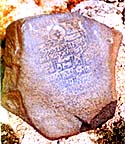 "University of Southampton archaeologists Professor David Peacock and Dr Lucy Blue have just returned from a pioneering expedition investigating Roman sites in the East African country of Eritrea alongside colleagues from the University of Asmara. The University group is the first from the UK to work in the country since it won its independence more than a decade ago.
British involvement in the area has a long history. In 1868 General Napier landed his troops near Adulis in a daring bid to rescue British hostages held by Emperor Theodore at his fortress of Magdala, now in Ethiopia. Napier built a landing stage and a railway to transport troops and equipment to the interior, and traces still survive on the coast 6 km to the east of Adulis. Archaeologists from the British Museum, who accompanied the army, excavated a church at Adulis, which can still be seen in a ruinous state."
See also: Eritrea Ruins of History
Thursday, May 20, 2004
Algorithms from the Human Genome Project used to piece together ancient Roman Map
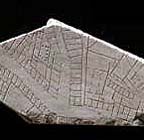 "It's the world's oldest and largest jigsaw puzzle - an ancient map of Rome in 1,200 fragments of marble. Archaeologists for centuries have tried to painstakingly piece together the sculpture, fragment by fragment. Now, computer wizards at Stanford University say they have created a software program that holds the key to the puzzle and the ancient city.
At the heart of the program are three-dimensional scans of the fragments and algorithms to find possible matches. Already the work has produced several dozen probable and possible matches.
'They've advanced farther and faster in the last months than we have in centuries,' said Roman archaeologist Margaret Laird, a visiting lecturer at the University of Chicago. 'These new matches are going to change a lot of what we know about the city of Rome.'
The undertaking is a five-year study conducted by Marc Levoy, an associate professor of computer science and electrical engineering at Stanford, to be completed by the summer. The findings and interactive 3-D models of the fragments are online, allowing scholars as well as elementary-school students unprecedented access to the monument."
Hopscotch: A Roman invention
On our imperial Rome discussion list we have been talking about how the Roman legions had to maintain a high level of physical fitness. So I found this item particularly interesting:
HOPSCOTCH: The Romans introduced Hopscotch to Britain. Their soldiers had to hop up and down along a 100ft court in their full armour to improve their footwork. Children copied this as a game and introduced scoring. Romans also played ball games, and had building blocks, swings and kites.
Apparently, the Romans also played marbles and may have adopted yo-yos from the ancient Greeks as well:
MARBLES: The earliest marbles were made of flint and clay, and in some cases marble, and date back as far as Ancient Egypt and Rome. The Venetians were the first to make glass marbles and the Germans began to mass produce them in the 19th century.
YO-YOs: Yo-Yos are the second oldest known toy. In ancient Greece they were made of terracotta, wood and metal and decorated with the pictures of the gods. As a rite of passage adult Greeks used to give up their childhood toys and place them on the family altar.
Thursday, May 13, 2004
Yale Acquires Roman Coin Collection
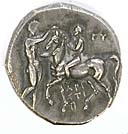 "Yale University Art Gallery has acquired a collection of 4,100 coins of Greek and Roman origin. The collection was established over a period of forty years by Peter R. Franke, formerly Professor of Ancient History and Numismatics and head of the Institute for Ancient History at the University of Saarbrucken, Germany. Franke was mentor to many of the numismatists on staff at various collections throughout Europe, and taught until recently at the Institut fur Numismatik in Vienna. He is well-known as the author of a number of specialized monographs as well as introductory treatments of coinage. Although it covers the entire Mediterranean basin, the principal focus of the collection on Greek coins of the Roman period, which were produced at individual cities to meet local currency needs. "I am delighted that my collection has been acquired by Yale," said Professor Franke, "since I know that there the coins will be employed for teaching as well as research, and my work will be continued."
William E. Metcalf, who was appointed the first curator of coins and medals at the Yale Art Gallery in 2002 as well as adjunct professor of Classics, remarked, "Franke did not collect just to fill gaps in his holdings, every coin has a reason for being there. For the art historian, there are continuous streams of imperial portraits from various regions of the Roman Empire; for the historian there is evidence of local cults and magistrates, as well as representations of local buildings and such customs as games and religious festivals."
Tuesday, March 30, 2004
Archaeologists Locate Ancient Indo-Roman Trading Site
"Striking archaeological evidence suggests that the legendary seaport of Muziris, which was a bustling Indo-Roman centre of trade during the early historic period between the first century BC and the fifth century AD, could have been located at Pattanam, near Paravur on the south of the Periyar rivermouth.
What led Dr. K.P. Shajan, geoarchaeologist, and his team to Pattanam was clear geological evidence which suggested that the river Periyar had shifted its course from the south to the north over the millennia. A branch of the Periyar, called the Periyar Thodu, runs close to Pattanam and satellite imagery indicates that the Periyar delta lies on the southern side and the river could have flowed close to Pattanam about 2,000 years ago. This would place the ancient site alongside the Periyar in keeping with the descriptions in literary sources.
The site covers an area of about 1.5 sq km and the deposit is about two metres thick. It has produced fragments of imported Roman amphora, mainly used for transporting wine and olive oil, Yemenese and West Asian pottery, besides Indian rouletted ware common on the East Coast of India and also found in Berenike in Egypt. Bricks, tiles, pottery shards, beads and other artefacts found at Pattanam are very similar to those found at Arikamedu and other early historic sites in India.
The most striking finds from Pattanam are the rim and handle of a classic Italian wine amphora from Naples which was common between the late first century BC and 79 AD, when pottery production in the region was disrupted by the eruption of Mt. Vesuvius. Islamic glazed ware from West Asia indicate that the site remained active beyond the early historic period.
Monday, March 22, 2004
1st and 2nd Century Artifacts Recovered in Naples
"750 Artifacts including 22 high-quality marble and terracotta artefacts from the 1st and 2nd centuries a.C., probably belonging to patrician families from Pozzuoli and Baia who lived in the Roman Empire era, have been recovered by police in Naples. Some of the 350 terracotta artefacts from Cales dating back to the 1st and 2nd century A.C. are still covered in soil. 'These finds have an incredible value - says Paolo Caputo, head of the police archaeology department for Naples and Caserta."
Wednesday, February 25, 2004
Ancient Tiberias to rise from the ruins
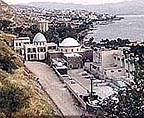 "From the vestiges of an old quarry, piles of rock, weeds, and a sewage treatment plant, a whole city will rise over the next 10 to 15 years. The theater will host performances, couples will stroll the main street, and the magnificent mosaics will be a sight for the sore eyes of visitors from afar. "
Tiberias was founded in 20 C.E. and its Jewish community continued in existence until the 11th century. At its height, from the 3rd to the 8th century, some 25,000-30,000 people lived there. According to Hirschfeld, "the city was full of life, with crowded streets, a busy fishing port and a market for the entire Galilee." Tiberias served as a spiritual and political hub for the Jewish people, as well as a center for halakha (Jewish religious law).
By the end of the 4th century, Tiberias also became a center of Christian pilgrimage. Professor Yizhar Hirschfeld of Hebrew University's Institute of Archaeology, director of the excavation, said, "This is one of the most beautiful sites in the world, of the greatest significance for Jewish history. Few other sites in the Roman Empire were more important."
Hirschfeld spoke of the markets and the bathhouse, which figured prominently in the sayings of the ancient Jewish sages, where "wise men would sit and spin tales." He showed the location of the basilica in which the Sanhedrin had its headquarters; the city's walls and its theater; the study house and the beautiful mosaics of the synagogues.
See also Tiberias
Tuesday, February 24, 2004
Second Roman Coin Featuring "Emperor" Domitianus Found
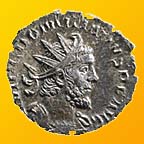 "A man with a metal detector has unearthed a Roman coin so rare it bears the face of a mystery emperor who ruled Britain for a matter of days.
Brian Malin, a father-of-one from Oxfordshire, unearthed the bronze coin in a field in Oxfordshire bearing the face of Emperor Domitianus.
It is only the second coin in existence to bear the image of the self-proclaimed ruler of Britain and France in 271AD.
A similar coin was found in France 100 years ago but until now its uniqueness had meant both Emperor Domitianus and the coin were dismissed as a hoax.
Historians say the British discovery confirms the French find is genuine and Domitianus existed.
They believe he was an upstart from the Roman legion who was ousted for treason for daring to declare himself emperor and have the coins made."
Richard Abdy, Roman coin curator at the British Museum, said: "The Roman empire was beginning to fray. Domitianus, it looks, ruled in 271AD, he was the penultimate emperor and there was only one coin with his image."
"There have been references to Domitianus in two ancient texts but they described him as an officer who had been punished for treason."
Domitianus probably ruled Britain for only days which would explain why only two coins bearing his image exist, said Mr Abdy.
Friday, February 20, 2004
Classical Scholars Aghast at Plans to Restore Ancient Rome
"A 78-year-old Italian professor of architecture, Carlo Aymonino, has been entrusted by the city's mayor with redesigning the area around the Roman forum - once dominated by a soaring, white marble temple.
Part of the professor's plan is to restore the ancient Coliseum
His plan is to do away with the modern road leading to the Coliseum, the ancient Roman amphitheatre where gladiators once fought wild animals - and each other - to entertain the crowds.
The modern road, built by Mussolini, covers many important ruins.
Professor Aymonino also proposes to fill in the missing part of the outer wall of the Coliseum with red brick.
He wants to clean out the weeds and the rubble nearby and to reconstruct part of the temple of Jupiter - which formed the heart of ancient Rome - adding a transparent dome amid the ruins. "
Antonine Wall's "Fields of Lilias" Nothing to Sneeze At
"Excavations of the 38-mile Antonine wall at Mumrills Fort, near Falkirk, have revealed evidence of the Romans' defensive structures, which were designed to cause the maximum damage to attackers, and even the daily cooking routines of foot-soldiers.
Archaeologists have discovered that the frontier, which briefly supplanted Hadrian's wall in the second century AD, was lined with pits filled with stakes which may have been dotted with sharp objects such as glass.
Similar fortifications, known as lilia because they apparently reminded Romans of lilies, are shown on Trajan's column in Rome and were described by Julius Caesar in the Gallic Wars, his description of one of his own campaigns.
Geoff Bailey, keeper of archaeology and local history at Falkirk Museum, said: 'We have now found these lilia on eight separate occasions and it looks like they will have gone along the whole 38 miles of the wall. They are another part of the defensive system which had never been discovered before. The Romans would have had the ditch, the wall and these lilia, which you could call the ancient Roman equivalent of the minefield.
'The Germans had similar structures called wolf pits in the first world war, and they were used relatively recently in the Vietnam war where they were smeared with animal fat, so that any injury inflicted would become infected.
'
We just don't know if the Romans did something similar here, but they provided an extra obstacle for people moving north to south and channelled people into the heavily guarded gateways where they could be easily controlled.'
Roman Coin Hoard Found in Bulgaria
"A total of 800 golden Republican-period coins dated from the period of II-I century B.C. as well as some Roman denars dated from the I century B.C. have been uncovered by Bulgarian archaeologists during excavations in the Lozyata region near the Pokraina village.
The northern Bulgarian region of Vidin has a rich ancient history as several ancient finds have already been excavated there. Different ancient ceramic works that are still to be studied and a cooper age village disclosed near the Antimovo village are among the numerous finds in the region."
The northern Bulgarian region of Vidin has a rich ancient history as several ancient finds have already been excavated there. Different ancient ceramic works that are still to be studied and a cooper age village disclosed near the Antimovo village are among the numerous finds in the region."
Ancient Infants May Have Been Fed With Cow's Milk
Yorkshire Today:
Molecular-level examinations of 2,000-year-old bones from the Wetwang burial site, near Driffield, East Yorkshire, have produced puzzling results, leading scientists to speculate that ancient people were even more concerned about food taboos than we are today.
Mandy Jay, of Bradford's archaeology department, has examined the bones of more than 50 adults and 25 infants, analysing isotopes of carbon and nitrogen in the collagen to see what kind of proteins the Iron Age people ate.
All the adults, from wealthy warriors interred with chariots in burial mounds to paupers buried in ditches, seem to have eaten plenty of animal protein, which produces the same type of collagen, whether dairy or meat.
That should mean bones of breast-fed infants would have even higher protein levels, as they would be drinking milk from mothers who were themselves nourished with animal proteins.
But instead, babies' bones have levels comparable with a diet of cows' milk.
Ms Jay said: 'It may be a society where they didn't want to breastfeed too long because they wanted to toughen the children up.
'If they were trying to feed their children cows' milk, the chances are they would have a higher mortality rate, which is something I would have to examine.'
Alternatively, the low levels could also be due to women becoming vegan when pregnant or breastfeeding. A temporary change in diet wouldn't show up in the women's bones, as adult collagen is laid down over several years.
"It's very difficult to understand what a different society would think. To them, drinking milk while producing milk may have seemed strange. There are societies that do all kinds of things with pregnant and menstruating women," she said.
Thursday, February 19, 2004
Etruscan-style statue uncovered in France
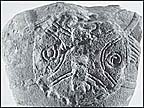 "A life-sized statue of a warrior discovered in southern France reflects a stronger cultural influence for the Etruscan civilization throughout the western Mediterranean region than previously appreciated.
Michael Dietler, Associate Professor in Anthropology, and his French colleague Michel Py have published a paper in the British journal Antiquity on the Iron Age statue, found at Lattes, a Celtic seaport Dietler is studying in southern France.
They found the fine-grained limestone statue in the door of a large courtyard-style house they are excavating in the ancient settlement, which is five miles south of the modern day city of Montpellier. The statue dates from the sixth or early fifth century B.C. "
Subscribe to:
Posts (Atom)