Tuesday, February 28, 2006

Phoenician temple found in Sicily


ANSA.it : "An ancient Phoenician temple unearthed in Sicily is 'unique' in the West, the head of the Italian dig team claims .

'You have to go all the way to Amrit in Syria to find a similar one,' said Lorenzo Nigro of the Rome University team .

The temple came to light last year after a portion of a lagoon surrounding the Phoenician city of Motya (present-day Mozia) was drained .

The pool began to fill up again and a fresh-water spring was found - a fact Nigro believes proves it was used as a holy place.

'The Phoenicians placed their cities on the coast near water springs, which for them meant that there was a divine presence there.' Digs at the site, on the westernmost tip of Sicily near Marsala, have brought to light the ruins of a 'monumental' temple including columns of a type used by the Phoenicians on Cyprus - as well as fragments of an obelisk .

'The similarity with the Temple of the Obelisks at Byblos, Lebanon, is clear,' Nigro said .

Nigro believes the pool flanking the temple was used for water rituals and offerings to Baal, the Phoenician god of the sea and the underworld .

However, other Italian archaeologists do not agree with him .

'The pool is without doubt merely a dock used for repairing ships,' said Sebastiano Tusa of Naples University, head of marine archaeology for the Sicilian regional government .

Motya - whose name means 'wool-spinning centre' - was founded in the 8th century BC, about a century after the foundation of the most famous Phoenician colony in the ancient world, Carthage in Tunisia ."

Thursday, February 23, 2006

G-String-Clad Gladiator Found


Somehow I missed this interesting little tidbit a couple of months ago.

Discovery Channel: "Divers exploring a river near a former Roman Empire fort and settlement in Britain have found a piece of pottery that depicts the backside of a rather buff gladiator wielding a whip and wearing nothing but a G-string, according to British researchers.

The image represents the first known depiction of a gladiator in such revealing attire. It adds to the evidence that ancient Romans viewed gladiators not only as fearless warriors, but also as sex symbols.

Philippa Walton, who analyzed the object and is a finds liaison officer for the Cambridgeshire County Council, described the artifact to Discovery News. 'The find is a small shard of pottery possibly from a drinking beaker made in Britain in the 3rd century A.D.,' Walton said. 'It depicts a man wearing a G-string and possibly holding a whip and is likely therefore to represent a gladiator.'

"A lot of film stars and celebrities like to show a bit of bum, so the Romans were no doubt the same or worse," Rolfe Hutchinson told Discovery News. He discovered the object with diving partner Bob Middlemass. "After all, they were the celebrities of the day."

The ancient Romans may have relished such dramatic displays of beefcake and power, but they also could be quite practical.

Near the site of the pottery shard, Hutchinson and Middlemass also found a copper razor handle, dating to approximately the same period. The handle was modeled into the shape of a Roman soldier leg and foot, the two-inch-high foot wearing a heavy wool sock stuffed into a sandal."

Fair fight: research shows gladiators played by rules

World - smh.com.au: "GLADIATORS of the Roman arena fought according to their own brutal version of the Queensberry Rules, new research suggests.

Forensic tests on the remains of 67 gladiators from a cemetery in Turkey show the fighters stuck to strict rules of combat, just as modern boxers must follow the Queensberry guidelines, introduced in 1867.

Savage violence and mutilation, typical of battlefields at the time, was not the order of the day in the arena. Death for the vanquished was relatively swift and merciful.

The research also challenges the view of some experts that gladiatorial combat was a form of spectacular martial art that only rarely ended in death, as the fighters seldom fought until one of them died.

The latest evidence shows wounded participants were often given the coup-de-grace by a backstage executioner, delivered with a hammer blow to the head.

Although most gladiators wore helmets, 10 had died of a squarish hammer-like injury to the side of the head.

It is likely these injuries were inflicted after the fight - possibly by a backstage executioner who struck the doomed victim's head, as has been suggested in artworks and literature."

I found this latest conclusion a bit puzzling. The Discovery Channel produced a program about the excavation at Ephesus and the scientist interviewed attributed the small square head wounds apparently delivered when the victim was not wearing a helmet to a trident used on a hapless retiarius whose opponent had killed him with his own weapon. They even showed how the holes matched the penetration pattern of an ancient trident. Of course, it does make one wonder when they find ten of such victims in one dig. Maybe that ludus had a very poor retiarius trainer!

Wednesday, February 15, 2006

Hadrian's Villa yields Staircase and Sphinx in Tivoli

Having just visited Hadrian's Villa last spring, I found this article particularly interesting. Hadrian's sprawling complex covers at least 250 acres and may encompass over 650 acres, much of it as yet unexcavated. I wonder what other fantastic discoveries await?

ABC News: "A theatrical mask is seen during a presentation to the press of new findings from a dig at Hadrian's Villa in Tivoli, near Rome, Tuesday, Feb. 7, 2006. Archeologist who have been digging for more than a year at the villa got their reward, unearthing a monumental staircase, a statue of an athlete and what appears to be a headless sphinx. The findings were presented Tuesday by government officials, who described them as extremely important for understanding the layout of the ruins. The staircase is believed to be the original entrance to the villa, which was build for the Roman emperor in the 2nd century A.D. So far, 15 steps, each 27 feet wide, have been identified and archaeologists did not rule out uncovering more." (AP Photo/Riccardo De Luca)

For more on Hadrian's Villa see this article.

Trove of Teutonic weapons uncovered in Krusne Hory region


Trove of Teutonic weapons uncovered in Krusne Hory region - 09-02-2006 - Radio Prague: "It's not unusual in this country [Czechoslovakia] to come across weapons caches dating back to the Second World War. But, finding a pile of javelin tips, parts of shields and a sword dating back to the 2nd century A.D., doesn't happen every day.

'It is a remarkable find but not because of individual items but because of the number of items found,' archaeologist Lenka Onderkova explained. 'Germanic tribes regularly buried important warriors together with their swords, or spears, or bits of broken shield, but in this case what's unusual is the high number of items found at a single site. The number of objects found - and their variety in this case - is what makes this find important.'

'The only similar such find took place in Eastern Bohemia in the 1950s. But, it was not without controversy. To this day it has been a matter of debate whether that find was a destroyed burial site, or a place for sacrifice. There they found far less: for example just four spears compared to the eleven at Krusne Hory. The latest find could be truly unique.'

The Krusne Hory find certainly includes more items: twenty-two separate pieces including shield handles, pike tips, and an iron sword of typical Teutonic design. But, the find could have revealed more: archaeologists were reportedly upset - understandably- by the fact that the local who made the discovery not only removed the items from the area, but waited so ong to report his find. That complicated matters. Viewing the site and seeing the original positioning of the items, could have been invaluable, likely revealing more about the items' long-dead owners and the circumstances of their burial, than the weapons do on their own. Given the delay, archaeologists were no longer able to decipher, for example, why the items were originally placed in such a shallow grave.
On one thing specialists do agree: found at high altitude, far from the nearest settlement or the nearest river, this must have been a ritual burial site. A final, quiet resting place for Teutonic warriors."

Unfinished Maxentius Villa Puzzles Archaeologists


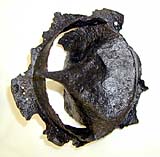
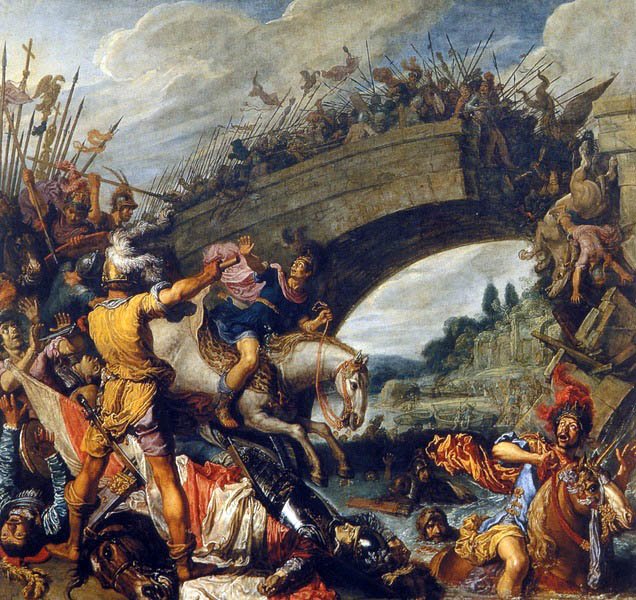
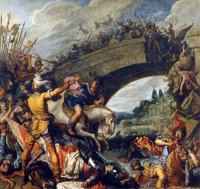
"Historians have long assumed that the reviled Roman emperor Maxentius lived part-time at an 80-acre suburban villa complex until he was killed by his rival Constantine at the Battle of the Milvian Bridge in A.D. 312.

But a University of Colorado-led archaeology team has uncovered evidence that the villa's main hall was never occupied.

Instead, it appears to have been abandoned before completion, said CU archaeologist Diane Conlin, co-director of the Maxentius project, a five-year excavation that began last summer.

'Maxentius builds a lot in Rome during his extremely short reign,' Conlin said. 'And the pattern - up to our project - is that Constantine either finishes the buildings and takes them over, or he demolishes them and builds something new.

'But this (villa) stands outside that pattern of behavior,' she said. 'Instead of being finished or demolished, it was abandoned.'

Marcus Aurelius Valerius Maxentius ruled Rome from A.D. 306 to 312, a time when the empire was in 'a holding pattern at the end of its period of greatness,' said CU historian Noel Lenski. Maxentius, son of the emperor Maximian, was in his 20s when he took power.

At the villa complex about two miles south of Rome's center and just outside the city's defensive walls, Maxentius built a chariot course with grandstand seating for 30,000 and monuments to his only son, Romulus. The boy was 9 when he drowned in the Tiber River, the same fate Maxentius met at the Milvian Bridge.

The day after that battle, Maxentius' armor-clad body was fished from the Tiber mud by Constantine's troops. His head was lopped off and displayed as 'an emblem of victory and conquest,' Conlin said.

Constantine reportedly had a vision of God the night before the battle and converted to Christianity on the spot.

But Maxentius was a pagan. Archaeologists wonder if his villa project on the Via Appia - the first and most well-known ancient Roman road - was an attempt to strengthen ties with Christians, Conlin said.

"One major question that we hope to answer is why Maxentius built this grand villa complex outside the defensive walls of the city when he had full control of pre-existing imperial palaces located in the heart of the capital," she said.

Limited investigations of the villa site were conducted in 1825 and again in the 1960s. Italian archaeologists exposed exterior walls but didn't dig into the interior of the large main hall, or basilica, Conlin said.

CU archaeologists and their colleagues sank two trenches in the main hall during a five-week field season last summer. Two more trenches will be opened in the basilica this summer. Twenty students from CU and Kalamazoo College in Michigan joined in the 2005 work.

After digging through modern garbage deposits and cemented chunks of architectural debris, the team reached the ancient basilica and found "a bare skeleton of brick and concrete," Conlin said.

A finished basilica from the period would feature stone mosaics on the floor and decorative marble slabs on the walls. The researchers found 800 pounds of marble fragments, but no piece was bigger than 12 inches by 6 inches. Instead of mosaic floors, they found only a brick subfloor.

"It seems like no one ever lived there," Lenski said. "It was 85 to 90 percent completed. It was the finishing touches that were left off."

The marble fragments suggest that bigger slabs had been installed but were later hauled away."

Thursday, February 02, 2006

Met to return antiquities looted from Etruscan tomb

"New York's Metropolitan Museum of Art today offered to return 20 artifacts in its collection to Italy, which says the ancient art was looted.

The disputed items include a 2,500-year-old vase painted by the Greek artist Euphronios, a 15-piece set of Hellenistic silver and four ancient pots.

The Euphronios vase is ``one of the finest existing examples of an Attic krater,'' a vessel used to mix wine with water, the Met's Web site says, referring to the museum's vase from Athens. It depicts a Trojan War scene from the Iliad in which Zeus's dead son, Sarpedon, is carried off the battlefield.

The talks with the Met are part of a broader push by Italian authorities to seize antiquities they say were illegally excavated or exported, including items at the J. Paul Getty Museum in Los Angeles, the Museum of Fine Arts in Boston, the Princeton University Art Museum in New Jersey, the Cleveland Museum of Art and others.

The Italian evidence for the Met's allegedly looted pots comes largely from the trial of Roman art dealer Giacomo Medici, who was convicted in December 2004 of smuggling objects that are now at the Met, Getty and other museums, Fiorilli said. Medici, 67, denies the charges and is free while appealing his conviction and 10-year prison sentence.

Prosecutors charge that Medici bought the Euphronios krater from tomb robbers who had excavated the pot in Cerveteri, near Rome."

Archaeologists unearth ancient Cretan tomb - Feb 2, 2006

CNN.com:A well-preserved underground tomb belonging to a prominent Roman-era family has been unearthed on the island of Crete, archaeologists said Wednesday.

The large first or second century A.D. structure beside one of the main gates to the walled city of Aptera was looted during Christian times, archaeologist Vanna Niniou-Kindeli said.

It still yielded a wealth of finds, including 10-inch pottery statuettes of the ancient Greek love deity Eros, glass and pottery vases and lamps.

Built of large stone blocks, the grave is reached by a flight of steps. It has an antechamber and a main room measuring three by two yards that was the site of four burials.

'These must have been highly important citizens, probably among the city's wealthiest, who had contributed to the common good of the city,' Niniou-Kindeli said. 'In return, they were buried in a prominent position so that whoever entered the city saw the grave.'

Archaeologists also discovered a small burial ground of newborns dating to the 4th century B.C., just outside the city walls."

Thursday, January 26, 2006

Unearthing history in the heart of ancient Rome. by Derek Wilson. Wanted in Rome


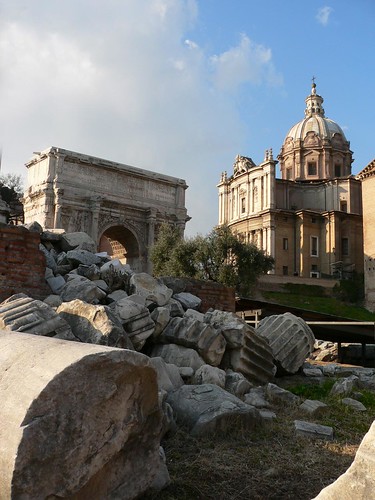
Unearthing history in the heart of ancient Rome. by Derek Wilson. Wanted in Rome: A cremation tomb that has been identified as going back to the 11th or 10th century BC, long before Romulus and Remus appeared on the scene has been uncovered in the Roman forum.

"Looking down into the forums from Via dei Fori Imperiali on the way to Piazza Venezia, the well-tomb, a perfectly circular hole in the ground, lies just to the right of the senate house in the Forum of Caesar. This forum was the first to be built, carved out of a former saddle between the Quirinale and Capitoline hills in 46 BC, and is thus on top of the tomb, which is suspected to be the first trace of a whole yet undiscovered ancient necropolis in the area.
Speaking to reporters, a jubilant Eugenio La Rocca, head of the Rome council?s cultural heritage department, dated the tomb to somewhere between the Bronze Age and the early Iron Age. ?It was a real surprise to find rich furnishings inside it,? he exclaimed. The findings included a funeral urn and eight hand-worked, patterned vases in terracotta. They contained tiny bronze miniatures of weapons, and elsewhere what seemed t o be the bones of a bird, placed there, La Rocca presumed, to accompany the deceased on his journey to the beyond, as was the custom. The riches were found after first rolling back the tomb?s cover, a weighty round slab of tufa, and then removing its seal, a container in the stylised shape of a hut, a model akin to real huts found much later on the Palatine Hill.
La Rocca and the director of the dig, Roberto Meneghini, both deduced that such a rich tomb must have been that of the head of a clan, a patriarch ruling over one of the scattered groups of families, or settlements, that had gathered around a fording point on the Tiber when the future Rome was still only a wild place of heavily wooded, isolated hills interspersed by tricky marshes."

Thursday, January 19, 2006

Roman artifacts thought to come from 1929 dig

"The discovery of Roman artifacts, possibly from JRR Tolkien's dig at the Lydney Park Estate, is proving far from an open and shut case. An early 20th century suitcase containing ancient pottery has been handed to the county council after it was found at a quarry near the Severnside town.

County archaeologist Jan Wills said the finds were a mystery. She said: 'It looks as if it could belong to Lydney Park. I'm in contact with them as we believe it was found on estate land.'

It is thought the case could relate to the dig around the Roman temple site on the estate in 1929 by eminent archaeologist Sir Mortimer Wheeler. One of his assistants was The Lord of the Rings writer Tolkien."

Ancient 'Cyclops' wall collapses

ANSA.it: "Part of a massive wall started in around 600 BC around the central Italian town of Amelia collapsed on Wednesday morning for reasons still unclear .

The so-called Polygonal walls around Amelia are famous not only for their age but also their size. Built out of huge polygonal stones, they are 8-10 metres high and about 3.5 metres thick .

The 800-metre long wall, which now has a breach in the section to the right of the old city gate, has always impressed archaeologists for the skill with which it was built .

According to local legend, it was constructed by the Cyclops, the one-eyed monster encountered by Greek hero Ulysses .

Amelia was founded by Umbri king Amero who gave it his name .
"

Roman era rock tombs unearthed near Develi in Turkey

An archaeological exploration of the Adana region in Turkey originally launched by Cukurova University in 2002, has uncovered a wealth of ancient settlements in the area once known as Cappadocia.

"Among the archaeological finds in Develi are numerous tumuli, ancient settlements, wine production facilities where famous Cappadocia wines were produced, underground cities, sacred places and Roman-era rock tombs."

Thursday, January 05, 2006

Alexander, Piece by Piece


I was so excited to read about the effort to recreate the famous Alexander and Darius mosaic. It is one of my favorite mosaics and I would have loved to have seen it in situ in the House of the Faun when I was in Pompeii this Spring. I hope it won't be too many years before I get a chance to return to Pompeii and see both the original in the Archaeological Museum of Naples as well as this new one.

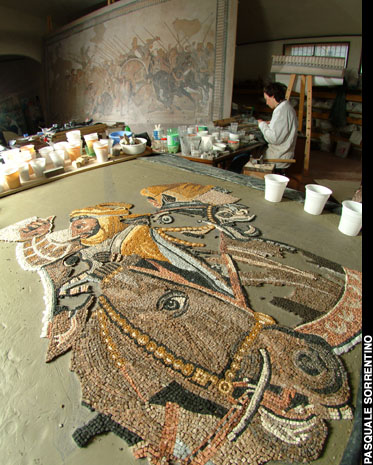
Alexander, Piece by Piece: "In 2003, a team of artists from the International Center for the Study and Teaching of Mosaic (CISIM) in Ravenna, Italy, made an ambitious proposal to the archaeological superintendent of Pompeii: create an exact copy of the Alexander Mosaic and install it in its original home. More than two years, 16,000 hours of work, and $216,000 later, the most famous mosaic to survive from the ancient Roman world once again adorns Pompeii's House of the Faun.

One of the iconic images of the great Macedonian leader, the mosaic depicts a confrontation between Alexander and the Persian king Darius in the fourth century B.C. Since 1843, the mosaic has hung on the wall of the National Archaeological Museum in Naples, safe from the feet of Pompeii's two million plus yearly visitors, as well as from the rain and sun that have damaged the whole site. So why bring Alexander back to Pompeii? The House of the Faun was once Pompeii's biggest and most impressive urban villa, filled with simple but elegant decorations designed to demonstrate the vast wealth of the house's owners. But today, although the sheer size of the house is still clear, the brightly colored paintings and mosaics, the gleaming marble and bronze statues, the fountains, and the hustle and bustle of a palatial villa are gone. Superintendent Pietro Giovanni Guzzo wants to change that. 'I want visitors to have the impression that they are entering the same luxurious house in which the ancient Pompeian owners lived before it was destroyed by the eruption of Mount Vesuvius in A.D. 79.'"

Ancient Roman Lighthouse May Have Been Destroyed by Tsunami


Turkish Daily News - Traces of tsunami in ancient city of Patara - Dec 27, 2005: "Archaeologists claim that an ancient lighthouse located in the ancient city of Patara on Antalya's Mediterranean coast might have been destroyed by a tsunami that hit the region in ancient times.

The ruins of the lighthouse were discovered two years ago during excavations that are still under way in Patara.

Professor Havva ??kan I??k, head of Akdeniz University's archaeology department, which is conducting studies in the ancient city, said they believed the lighthouse was destroyed by a tsunami since a human skeleton was found among the ruins.

I?ek said the skeleton could belong to a lighthouse keeper who was trying to escape a tsunami but was crushed under the lighthouse's stone blocks.

A bronze inscription the team discovered indicated that the lighthouse was built by the Roman Emperor Nero between A.D. 64 and 65."

Roman arrowhead among artifacts found in Temple Mount rubble

Arutz Sheva - Israel National News: "Archaeologists have discovered hundreds of coins and artifacts in Temple Mount rubble removed by Arabs who are building a huge underground mosque. Among the finds are a seal that was used to close sacks of silver at the time of the prophet Jeremiah, shortly before the destruction of the First Temple. The seal bears a name that suggest the owner may have been a brother of a priest named in Jeremiah's writings, according to Bar Ilan University Prof. Gabriel Barkai.

Also found was an iron arrowhead with a shaft used by the Romans in their attack on the Second Temple almost 2,000 years ago. Other finds date back to the Middle Ages and 'testify to large attendance at the Temple Mount during the Christian conquest and rule during the 11th to 15th centuries,' Prof. Barkai added."

Tuesday, January 03, 2006

Cache of Bronze Age Tools uncovered near Somerset

Edinburgh Evening News - UK - Legal history as mum faces killing charge: "Archaeologists have uncovered hundreds of Bronze Age tools at a construction site in Somerset. Some 800 pieces were found at the former hunting site that was in use 4000 years ago."

Mole family uncovers Roman villa

CBBC Newsround | UK | Mole family uncovers Roman villa: "A group of busy moles has been credited with helping archaeologists find a Roman villa in Gloucestershire.

Fragments of ancient tiles from the villa were found in molehills and are believed to have been pushed above ground by the creatures' burrowing.

The discovery was made in the Cotswold village of Withington where several other Roman villas have recently been uncovered."

Wednesday, December 28, 2005

'Paradise' found in Brooklyn Museum


'Paradise' found in Brooklyn Museum: During the reign of the first Roman emperor Augustus, Carthage, once Rome's greatest enemy, became the capital of the Roman African Proconsularis. Important as a port and an invaluable source of grain and trade goods, Carthage became the home of very wealthy Roman citizens, including a large population of wealthy Roman Jews.

In the late 19th century, a captain in the occupying French army, Ernest de Prudhomme built a villa in the town of Hammam-Lif, a small town on the peninsula about 50 kilometers from Tunis. Wishing to add a new garden to his villa, Prudhomme instead discovered the remains of a Jewish synagogue of the Roman period, with beautiful mosaics of natural, personal, and religious themes inlaid in the floors, perfectly preserved beneath the villa?s yard.

This synagogue must have been a lovely place, if the mosaics in 'Tree of Paradise: Jewish Mosaics from the Roman Empire' are any indication. The floor of the main sanctuary must have looked like a Garden of Eden with menorahs. The mosaic panels overflow with roosters, partridges, ducks, lions, hyenas, fish, vines, flowers and date palms (the Tree of Paradise).

"In 1905, the Brooklyn Museum received 21 of these mosaics excavated in the North African ruins of the first Roman-era synagogue to be uncovered in modern times.

Now on exhibit until June 4, 2006, these mosaics are as fresh-looking as the day they were made -- mosaics keep well -- about 1,500 years ago in the city of Naro, not terribly far from the ancient stronghold of Carthage, in Tunisia. An inscription on one in Latin indicates they were donated to the synagogue by Julia of Naro. These mosaics are evidence that, although the Roman empire continued a policy of non-tolerance towards Jews throughout this period, in some places around the Mediterranean, Jewish people prospered.

Tuesday, December 27, 2005

Italy Offering "Loans" of Antiquities to Replace Works Without Provenance in American Museums

New York Times: "When Italian cultural officials faced off in Rome last month with Philippe de Montebello, the director of the Metropolitan Museum of Art, they were gambling that they could make headway on a cause that had stymied them for three decades: getting the Met to give up a krater, or vase, by the fifth-century artist Euphronios, that they say was looted from an Etruscan tomb north of Rome.

On the face of things, it hardly seemed likely that the Met would suddenly consider returning an object that had been a prized mainstay of its Greek and Roman galleries for so many years.

But the Italians had seized on a new strategy: an offer to replace that work - and others they hope to get back from the museum - with loans of equal or similar value. The museum might even be able to hold on to some of the disputed objects as long-term loans, they suggested.

The strategy is part of a broader offensive to crack down on stolen antiquities. Italy has gained additional clout - at least in terms of public awareness - from the current criminal trial of Marion True, a former curator at the J. Paul Getty Museum in Los Angeles, and of antiquities dealers with ties to top American museums."

The article goes on to say that several years ago Italy denied a Getty Museum request for the loan of a group of bronzes from the Naples Archaeological Museum that would have been featured when the newly expanded Getty Villa reopens January 28. I was sad to read this as I am anticipating a visit to the Getty Villa and I would have been thrilled to see the bronzes from the Naples Archaeological Museum since I didn't have time to visit that museum when I explored Pompeii last spring.

Friday, December 23, 2005

Romans may have learned from Chinese Great Wall

The construction of the Roman Limes was quite possibly influenced by the concept of the Great Wall in China, though the two great buildings of the world are far away from each other, said archaeologists and historians.

Although there is no evidence that the two constructions had any direct connections, indirect influence from the Great Wall on the Roman Limes is certain, said Visy Zsolt, a professor with the Department of Ancient History and Archaeology of the University of Pecs in Hungary.

The Roman Limes are Europe's largest archaeological monument, consisting of sections of the border line of the Roman Empire at its greatest extent in the 2nd century AD.

All together, the Limes stretch over 5,000 kilometers from the Atlantic coast of northern Britain, through Europe to the Black Sea, and from there to the Red Sea and across North Africa to the Atlantic coast.

Vestiges include the remains of the ramparts, walls and ditches, close to 900 watchtowers, 60 forts, and civilian settlements which accommodated tradesmen, craftsmen and others who served in the military.

Visy noted that there are a lot of similarities between the Roman Limes and the Great Wall. Both empires wanted to launch a strong barrier against "barbarians" and to prevent their invasions. In doing so, the Han Dynasty (226 BC-220 AD) built a continuous wall, but Rome built a wall only in special cases.

"It was an important point in both systems to build a military road along the limes, as well as a row of beacon towers in a strict sequence. Also the military centers and bigger forts are similar in the Roman and in the Chinese constructions," Visy said.

Archaeologists have found almost the same methods were used for providing signs at the Great Wall and the Roman Limes.

Visy said another factor that should not be neglected is that the western most sector of the Great Wall was built in the last decades of the 2nd century BC, during the strong rule of Emperor Wu of the Han Dynasty.

The trade connections between the two empires were quite intensive in the first century and at least in the first half of the second one. "It is worth noting that the north line of the Silk Road was opened also at the beginning of the 1st century AD," Visy said.

Tuesday, December 13, 2005

Hill near Evros holds story of Plotinopolis

ekathimerini.com | Hill near Evros holds story of Plotinopolis: "Ever since the 1960s, the site where the hill of Aghia Petra rises between the Evros and Erythrpotamos rivers has been identified with the city of Plotinopolis. The Roman Emperor Trajan (AD 98-117) founded the city 2 kilometers from the Evros in honor of his wife Plotina.

In 1965, soldiers digging a trench in the area discovered a beaten gold bust of Septimus Severus, the Roman emperor who reigned from AD 193 to 211. That find is now in the Komotini Museum. In 1977, Georgios Bakalis and Dimantis Triantofyllos began systematic excavations, bringing to light new finds including mosaic floors.

Since Mathaios Koutsoumanis undertook the dig in 1996, he has unearthed many impressive finds, including the remains of mosaics from a large building complex, ceramics, coins (the most remarkable of which depicts Antiochus II of Syria), and inscriptions which show that the site was in use from the second to the sixth century AD."

Roman forts had a woman's touch.

Roman forts had a woman's touch. 13/12/2005. ABC News Online: "In a unique study, Dr Penelope Allison of the Australian National University has been analysing patterns of objects found throughout the forts that support the presence of women.

'The distribution of lost and abandoned objects, tells us quite a lot of about where people go and how they use a space,' she says.

Using computer software, she has mapped the distribution of over 30,000 artefacts.

She found objects used by women, such as hairpins, beads, perfume bottles and spindle wheels scattered in buildings and along the streets of the forts.

'They all tend to group together in different parts of the fort,' she says.

The location of these objects suggest women often played an active life in the fort, says Allison, which might be better described as a functioning town with a market rather than a sterile male-only province.

She says women were well and truly integrated into the forts, playing 'helpful' non-combatant roles of wives, mothers, craftspeople and traders."

Tuesday, December 06, 2005

Prison cells unearthed in Tiberias


Haaretz : "A bit of what prisoners suffered in ancient times can be seen as of yesterday at the archaeological dig in the old city of Tiberias. Excavations of the basilica compound in the eastern part of the old city recently unearthed two small chambers believed to have served as holding cells for prisoners awaiting trial.

The cells are located below the level of the main administrative building, the basilica. That fact bolsters the theory that they served as holding cells, where crowded prisoners waited to be called for trial. Each cell measures 1.8 by 2.7 meters, and is 2.07 meters high. Its walls are extremely thick, with the outer wall (1.1 meters thick) containing two narrow openings onto the city square. The slits presumably provided ventilation, and one also served as a food portal.

Narrow benches run along the length of the cells uncovered. One can only imagine what the prisoners experienced as they waited in the blazing heat of the Tiberias' summer. Some might have languished there for months, waiting for the governor to arrive, in the event of a complicated trial."

Five Untouched Sarcophagi Found Near Rome


"Italian archaeologists have found a remarkable trove of five untouched Roman sarcophagi in a burial vault outside Rome .

"It's really rare to find so many sarcophagi that have never been profaned or even opened - as can be seen by the intact lead clasps on their edges," said the head of the dig, Stefano Musco .

He said the sarcophagi dated from the II century AD and probably contained the remains of the wealthy residents of a villa that once stood in the area - now a building site on Rome's north-eastern outskirts .

All the sarcophagi are marble and all decorated, leading archaeologists to suppose they could have been made for a prominent aristocratic family .

One of them is much smaller than the others and believed to contain the remains of a small child.

The largest sarcophagus is decorated with lion's head masks and a central relief showing a reclining couple - a motif that dates back to Etruscan times .

Rome anthropologist Paola Catalano said she hoped the skeletons and funerary objects would provide information on burial rites and the lifestyles and social position of the dead, "even though the acidity of the terrain and rainwater has already corroded the marble."

Ancient Roman brickworks uncovered near Ronta


ANSA.it : "An Ancient Roman brickworks in near perfect condition has been discovered in Emilia Romagna .

The complex, the largest anywhere in the region and one of the biggest in Italy, was unearthed near a canal in the central Italian town of Ronta .

'This is a truly extraordinary find,' said a culture ministry spokesman. 'It is so well preserved that with minimal restoration it would still work perfectly today.'"

So far, archaeologists have uncovered two large rectangular ovens for baking bricks, a tiled floor that was once part of a production vat, a large terracotta tub and the remains of the walls .

The largest oven-room is 4.2 by 5 metres and has a hole in the centre showing the cavern underneath for lighting the fires. This had two-metre-high walls supporting a layer where the bricks were laid to bake .

Experts say that the room was extended on three occasions, presumably coinciding with a period of general expansion for the brickworks .

The brazier in the second oven-room, which is 3.8 by 3 metres, is constructed from a series of arches and small walls, allowing larger pieces to be placed directly over the flames .

The walls of the room are made of soft clay tiles that were gradually baked solid by the heat .

The complex, which dates back to the 2nd century BC, is the second oldest brickworks uncovered in Emilia Romagna. An earlier structure in Ca Turci Cesenatico has been dated back to the end of the 3rd century BC, which was when the Roman first occupied the area."

Tuesday, November 29, 2005

Ancient Roman Anchors Found in Israel

Newsday.com: "Ancient wooden anchors preserved by natural salt for more than 2,000 years have been discovered on the receding shores of the Dead Sea, Israel TV reported Monday.

Archaeologist David Mevorach told the TV station that one anchor dated back 2,500 years -- the oldest ever found. Another anchor was 2,000 years old, he said. They were built from acacia wood for Roman ships, he said. "

Friday, November 18, 2005

Archaeologists find western world's oldest map


"The oldest map of anywhere in the western world, dating from about 500 BC, has been unearthed in southern Italy. Known as the Soleto Map, the depiction of Apulia, the heel of Italy's 'boot', is on a piece of black-glazed terracotta vase about the size of a postage stamp.

It was found in a dig led by the Belgian archaeologist Thierry van Compernolle, of Montpellier University, two years ago. But its existence was kept secret until more research was carried out.

'The map offers, to date, for the Mediterranean, and more generally for western civilisation, the oldest map of a real space,' the university said recently.

Its engraved place names are indicated by points, just as on maps today, and are written in ancient Greek.

The sea on the western side, Taras (Taranto), today's Gulf of Taranto, is named in Greek. But the rest of the map is in Messapian, the ancient tongue of the local tribes, although the script is ancient Greek."

Friday, November 04, 2005

A Roman soldier?s story

"His name was Papas the Son of Cillis. He lived nearly 2,000 years ago, and it?s likely he would be mighty surprised at what James Russell has learned about his life.

Mr. Russell knows that Papas was an Anatolian who enlisted as an auxiliary in the Roman legions, serving in outposts of the empire for 25 mostly peaceful years. The auxiliaries were second-class soldiers who were natives of distant provinces that the Romans had conquered; Roman citizens served as prestigious legionaries.

Toward the end of his enlistment, Papas? regiment was sent to Judaea to help put down an uprising by the Jews. When he was honorably discharged, he was given Roman citizenship, as were all auxiliaries.

Papas returned home to his province to live out his life with his four children, who also were granted Roman citizenship, which would have set them on the path of upward social and political mobility.

Mr. Russell, an archaeologist and professor emeritus in the department of classics at the University of British Columbia, speaks about Papas as if he were an old friend. And, indeed, it must seem that way. The scholar has spent perhaps a decade tracing the life of the ancient Anatolian from information inscribed in Latin on a fragment of a bronze tablet, which was found in the rugged hills of Southern Turkey. Mr. Russell was given the fragment by farmers who uncovered it not far from his main archaeological site, the coastal Romano-Byzantine city of Anemurium.

The archaeologist worked backward from the substantial number of facts recorded on the tablet, including the date it was issued and the names of the emperor and the consuls for that year.

Also inscribed are Papas? native province and the names of the commanding officers of his regiment, as well as the names of members of his family, including his children.

?Emperor Trajan was mounting a campaign in the East. We know from stone inscriptions where his regiment was. We can trace its movements from Syria to Egypt to Judaea,"
Mr. Russell said.

It seemed straightforward enough until Mr. Russell remarked that he had discovered the regiment had been in Egypt from hieroglyphics on two papyri. ?Our kind of scholarship is sort of serendipitous,? he remarked.

Becoming an auxiliary in the Roman legions was a good job for a young man with wanderlust; the auxiliaries were shipped out to defend the empire?s frontiers. They quickly learned to speak ? and even read and write ? Latin. With those skills, an auxiliary could rise to the rank of sergeant. Papas gave at least two of his children Roman names, probably in honor of favorite centurions
."

Friday, October 28, 2005

Cardiff Professor questions the reason for late Roman Britain gold hoards

MORE Roman gold is found in Britain than anywhere else - and now a Welsh academic has come up with an intriguing theory explaining why.

Thousands of gold and silver artifacts from the Roman period, especially when the conquerors finally left these islands in the 4th and 5th centuries.

Dr Peter Guest, of Cardiff University's School of History and Archaeology, is the leading expert on the biggest ever Roman gold treasure discovered in Britain. In 1992, 15,000 gold and silver coins were found at Hoxne in Suffolk in 1992.

Dr Guest explained that the gold mostly comes from a 50-year period towards the end of Roman occupation.

He said, "Before then, Britain is not very special, but in that 50-year phase, which coincides with the end of Roman control, lots of stuff is found.

"It normally consists of gold jewellery, spoons, toothpicks, thousands of coins and other items. I think connected to the fact that the Roman administration in Britain stops around 400 to 410 and the fact that the separation Britain experienced from the Roman Empire would have been so sudden.

"We had been part of the Empire for 350 years by that time, which is a very long time.

"It happened very suddenly and it might have been quite violent and one of the reasons for the huge amount of gold and silver is related to this separation.

"People weren't able to leave Britain and move somewhere else or weren't able to reuse it and recycle it and for some reason it has just stayed there." A theory already exists that people buried the treasure because of invasion from the Angles and Saxons of northern Germany.

Dr Guest said, " It is based on the Angles, Saxons and German groups coming over via the North Sea conquering eastern England, forcing all this gold and silver to be buried .

"The reason for that would have been people were being forced into slavery or killed.

"I think there is an element of truth in that but to blame the collapse of Roman gold on the Saxons is unfair. They wanted to come over here and live like the Romans, there was no point in them destroying everything.

"We need to be more careful and sophisticated in the way we approach this. The period we are looking at was known as the Dark Ages, there is very little archeological or historical evidence from the time."

Divers find image of Gladiator in G-String

The Teesdale Mercury: "AN image of a Roman gladiator wearing only a G-string has been dug from the bed of the River Tees.

Broken Roman pottery, decorated with the picture, was recovered from the river at Piercebridge.
Archaeologists believe the figure of a gladiator, who also appears to be holding a whip, may be the first of its kind ever discovered."

Thursday, October 20, 2005

Remanants still remain of the battle of Mons Graupius

Sunday Herald: "THE dawn of Scottish history began with a battle on an Aberdeenshire hill in 84AD. On one side of the field were the vast legions of the mighty Roman Empire. On the other, a 30,000-strong confederate army of Caledonians ? our Scottish ancestors. This encounter, which became known as Mons Graupius, was a key moment for the Romans in their almighty struggle to conquer the whole of Britain. For the Scots, it was a battle for survival against a brutal occupation.


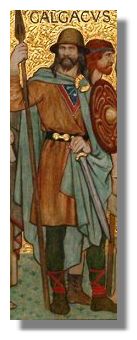
?Robbery, butchery, rape: the liars call it Empire,? roared Calgacus, leader of the Caledonians, at the men gathered before him. ?They create a desolation and call it peace. Whether you are to endure slavery forever or take summary vengeance, this field must decide.?

In the event, Calgacus and his brave warriors marched into a defeat at the hands of General Agricola, the Roman leader. The legions forced their adversaries to melt away into the great forest . But the Caledonians? fate would not be decided that day, as Calgacus had believed. Although the Romans won at Mons Graupius, they would never win the war against Scotland.

We should, nonetheless, be grateful that Rome decided to invade this remote corner of Europe. Had the Empire failed to penetrate so far north following the initial conquest of south Britain in around 43AD, we would know next to nothing about the natives. Calgacus ? whose name means ?swordsman? ? is, after all, the first Scot in recorded history.

His identity, and virtually all that we know about our early forebears, was recorded for us by Tacitus ? historian of the Roman campaign in Britain (and Agricola?s son-in-law). What Tacitus tells us should not be taken at face value. He aimed to write a glowing biography of Agricola and use his talents as a rhetorician to criticise Rome. He put noble words in Calgacus?s mouth to contrast the freedom-loving, uncorrupted Caledonians with the slavery of the south Britons, tainted by the vice, greed and arrogance of an autocratic empire, which Tacitus considered to have fallen after the golden age of the republic.

Mons Graupius should have been the beginning of a long haul to conquer the Caledonians. But instead, Agricola marched south to winter quarters. With reinforcements required on the Rhine and Danube, the Romans were obliged to give up on Scotland and withdraw to bases in safer southern territory. "


The remnants of the mightiest marching-camp in the northeast ? with space for 30,000 men ? can be found at Logie Durno, adjacent to Bennachie hill, near the field where Mons Graupius was probably fought. Enduring as their ghostly outlines are, however, these were not permanent garrisons and attempts to build such had to be aborted.

For more information about Calgacus, see Famous Scots

Ancient Roman town of Claterna uncovered near Bologna

ANSA.it : "The once bustling Roman town of Claterna is slowly re-emerging from the soil 15 centuries after it was abandoned and then vanished beneath farmland .

As a result of haphazard excavations in the past, the remains of a few patrician homes have been uncovered at the site near Bologna, along with mosaics and some pottery shards .

But a methodical, long-term research project is now getting under way for the first time ever, with funding from regional and provincial authorities, which have acquired the site .

So far digs have uncovered small portions of the town, revealing the street layout and mosaic paving from homes. Archaeologists have also found pottery, coins, metalwork and decorated bone .

An Etruscan-Celtic settlement stood in the area prior to the arrival of the Romans, who founded Bononia (Bologna) in 189 BC before spreading out to the surrounding area .

Claterna took its name from the river that still runs in the area today, the Quaderna, a clue that helped archaeologists identify the Roman ruins .

In fact, while Claterna's precise location was a mystery, historians had long known of its existence from various documents and maps .

A careful study of local place names, combined with the large number of Roman finds being unearthed by farmers, led experts to place Claterna between Bologna and Imola .

The town's prominence in ancient times was partly due to its location, at a crossroads between the ancient Roman highway of Via Aemelia, now the Via Emilia, and an important route across the Apennines, which archaeologists believe was probably the Via Flaminia Minor .

Both roads, constructed as consular routes in 187 BC, were major highways in Roman times, ensuring Claterna a constant flow of visitors, who brought with them trade, business and cash."

Associations appeal for new archaeological site in Morocco to be saved

Archeology : Associations appeal for new archaeological site to be saved :: moroccoTimes.com: "

When founded by the Phoenicians in the 6th century BC, Dhar Asekfane in Morocco overlooked a marshy zone near a river leading to the nearby coast. This is a typical choice of the Phoenicians, who looked for dominant locations with easy access to the interior for their agricultural and trading contacts with the local people combined with a navigable river, explained the archaeologists working on an excavation of the site.

The local Mauretanians followed the Phoenicians from the 5th-2nd century BC. Towards 40 BC, the Romans took over, staying until the 5th century AD. Coins and ceramics indicate a Moslem presence from the 12th-13th century AD.

The excavations, going down 60 cm, have brought to light well-preserved Roman remains: pottery, coins, large jars, thermal baths with changing room and cold, tepid and hot rooms. Also revealed was a group of fish-salting basins, supplied by large water reservoirs.

During the Roman occupation, the site was fortified by an impressively wide rampart. The main entry to the city was on the south face of the rampart, which contained several towers. "

Berlin Museum to Restore Famed Roman Gate


ABC News: "Officials from Berlin's Pergamon Museum announced plans Wednesday to dismantle and remove much of its famed Market Gate of Miletus over the next year and a half and to spend the next 10 years restoring it.

The towering Roman gate, built around 120 A.D. as the entrance to the market square in the Aegean coastal city of Miletus in what is now Turkey, is one of the museum's chief attractions. But metal supports built decades ago are sagging dangerously.

In the next three weeks, workers will cut a hole in the 75-year-old museum's southern exterior wall. Through it, they will pass 58 of the gate's marble blocks weighing about 110 tons to load them onto flatbed trucks and take them to an offsite facility for restoration.

The entire project is expected to take about 10 years and cost about $60 million, according to Gisela Holan, who oversees reconstruction work on the Pergamon and the four other museums that collectively make up Berlin's Museum Island.

The museum plans to put up a transparent wall that will contain dust and noise but let visitors continue to view the gate. Peter-Klaus Schuster, city museum director, said the unique setup will help make the Pergamon an 'academy of restoration work.'"

An ancient map of Rome that's surprisingly up to date

Glad to see my own University's Nolli Map Project is finally getting a little more press. I met with Dr. Tice and offered to provide images for the project.

"In 1748, architect and surveyor Giambattista Nolli completed a map of his hometown. The Pianta Grande di Roma ("Great Plan of Rome") was built from 12 minutely detailed copper plates, covered six by seven feet in its assembled state, and was so accurate that it continued to be used as the basis for government maps of the city until the 1970s. In 2005, a team at the University of Oregon brought the map online in order to "create and implement an innovative and highly interactive website and teaching tool for the study of the city of Rome." It may be a wordy mission statement, but the University of Oregon team certainly met its goals - The Interactive Nolli Map Website offers a good deal more than just a new look at an old map.

When created, the "Great Plan" was not only an impressive scientific and artistic achievement, it also set some cartographic precedents that are still followed today - such as Nolli's choice of the ichnographic, or plan, style of illustration rather than the more popular "bird's eye view." Nolli's was also the first map to use dark shades to mark buildings and private spaces and light shades for streets and public spaces, and the first such chart oriented so that North, rather than East, was at the top of the page. (In fact, the phrase, 'to orient' oneself, comes down from the earlier practice of placing the East at the top of maps.) Now, in its interactive incarnation, the map continues to set new precedents, as it folds history, cartography, urban design, and even architecture into a single presentation."

Friday, October 14, 2005

Carnegie Mellon Grant funds Roman and Medieval Research

Two years ago, Harvard's Goelet Professor of Medieval History Michael McCormick was awarded $1.5 million as part of a grant from the Mellon Foundation in New York.

McCormick asked for a two-year deferment and has since been planning a series of interdisciplinary projects?including researching isotopes and teeth, making old Latin texts accessible, and starting a summer internship program?which he will begin to execute this year.

McCormick said. ?The other things the grant will fund include launching a program to study isotopes and DNA of my Roman and medieval skeletons....I?m also trying to convince the University to help me create an undergraduate internship in medieval archaeology in Oxford, starting next summer.?

McCormick said he wants to make research into medieval life an interdisciplinary project. Speaking of a project involving the study of ancient Roman teeth, McCormick said, ?We?re planning on bringing together historians, economists, archaeologists, natural scientists, and bone specialists.?

He said they plan on studying the ancient Romans? diet, health, DNA, and the diseases they may have suffered.

Darryl J. Campbell ?06, one student already working with McCormick, said he is focusing on the Computative Philology Initiative, for which he helps scan old Latin texts and makes them legible. Campbell said his group hopes to compile Latin texts that are not available to the public and build a library that would be freely accessible to all.


A recent lecture led by Thomas Calligaro, the head physicist of the world-renowned Louvre Museum, and Peter Perin, the director of the French Musee d?Archeologie Nationale, also funded by the grant?focused on the duo?s discoveries of a link between India and France in the 6th century.

Calligaro and Perin said that by using a fusion of physics and history, they were able to determine that garnets with which a French queen was laid to rest had Indian origins. The garnets were set in cloisonne, and French garnets rarely are set that way. Perin traced its origins and Calligaro employed particle induced x-ray emission, or PIXE, a technique that accelerates particles, to discern the elements in the different garnets by their movement. Because garnets of different elements are found in different locations, the researchers were able to conclude that they, indeed, were of Indian origin.

Friday, October 07, 2005

The Solarium of Augustus to be Recreated in Eugene Oregon


Physorg.com: "Historian John Nicols and physicist Robert Zimmerman have joined with architects James Tice and Virginia Cartwright to lead a group of scholars and students seeking to create a replica of the Horologium / Solarium of Augustus, a 60-foot granite obelisk erected at Heliopolis in the seventh century B.C. by Psammetichus II and brought to Rome by Augustus in 10 B.C. The obelisk was to be used as the 'gnomon' (the staff against which the shadow is projected from the sun to the ground) of a new solar calendar and 'clock.'

'It was a momentous event in the history of time, for it marks the revolutionary shift in time-keeping from the lunar to a solar-based system we now use,' said Nichols, who specializes in ancient history and the history of science.

'What makes the Augusti solarium so significant is that it was the first attempt in the West to display the hours of the day and the days of the month - as well as the months and the seasons - in an astronomically correct way. Previous calendars were based primarily on the lunar cycle which created a 355-day year.'

The obelisk was toppled in late antiquity, rediscovered in the Renaissance, and set up again - without the face of the dial - in front of the Italian Parliament in Rome. About 20 years ago, a team of German archaeologists located the 'face' of the sun, which measures roughly 300 by 200 feet, 18 feet below the current street level of Rome. Nicols said the scholars and students hope to lay out the gnomon, or obelisk, for the solarium on a half-scale model. Hours of the day, days of the month, and the seasons will all be clearly marked."

I met with Professor Tice about participating in the Nolli Map Project. I didn't realize he was also working on this endeavor. When it is completed, I'll have to grab my digital camera and go have a look!

See the project website: http://darkwing.uoregon.edu/~klio/solarium/images.htm

Lavish Byzantine Mansion unearthed near Caesarea


The remains of a lavish Byzantine mansion with pictorial mosaic flooring and a rare table with gold-encrusted glass platelets have been uncovered in the coastal city of Caesarea during an archaeological excavation, Israel's Antiquities Authority announced Monday.

The 16 X 14.5 meter rectangular colorful mosaic -- part of the main central courtyard of the palace -- located just off the shorelines of the Mediterranean Sea, had been buried under sand dunes for the past 50 years, since 1950, when an Israeli army unit undergoing
training in the area accidentally stumbled on a section of the impressive mosaic flooring when digging trenches, excavation director Dr. Yosef Porat said.

According to the director of the excavations, the 6th century mansion likely belonged to one of the richest Christian families in Caesarea, possibly the aristocracy, although no inscriptions have been found
at the site to date.

The palace was destroyed by fire near the end of the Byzantine Period (324-638 CE) when the Arabs conquered the strategic harbor city, and set fire to any building outside the city walls, he said.

The mosaic-lined courtyard is composed of a series of animals, including lions, panthers, wild boars, dogs elephants, antelopes, and bulls, all enclosing 120 medallions, each of which contains a single bird, causing archaeologists to dub it "the bird mosaic."

During the excavations surrounding the central courtyard, archaeologists uncovered a unique table inlaid with a checkerboard pattern of gold-encrusted glass platelets in various shapes. Each square glass platelet in the table, which was found lying
upside-down on the pavement, bears a flower or cross stamped into the platelet after its production was completed, an unusual process that required reheating the glass. "

Friday, September 30, 2005

US Army helps restore Ladenburg's ancient past


Stars & Stripes: The village of Ladenburg, just north of Heidelberg, has the allure of many charming towns in Germanyss Neckar Valley.

But it has something more: a major historical find that U.S. soldiers helped uncover.

A stroll through the town's maze of cobblestone streets brings tourists face to face with crumbling Roman walls, an ancient standing column and an excavation that continues to yield items from long ago.

While the town's known history dates to the first century, the unearthing of its past goes back only about 50 years.

Villagers in the early 1950s noticed that large portions of crops throughout Ladenburg grew unevenly. German archaeologist Dr. Berndmark Heukemes knew of recent British finds that used a technique of flying high above oddly growing crops to find outlines of old ruins.

However, during this post-World War II time, Germans were not allowed to use aircraft for any reason.

Heukemes drafted a request for help from the U.S. Army, specifically from troops stationed in Heidelberg. In a letter sent to Washington, D.C., he said he strongly believed there were ancient wonders to be found in the fields of Ladenburg if he could only get an aircraft to see them. He proposed his idea as an international scientific project.

The proposal was accepted, and from 1952 to 1958, Army officers and soldiers helped unearth the remains of a Roman society that had long been forgotten.

Now, the Lobdengau museum, located inside Ladenburg's ancient city walls and next to fenced-off outdoor Roman ruins, has cultural finds from throughout the area going back two millenniums."

Ancient Roman Seaman Portrait Found


Discovery Channel: Ancient Roman marines had a bowl haircut and delicate, child-like features ? at least according to the first image of an Imperial Roman naval officer unearthed in Italy.

Carved on a funerary stone, the portrait was found three metres (10 feet) under water near the Classe necropolis in Ravenna, the port town where Rome's Adriatic fleet was based.

Made of marble, the one-metre-long (three foot) slab dates to the first century A.D. and bears a cavity on the top which originally contained the ashes of the portrayed military sailor.

According to the partly missing inscription, the tombstone was commissioned by a man named Cocneus for Monus Capito, an officer who served aboard the liburna "Aurata" (Golden).

An important part of the Roman fleet, the liburna was an easily manouvreable, light and fast galley used to fight pirates in the Adriatic Sea, a major problem for Roman merchant ships. "

Tuesday, September 13, 2005

Switzerland's Augusta Raurica Museum celebrates 50 years at annual Roman Festival


Switzerland's most important archaeological site is celebrating the 50th anniversary of its museum and Roman house.

Augusta Raurica, the first Roman colony to be built on the Rhine, receives 140,000 visitors every year and offers fascinating insights into the way the Romans lived.

The adjacent Roman house is a careful reconstruction of a Roman dwelling and workshop showing life as it would have been 2,000 years ago.

Founded in 44 BC in the vicinity of modern-day Basel by Lucius Munatius Plancus, a military commander and friend of Caesar, the original purpose of the Colonia Raurica was to defend Rome's new frontier along the Rhine, following the conquest of Gaul.

The earliest evidence of Roman settlement at Augusta Raurica dates back to 15BC, when the Emperor Augustus incorporated the area which is now Switzerland into the Roman Empire.

From a military base, Augusta Raurica soon developed into a vital staging post and trading centre in a great single market which stretched from Britain in the north to Africa in the south, from the Iberian peninsula in the west to Asia in the east.

Just a few decades after its foundation, a building boom transformed the military encampment on the Rhine into one of the continent's major cities. Wooden fortifications and houses were replaced by a grid layout of broad avenues fronted by imposing constructions in bricks and mortar."

Monday, September 12, 2005

Mummy of ancient Palmyra found in Syria

RIA Novosti - World - UPDATE: "Syrian archaeologists have discovered a sarcophagus with the best-preserved mummy ever in a tower tomb in Palmyra.

The two-meter-long conical sarcophagus is made of stone. The name of Hanbal Saadi, who the scientists believe was the owner of the tomb, is engraved upon it.

The mummy is 175 centimeters (5 feet 9 inches) long.

The discovery was a surprise for the archaeologists. Ancient residents of this town are known to have buried their relatives in separate niches that lined the walls of a burial chamber.

According to scientists, the rich in ancient Palmyra could afford to build large burial chambers and tomb towers not only for their own relatives, but also to lease them to people not connected with them by family ties. Some of the tombs could become a resting place for hundreds of bodies.

It is the first time that Syrian archaeologists have discovered a tomb with so many mummies, which date back to over 2,000 years ago."

Wednesday, August 31, 2005

Anatolia's largest Roman bath waiting to be excavated

"The Herodes Atticus Hamam, situated in the ancient ruins of Alexandria Troas, is believed to be the largest bath from the Roman era in Anatolia and is just waiting to be unearthed," excavation team leader and German archaeologist Professor Elmar Schwertheim told the Anatolian Press. "Up until 1809 the major part of the structure was standing, but after an earthquake only the visible part of the arches remains."

The ancient city of Antigoneia was built by Antigonos Monoftalmos (one-eyed Antigonos) at the end of the fourth century B.C. It was rebuilt by Lysimakos at the beginning of the third century B.C. and renamed Alexandria Troas in honor of Alexander the Great.

It is believed this area was used as an area of settlement during the Hellenistic period since it was built on the coast.

Greeks from the cities of Gargara, Hamaxitos, Neandria, Kolonai, Larisa, Kebren and Skepsis settled down here to make it the biggest settlement in Anatolia at the time. Based on Roman texts, Alexandria Troas was visited by Julius Cesar and deemed important enough to be declared a capital city.

Friday, August 26, 2005

Ancient burial site dating back to Roman period unearthed

Arabic News.com: "A group archeological burial site dating back to the Roman period was unearthed 800 meters northwest of Sheizer village, Hama Governorate, as a statue of a goddess was also discovered in a nearby place.

Director of Hama Ruins Department, Majd Hijazi told SANA that the statue depicted a naked woman believed to be goddess Venus. The statue was broken in two haves and relies on a 40-cm base.

He added that one of the tombs unearthed was uncovered and included a skeleton, three golden rings, various earrings, little funeral clay pots and rotten metal nails.

Hijazi said several items were found in another tomb, including a clay pot, some copper flat and circular pieces, glass bracelet, fractions of earrings and some very old coins. He said all the tombs were documented while the findings were sent to the laboratory of Hama Museum."

Dig finds remains of 2,000-year-old farm near Cambridge

CEN News : "GLOBAL positioning systems and digital aerial photographs are helping to uncover the 2,000-yearold secrets of Cambridgeshire's farmers.

The county's biggest archaeological dig is taking place at a 60-acre site and its findings are unearthing how the countryside developed over the course of two millennia.

On Monday, history enthusiasts, families and curious members of the public will be able to visit a display and tour the site at Love's Farm, near St Neots, which is soon to be developed for housing.

Archaeologists from Cambridgeshire County Council are half-way through excavating the remains of a derelict farmstead.

The dig began in February and before it finishes, 30 acres of soil will have been removed and searched for clues to the past.

The site has revealed traces of farming communities from the Iron Age and Roman era to Saxon times - about 100BC to 400AD.

Evidence of wells, paddocks and animal enclosures, together with bones and pottery has been uncovered, all of which point to the site being used as a farmstead 2,000 years ago."

Roman mosaic unearthed 25 miles from the Suez Canal


The Egyptian State Information Service: "An Egyptian-Polish excavation team working in Sinai has unearthed a multi-coloured mosaic floor 25km east of the Suez Canal, announced Supreme Council of Antiquities Secretary-General Zahi Hawass yesterday.

Hawass said that the 9x15m discovery, constructed of glass, pottery, limestone and marble,dates to the second century, C.E. He added that multi-national team is now working on the mosaic in order to move it to el-Arish National Museum where it will be displayed alongside other antiquities discovered in the area.

The site is already famous for the "Blosium" Roman theatre discovered there, noted Hawas; it is the biggest Roman theatre in Egypt with a 110m long stage."

Friday, August 12, 2005

Rome's Greatest Brickmakers Identified


Discovery Channel: "Two brothers are behind Rome's greatest monuments, according to Italian archaeologists who have discovered two furnaces that provided the bricks for buildings such as the Colosseum and the Pantheon.

Found in Mugnano in Teverina, a tiny village some 80 kilometers (50 miles) north of Rome, the furnaces belonged to Tullus and Lucanus, brothers of the Domitii family, as an inscription found on the road leading to the brickfield confirms: 'iter privatum duorum Domitiorum' (private road of the two Domitii).

The furnaces provided bricks for grandiose buildings such as the Colosseum, the Pantheon, the Market of Trajan and the Diocletian and Caracalla Baths, said archaeologist Tiziano Gasperoni, who discovered the furnaces.

Besides bricks and tiles, the Domitii furnaces were also specialized in the production of doli, big containers in terracotta which were buried up to their necks to preserve wine and olive oil, and mortars to grind seeds, herbs and nuts into meal."

ANSA.it - News in English - Ancient Roman temple found


ANSA.it: "An ancient Roman temple dating to the first or second century AD has been unearthed by archaeologists in the southern island of Pantelleria .

They have already dug up a three-metre portion of one of the walls of the temple, situated on a hill known as Cossyria .

Pantelleria is a volcanic island southwest of Sicily, nearer to the African coast than to Sicily. It may have been inhabited since the Neolithic Age, as suggested by traces of a village and fortifications in the district of Mursia. The historical period shows the presence first of the Phoenicians and then of the Punics; the Carthaginian presence unquestionably lasted from the fourth to the second century BC. Pseudo-Skylax informs us that Kossyra was the gateway to Lilybaeum as early as the fourth century. Also, Cossura must have been a city frequented and fortified also by the Romans throughout the first century AD, if Pliny the Elder (Nat. Hist., V, 7) defined it "Cossura cum oppido."

Today, however, we possess new data regarding the Roman occupation.
But before proceeding any further, we must recall the initial studies of Paolo Orsi (1889), and the later studies of Verger (1966), Tozzi (1968), and Bisi (1970). Since the summer of 2000, thanks first to the University of Greifswald and then to the University of Tübingen, the Università degli Studi della Basilicata, and the Archaeological Heritage branch of the Environment and Cultural Heritage Department of Trapani Town Council, there has been a systematic archaeological investigation of the hegemonic centre of the ancient Hellenistic-Roman island of Cossyra.

Recent digs would appear to show that a large part of the hill was used essentially for residential purposes. A series of buildings, made by terracing the slope of the hill with elegant signinum paving, belongs to the urban redefinition following the Roman occupation of the city. Among the monumental structures that must have been in this area, there is a temple datable to the 2nd century BC, significant traces of which have been found inside the cisterns.

Other than the numerous fragments of inlaid marble that have been discovered, the numerous fragments of marble sculptures and the now famous imperial portraits indicate that the hill was much frequented in the Imperial Age. Also, three interesting sculptures portraying the same figures as portraits of well-known figures in Roman history, between the end of the 1st century BC and the 1st century AD, were found inside two of the cisterns in the acropolis. The contextual environment of the discoveries was not homogeneous. The first two portraits found together in the cistern are in Parian marble, and they portray Julius Caesar and a lady of the Julio-Claudian family, probably Antonia Minor or Agrippina Major.

See also: Special Archaeological Exhibit

Tuesday, August 02, 2005

Volubilis, Morocco Offers a Wealth of Mosaics


Volubilis, Morocco: Mosaics: "Volubilis a Roman settlement constructed on what was probably a Carthaginian city dating from 3rd century BC, was a central administrative city for this part of Roman Africa. It was responsible for the grain production in this fertile region, and exports to Rome. Volubilis was also administering contacts with the Berber tribes which the Romans never managed to suppress cooperated with the Romans for mutual benefits.

Unlike so many other Roman cities, Volubilis was not abandoned after the Romans lost their foothold in this part of Africa in the 3rd century. Even the Latin language survived for centuries, and was not replaced before the Arabs conquered North Africa in the late 7th century.

Volubilis is definitely an ancient Roman city where you should be careful about keeping a good eye with the ground. There are many mosaics here and an impressive quantity of them are in excellent conditions.

There are mainly three houses that you should stop by: House of the Euphebus right next to the triumphal arch; the House of Orpheus to the south near the olive oil presses; and the house of Dionysus near the Decumanus Maximus."

Thursday, July 28, 2005

Excavations Reveal Via Egnatia equivalent of a modern day highway


The Hindu: "An excavation near the town of Komotini, some 270 km east of Thessaloniki, revealed the Romans' sophisticated road-building techniques.

Built between 146 and 120 B.C. under the supervision of the top Roman official in Macedonia, proconsul Gaius Egnatius, the highway ran from the Adriatic coast in what is now Albania to modern Turkey, giving Rome quick access to the eastern provinces of its empire.

A central partition of large stones protected charioteers from oncoming vehicles, with similar barriers on the verges. ``This prevented chariots, wagons and carts from skidding off the road,'' archaeologist Polyxeni Tsatsopoulou said.

She pointed out that drivers held the reins with their right hand and wielded their whip with the left, so the Romans made drivers stay on the left to avoid the lash of oncoming riders and keep road-rage incidents to a minimum.

There were inns every 50 to 64 km, and post stations, the Roman equivalent of gas stations, every 11 to 23 km. "These post stations had spare beasts, as well as ... vets, grooms and shoesmiths,'' Ms. Tsatsopoulou said.

Archaeologists also discovered ruins of military outposts, checkpoints and camps, with guard posts built near narrow passes to curb highway robbery."

Statue of Emperor Found Among Rome Ruins


Metromix : "A sewer might be no place for an emperor, but it is precisely from an ancient drainage system that archaeologists have dug-up a large marble sculpture of Constantine, one of Rome's greatest leaders.

Archaeologists found the 24-inch-tall head last week while clearing up a sewer in the Roman Forum, the center of public life in the ancient city, said Eugenio La Rocca, superintendent for Rome's monuments.

"We can't be sure of why it was put there," La Rocca said Thursday at a news conference during which authorities showed the bust to the media.

One possibility is that the sculpture of the man who reunited the Roman Empire in the early fourth century and ended years of persecutions against Christians was unceremoniously used later to clear a blocked sewer, he said.

La Rocca called the statue a rare find, saying that its insertion in the sewer probably saved it from the plundering the Forum suffered after the fall of the Roman Empire in the fifth century.

"Many portraits have been found in Rome, but these days it's not easy to find one, especially of this size and so well preserved," he said.

Experts confirmed that the sculpture portrays Constantine by comparing it to coins and two other giant heads of the emperor that are kept in Rome's Capitoline Museums, La Rocca said. The Carrara marble head probably belonged to a statue of the emperor in full armor, and was erected in the part of the Forum built by the emperor Trajan after Constantine conquered Rome from a rival in A.D. 312.

The style and stern features used in all of Constantine's portraits also recall the traits of Trajan, who expanded the empire to its maximum size in the early second century.

"Trajan was the greatest emperor and Constantine considered him a model," La Rocca said."

Monday, July 25, 2005

Ancient Jewelry Of Theodoric Discovered near Ancient Legion Camp in Bulgaria

Bulgarian Archaeologists Discover Ancient Jewelry: "Five golden jewelry pieces were found during excavations of the Necropolis, located outside ancient Roman legion camp near the Danube town Svishtov.

The jewelry weighting 82gram is dated back to the second half of the 5th century.

Pavlina Vladkova, an archaeologist from the team working near Svishtov, explained that the art pieces belonged to the people of the Goth King Theodoric.

There are at least 100 Goth's graves in the Necropolis near Svishtov and archaeologists claims that these people were from noble kin. One of the richest burials there was of a child. A massive golden rig was found there.

Roman legion camp Nove has been explored by Bulgarian-Polish expedition over the last 46 years."

Friday, July 08, 2005

Soloi Pompeipolis excavations to begin

Turkish Daily News: " Excavations in the ancient city of Soloi Pompeipolis, located 10 kilometers from Mersin in the district of Mezitli, will start next week, reported the Anatolia news agency.

The site was called Soloi, which means the sun. Persian rule in the region ended with the conquest of Alexander the Great in 333 B.C. The Roman general, Pompeius, defeated the pirates in Soloi during the Roman era and the site was renamed Pompeipolis after him. The site was completely destroyed by an earthquake in A.D. 527.

Today, a section of the colonnaded street and ruins of the ancient harbor, aqueduct and a bath as well as a mound are still visible at the site. Demirsoy said that they were conducting clean-up work in the ancient city and that excavation work would begin next week in collaboration with the Culture and Tourism Ministry and Mezitli municipality. The excavation team of 20 archeologists will be led by Associate Professor Remzi Yagci from Dokuz Eylul University, a lecturer at the Archeology department."

Monday, June 27, 2005

New Roman finds could turn history on its head

Scotsman.com : "The conventional story of the landing, at Richborough, Kent, in AD43, of 40,000 Roman soldiers who then marched through the English countryside conquering all before them, is being questioned by Dr David Rudkin, a Roman expert.

Archaeologists believe that a series of military artefacts unearthed in Chichester, Sussex, and dated decades before the AD43 date will turn conventional Roman history on its head.

The experts also believe that when the Romans arrived in Chichester they were welcomed as liberators by ancient Britons who were delighted when the "invaders" overthrew a series of brutal tribal kings guilty of terrorising southern England."

I wonder if these could have been remains of the earlier invasion by Caesar that included the defeat of Cassivellaunus in Hertfordshire? The Discovery Channel has taught me to be very skeptical of "sensational" finds like this.

Friday, June 17, 2005

Excavation of Ancient Roman Halai Continues

CHELP: "'During the Late Roman/Early Byzantine period (350-650 AD) there seems to have been renewed activity at Halai. Evidence for this activity exists not only in the large volumes of Late Roman fill found around the site by the current expedition but also by the large church located at the peak of the acropolis and the references to Byzantine walls and levels noted by Hetty Goldman in both her field diaries and her published articles. Little survives to the present of Goldman's perfect network of Byzantine walls that everywhere covered the more ancient constructions, but the remains of the basilica-style church in Area G point to a settlement (whether at Halai itself or nearby is presently undetermined) capable of supporting a church complete with mosaic and fresco decoration.'

'During the 1992 season a test trench was dug in the eastern end of the nave and northern aisle in order to help clarify the chronology of the basilica church. This trench revealed a mosaic floor approximately 0.30 m below the modern ground surface. Later expansion of the trench showed that the mosaic also extended into the apse itself, but the northern boundary of the mosaic appears to be the colonnade wall (wall BS/BW) as no mosaic was found in the northern aisle. The full dimensions of the mosaic are not yet known, but it undoubtedly continues further into the nave and apse.'

'Study of the mosaic suggests that it can be dated stylistically to the 6th century AD. Clearly there was activity at the site around this time as Goldman records several Late Antique period artifacts, including coins of Arcadius (395-408) and Honorius (395-423) from the so-called bath complex, a coin of Justinian (527-565) found near Tower I, and many Late Roman lamps with the chi-rho symbol found in various trenches around the site and in Tomb VII. Goldman s excavations in the church also revealed a pebble and mortar pavement which may have served as the floor for the aisles or the nave.'"

Thursday, June 16, 2005

Roman midden uncovered in Croydon

Croydon Guardian: "Archaeologists say the Roman dumping ground unearthed during an excavation of a former car park in Lower Coombe Street could be an indication of an occupied settlement nearby, which may be hidden under houses or businesses.

A two-month excavation at the site in Lower Coombe Street, carried out by Pre-Construct Archaeology (PCA) and overseen by English Heritage, uncovered finds dating from the second to fourth centuries AD and is believed by experts to be a rubbish site.

During the dig, a thick layer of pottery and rubble was unearthed containing a small number of precious artefacts including a Roman dress pin and a copper alloy lion's head."

Monday, June 13, 2005

Spectacular Mosaic in Libya gains kudos

Times Online: "A SPECTACULAR Roman mosaic discovered in Libya has been hailed as one of the finest examples of the artform to have survived.

British scholars yesterday described the 2,000-year-old depiction of an exhausted gladiator as one of the finest examples of representational mosaic art they have seen ? a masterpiece comparable in quality with the Alexander mosaic in Pompeii.

Archaeologists from the University of Hamburg were working along the coast of Libya when they uncovered a 30-ft stretch of five multicoloured mosaics created during the 1st or 2nd century. The mosaics show with extraordinary clarity four young men wrestling a wild bull to the ground, a warrior in combat with a deer and a gladiator. The gladiator is shown in a state of fatigue, staring at his slain opponent.

The mosaics decorated the cold plunge pool of a bath house within a Roman villa at Wadi Lebda in Leptis Magna, one of the greatest cities of antiquity.

Although the discovery was initially made in 2000, by Dr Marliese Wendowski of the University of Hamburg, it has been kept secret until now, partly to ensure that the excavations were not disturbed by looters."

More about ancient Tiberias.

Thursday, May 26, 2005

Cyprus Produced First Mediterranean Wine

Discovery Channel: "The Mediterranean's first wine was made in Cyprus some 5,500 years ago, according to Italian archaeologists who unearthed evidence that predates winemaking by ancient Greeks by at least 1,500 years.

Digging in Pyrgos, in southern Cyprus, Maria Rosaria Belgiorno, of the Italian Institute of Technologies Applied to Cultural Heritage, found two jugs used for wine that date back to the fourth millennium B.C.

Researchers examined chemical signatures in 18 of the Erimi jars. A dozen showed traces of tartaric acid, a key component of wine, proving, according to Belgiorno, that the 5,500-year-old vases were used for wine."

Wednesday, May 18, 2005

Ancient gods dating to 1st century uncovered in Petra

Ancient gods uncovered: The stone heads of 22 ancient gods have been found at an excavation in Petra. Patricia Bikai, who headed the excavation team that made the discovery, said that they 'initially thought the building was either a shrine or a royal residence'.

'However, after further examination we identified the monument as a banquet hall,' she added.

Bikai, an archaeologist at the American Centre of Oriental Research (ACOR), pointed out that the monument, which dated back to the first century, was only found last week after her team had been digging in the area for the past four years.

She said the remains of the building, which had probably collapsed after a major earthquake in 363 AD, were buried in its basement that was covered by sand."

Thursday, May 12, 2005

Clipper Cruise Lines to Offer North African Archaeological Adventure

Travel Video Television News: I see Clipper Cruise Lines will offer a new North African cruise in March and April 2006 that combines the antiquities of the Greek Isles with the Roman ruin sites in Libya (Leptis Magna and Sabratha) and Tunisia (Carthage and Sousse). I would particularly love to see the Roman ruins and mosaics of Leptis Magna.

Friday, May 06, 2005

Scientist struggles to preserve the Madara horseman

READING ROOM 2: Stone Sleuthing: The Madara Horseman: The Madara Horseman, once thought to be the work of Roman or even Thracian sculptures, has now been dated to the early Middle Ages. A UNESCO World Heritage Site, it is a rock relief carved into a vertical cliff face depicting a life-size horseman, a lion, a dog and inscriptions in northeast Bulgaria.

Dr. Valentin Todorov explains, "There has been much speculation in the past, but today we know exactly when the relief was created. Before World War 2, the common belief was that the horseman was Khan Krum who ruled Bulgaria from 804 - 815 AD. In fact, a Bulgarian coin was minted in the 1930's with a picture of the relief credited to Khan Krum. Many investigations later, a leading Bulgarian archaeologist, Vesilin Besheliev, determined the age of the relief at 705 AD just 24 years after the founding of Bulgaria in 681 AD. The age is founded on the inscriptions, one of which describes the relationship of the Bulgarian Khan Tervil with Justinian II, Emperor of the Eastern Roman Empire. The inscription notes Justinian II's acceptance of Khan Tervil?s rule over Bulgaria with the gesture of bestowing gifts. It was during the rule of Khan Tervil that, in fact, the Byzantines paid tax to the Bulgarians.

But Dr. Todorov, a conservation scientist with the Department of Conservation and Restoration at the National Academy of Arts, is concerned for its future. "For 1300 years the relief has stayed in place, but we should prepare it for many more. It is slipping very slowly due to fractures in the rock on either side of the horse.

He has proposed shielding the relief from rainwater and airborne particles with a roof mounted to the rock face.

"The roof will also be constructed with brass which when exposed to weather, leaches copper ions. The leached cooper acts as a natural biocide against the lichen populations."

Currently, I am testing these theories at the Madara site with two other professors- Dr. Warshneid from Aldenberg, Germany and Dr. Orial from the French Laboratory on Historic Monuments. We are installing an experimental roof on the same rock face, but some distance away from the actual relief. In addition, we will experiment with artificial calcification of the rock surface to imitate natural preservation processes. To date, we have funding only for the initial stage of these investigations. We are looking for additional support."

"The area of the Madara Horseman is a historical and archaeological reserve. Monuments from six different historical periods can be found there, including: prehistoric caves, Roman settlements, monuments from protobulgarians, medieval Christian churches, and rocky chambers of monks following the Ottoman invasion. Indeed, this is a sacred place known by many people around the world."

Thursday, May 05, 2005

Carlisle's rich Roman past

News & Star: "REMINDERS of Carlisle's rich Roman past have been discovered by builders working in West Walls.

The remains, which include a complex under-floor heating system, were found last month while builders were excavating foundations for a property development.

It is believed that they may have been part of a bath-house serving a post house for travelling government officials.

The remains have been removed to be studied, but may return as an display in the garden area of the five flats, to be known as Weaver Court, which will be completed in August. "