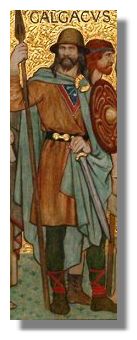
 field were the vast legions of the mighty Roman Empire. On the other, a 30,000-strong confederate army of Caledonians ? our Scottish ancestors. This encounter, which became known as Mons Graupius, was a key moment for the Romans in their almighty struggle to conquer the whole of Britain. For the Scots, it was a battle for survival against a brutal occupation.
?Robbery, butchery, rape: the liars call it Empire,? roared Calgacus, leader of the Caledonians, at the men gathered before him. ?They create a desolation and call it peace. Whether you are to endure slavery forever or take summary vengeance, this field must decide.?
In the event, Calgacus and his brave warriors marched into a defeat at the hands of General Agricola, the Roman leader. The legions forced their adversaries to melt away into the great forest . But the Caledonians? fate would not be decided that day, as Calgacus had believed. Although the Romans won at Mons Graupius, they would never win the war against Scotland.
We should, nonetheless, be grateful that Rome decided to invade this remote corner of Europe. Had the Empire failed to penetrate so far north following the initial conquest of south Britain in around 43AD, we would know next to nothing about the natives. Calgacus ? whose name means ?swordsman? ? is, after all, the first Scot in recorded history.
His identity, and virtually all that we know about our early forebears, was recorded for us by Tacitus ? historian of the Roman campaign in Britain (and Agricola?s son-in-law). What Tacitus tells us should not be taken at face value. He aimed to write a glowing biography of Agricola and use his talents as a rhetorician to criticise Rome. He put noble words in Calgacus?s mouth to contrast the freedom-loving, uncorrupted Caledonians with the slavery of the south Britons, tainted by the vice, greed and arrogance of an autocratic empire, which Tacitus considered to have fallen after the golden age of the republic.
Mons Graupius should have been the beginning of a long haul to conquer the Caledonians. But instead, Agricola marched south to winter quarters. With reinforcements required on the Rhine and Danube, the Romans were obliged to give up on Scotland and withdraw to bases in safer southern territory. "
The remnants of the mightiest marching-camp in the northeast ? with space for 30,000 men ? can be found at Logie Durno, adjacent to Bennachie hill, near the field where Mons Graupius was probably fought. Enduring as their ghostly outlines are, however, these were not permanent garrisons and attempts to build such had to be aborted.
For more information about Calgacus, see Famous Scots





 "In her late teens,
  "The first major national exhibition of British archaeology in over 20 years, Buried treasure: Finding our past will show how much chance archaeological discoveries have revolutionised the understanding of our past. We also celebrate the role of the general public in discovering treasures over the centuries, from farmers ploughing fields to metal detector users. Major treasures on display include the Mildenhall treasure of Roman silver, the Ringlemere gold cup, the Winchester gold, the Amesbury Archer and the Fishpool hoard. Many treasures will be on view for the first time."
 The next scheduled excavation session at the ancient site of Tiberias will be devoted to the exposure of the Roman basilica and auxiliary buildings in use between the 2nd and 10th centuries CE. In contrast to the basilical plans of the church on top of Mount Berenice and the synagogue of Hammat Tiberias, this basilica was not used for sacral purposes. The excavation is planned between October 31-November 25, 2004.
 "The Turkish designer, Atil Kutoglu took inspiration from the ancient Roman city of Zeugma, founded in 300 BC, for a collection of robes, cloaks and fresco-printed tunics, worn with flat 'centurion' sandals.