Friday, June 17, 2005

Excavation of Ancient Roman Halai Continues

CHELP: "'During the Late Roman/Early Byzantine period (350-650 AD) there seems to have been renewed activity at Halai. Evidence for this activity exists not only in the large volumes of Late Roman fill found around the site by the current expedition but also by the large church located at the peak of the acropolis and the references to Byzantine walls and levels noted by Hetty Goldman in both her field diaries and her published articles. Little survives to the present of Goldman's perfect network of Byzantine walls that everywhere covered the more ancient constructions, but the remains of the basilica-style church in Area G point to a settlement (whether at Halai itself or nearby is presently undetermined) capable of supporting a church complete with mosaic and fresco decoration.'

'During the 1992 season a test trench was dug in the eastern end of the nave and northern aisle in order to help clarify the chronology of the basilica church. This trench revealed a mosaic floor approximately 0.30 m below the modern ground surface. Later expansion of the trench showed that the mosaic also extended into the apse itself, but the northern boundary of the mosaic appears to be the colonnade wall (wall BS/BW) as no mosaic was found in the northern aisle. The full dimensions of the mosaic are not yet known, but it undoubtedly continues further into the nave and apse.'

'Study of the mosaic suggests that it can be dated stylistically to the 6th century AD. Clearly there was activity at the site around this time as Goldman records several Late Antique period artifacts, including coins of Arcadius (395-408) and Honorius (395-423) from the so-called bath complex, a coin of Justinian (527-565) found near Tower I, and many Late Roman lamps with the chi-rho symbol found in various trenches around the site and in Tomb VII. Goldman s excavations in the church also revealed a pebble and mortar pavement which may have served as the floor for the aisles or the nave.'"

Thursday, June 16, 2005

Roman midden uncovered in Croydon

Croydon Guardian: "Archaeologists say the Roman dumping ground unearthed during an excavation of a former car park in Lower Coombe Street could be an indication of an occupied settlement nearby, which may be hidden under houses or businesses.

A two-month excavation at the site in Lower Coombe Street, carried out by Pre-Construct Archaeology (PCA) and overseen by English Heritage, uncovered finds dating from the second to fourth centuries AD and is believed by experts to be a rubbish site.

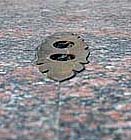
During the dig, a thick layer of pottery and rubble was unearthed containing a small number of precious artefacts including a Roman dress pin and a copper alloy lion's head."

Monday, June 13, 2005

Spectacular Mosaic in Libya gains kudos

Times Online: "A SPECTACULAR Roman mosaic discovered in Libya has been hailed as one of the finest examples of the artform to have survived.

British scholars yesterday described the 2,000-year-old depiction of an exhausted gladiator as one of the finest examples of representational mosaic art they have seen ? a masterpiece comparable in quality with the Alexander mosaic in Pompeii.

Archaeologists from the University of Hamburg were working along the coast of Libya when they uncovered a 30-ft stretch of five multicoloured mosaics created during the 1st or 2nd century. The mosaics show with extraordinary clarity four young men wrestling a wild bull to the ground, a warrior in combat with a deer and a gladiator. The gladiator is shown in a state of fatigue, staring at his slain opponent.

The mosaics decorated the cold plunge pool of a bath house within a Roman villa at Wadi Lebda in Leptis Magna, one of the greatest cities of antiquity.

Although the discovery was initially made in 2000, by Dr Marliese Wendowski of the University of Hamburg, it has been kept secret until now, partly to ensure that the excavations were not disturbed by looters."

More about ancient Tiberias.

Thursday, May 26, 2005

Cyprus Produced First Mediterranean Wine

Discovery Channel: "The Mediterranean's first wine was made in Cyprus some 5,500 years ago, according to Italian archaeologists who unearthed evidence that predates winemaking by ancient Greeks by at least 1,500 years.

Digging in Pyrgos, in southern Cyprus, Maria Rosaria Belgiorno, of the Italian Institute of Technologies Applied to Cultural Heritage, found two jugs used for wine that date back to the fourth millennium B.C.

Researchers examined chemical signatures in 18 of the Erimi jars. A dozen showed traces of tartaric acid, a key component of wine, proving, according to Belgiorno, that the 5,500-year-old vases were used for wine."

Wednesday, May 18, 2005

Ancient gods dating to 1st century uncovered in Petra

Ancient gods uncovered: The stone heads of 22 ancient gods have been found at an excavation in Petra. Patricia Bikai, who headed the excavation team that made the discovery, said that they 'initially thought the building was either a shrine or a royal residence'.

'However, after further examination we identified the monument as a banquet hall,' she added.

Bikai, an archaeologist at the American Centre of Oriental Research (ACOR), pointed out that the monument, which dated back to the first century, was only found last week after her team had been digging in the area for the past four years.

She said the remains of the building, which had probably collapsed after a major earthquake in 363 AD, were buried in its basement that was covered by sand."

Thursday, May 12, 2005

Clipper Cruise Lines to Offer North African Archaeological Adventure

Travel Video Television News: I see Clipper Cruise Lines will offer a new North African cruise in March and April 2006 that combines the antiquities of the Greek Isles with the Roman ruin sites in Libya (Leptis Magna and Sabratha) and Tunisia (Carthage and Sousse). I would particularly love to see the Roman ruins and mosaics of Leptis Magna.

Friday, May 06, 2005

Scientist struggles to preserve the Madara horseman

READING ROOM 2: Stone Sleuthing: The Madara Horseman: The Madara Horseman, once thought to be the work of Roman or even Thracian sculptures, has now been dated to the early Middle Ages. A UNESCO World Heritage Site, it is a rock relief carved into a vertical cliff face depicting a life-size horseman, a lion, a dog and inscriptions in northeast Bulgaria.

Dr. Valentin Todorov explains, "There has been much speculation in the past, but today we know exactly when the relief was created. Before World War 2, the common belief was that the horseman was Khan Krum who ruled Bulgaria from 804 - 815 AD. In fact, a Bulgarian coin was minted in the 1930's with a picture of the relief credited to Khan Krum. Many investigations later, a leading Bulgarian archaeologist, Vesilin Besheliev, determined the age of the relief at 705 AD just 24 years after the founding of Bulgaria in 681 AD. The age is founded on the inscriptions, one of which describes the relationship of the Bulgarian Khan Tervil with Justinian II, Emperor of the Eastern Roman Empire. The inscription notes Justinian II's acceptance of Khan Tervil?s rule over Bulgaria with the gesture of bestowing gifts. It was during the rule of Khan Tervil that, in fact, the Byzantines paid tax to the Bulgarians.

But Dr. Todorov, a conservation scientist with the Department of Conservation and Restoration at the National Academy of Arts, is concerned for its future. "For 1300 years the relief has stayed in place, but we should prepare it for many more. It is slipping very slowly due to fractures in the rock on either side of the horse.

He has proposed shielding the relief from rainwater and airborne particles with a roof mounted to the rock face.

"The roof will also be constructed with brass which when exposed to weather, leaches copper ions. The leached cooper acts as a natural biocide against the lichen populations."

Currently, I am testing these theories at the Madara site with two other professors- Dr. Warshneid from Aldenberg, Germany and Dr. Orial from the French Laboratory on Historic Monuments. We are installing an experimental roof on the same rock face, but some distance away from the actual relief. In addition, we will experiment with artificial calcification of the rock surface to imitate natural preservation processes. To date, we have funding only for the initial stage of these investigations. We are looking for additional support."

"The area of the Madara Horseman is a historical and archaeological reserve. Monuments from six different historical periods can be found there, including: prehistoric caves, Roman settlements, monuments from protobulgarians, medieval Christian churches, and rocky chambers of monks following the Ottoman invasion. Indeed, this is a sacred place known by many people around the world."

Thursday, May 05, 2005

Carlisle's rich Roman past

News & Star: "REMINDERS of Carlisle's rich Roman past have been discovered by builders working in West Walls.

The remains, which include a complex under-floor heating system, were found last month while builders were excavating foundations for a property development.

It is believed that they may have been part of a bath-house serving a post house for travelling government officials.

The remains have been removed to be studied, but may return as an display in the garden area of the five flats, to be known as Weaver Court, which will be completed in August. "

Monday, April 11, 2005

Roman Legend Legitimized?

CBS News : "Traces of a royal palace discovered in the Roman Forum have been dated to roughly the period of the eternal city's legendary foundation.

Andrea Carandini, a professor of archaeology at Rome's Sapienza University who has been conducting excavations at the Forum for more than 20 years, said he made the discovery over the past month at the spot where the Temple of Romulus stands today.

It is next to the Sanctuary of Vesta - the Roman goddess of the hearth - just outside the Palatine walls, site of the earliest traces of civilization in Rome.

Where previously archaeologists had only found huts dating to the 8th century B.C., Carandini and his team unearthed traces of regal splendor: A 3,700-square-foot palace, 1,130 square feet of which were covered and the rest courtyard. There was a monumental entrance, and elaborate furnishings and ceramics.

The walls were made of wood and clay, with a floor of wood shavings and pressed turf. It was tests on the clay that allowed the archaeologists to confirm the age of the find. "

Wednesday, March 30, 2005

Herod's Villa to Become Museum

Ekathimrini" Herod's villa that Thodoros Spyropopoulos began excavating in the early 1990s covers 20,000 square meters. It contains remarkable collections that reveal the history of Herod himself, who dreamed of a happy home filled with original works of ancient Greek art and Roman copies of ancient works. But he succumbed to depression when his wife Rigilla died, children and pupils died, and turned the luxurious villa into a museum and site for the mystical worship of his dead.

"Throughout the villa he put up funeral stelae, scenes of funeral feasts from classical cemeteries and heroes' monuments in Attica, and above the famous stelae of the Marathon warriors, a supreme monument to the heroized dead," said Giorgos Spyropoulos, curator and co-excavator with his father of Eva, Kynouria, who compared Herod's villa with the Vatican Museum.

The sculptures that decorated Herod's villa (stelae and statues of athletes) expressed "his deep concern with Greek educational values and Greek virtue, and referred to the sports practiced by him and by his father, who had led a chorus of ephebes in Sparta that revived the Lycurgan institutions and the team games of children and ephebes," said the curator.

The construction of the villa resembles that of Hadrian's villa at Tivoli. As the curator explained: "Hadrian was a friend and protector of Herod and he visited Mantineia, Tega and possibly Eva in 131-132 AD. The capitals of the peristyle in the garden, which are from Hadrian's era, like those in the Olympeion in Athens, indicate that the villa was completed in Hadrian's time, around 117-138 AD.

The hundreds of finds are evidence of Herod's desire to collect original works. Among the most important finds are the Orchoumenous Lakaines, statues of dancing Laconian women made by Callimachus (420 BC), which were in a stoa opposite the Caryatid Amazons."

Frontiers of the Roman Empire considered for multinational heritage site

"THE FRONTIERS of the Roman empire could be resurrected under plans to join Hadrian?s Wall with the chain of forts and walls across Europe in one World Heritage Site.

Such a move could create a European rival to the Great Wall of China and a major boost to tourism in Cumbria.

An Anglo-German bid will be considered by the World Heritage Committee in July to create a new heritage site called Frontiers of the Roman Empire.

Hadrian?s Wall already has world heritage status but has no links to the thousands of miles of ancient Roman boundary sites in countries like Austria, Slovakia and the Limes defences in Germany including 300 miles of forts and ditches."

Friday, March 04, 2005

Roman oven discovered in Manchester

Manchester Online: "A ROMAN oven and pieces of pottery have been uncovered beneath the site of a new shopping arcade. In addition to the Roman oven and pottery, remains of Westerwold German stoneware have been uncovered.

Wigan was the site of a Roman fort known as Coccium, which was in existence in the second century AD.

Three Roman roads have been traced in the Wigan area and researched by the Wigan Archaeological Society.

Other Roman finds in the area include hordes of coins, cremation urns and a headless statue of the Persian god Cautopates."

Monday, February 28, 2005

Roman coin hoard found in Norfolk

Roman coin hoard revealed: "A collection of 963 Roman denarii, including coins from 270 years of early British history, have been found by hobbyists near Norfolk. Most of the coins were found in a ceramic pot buried 14 inches down.

The earliest coins date from 32BC and feature Cleopatra's consort Marc Anthony. The most recent are from 240AD and the short-lived reign of teenage emperor Gordian III."

49 Headless Roman skeletons unearthed

Times Online - Britain: "ARCHAEOLOGISTS have unearthed a Roman cemetery in York with the skeletons of 49 beheaded young men.

Experts from the York Archaeological Trust have yet to explain why the men had been decapitated. One of the victims was buried with thick iron rings around his ankles that had been forged on to him while he was alive.

There are also skeletons of seven children, though their bodies were not mutilated. Dr Ottaway believes that the men were beheaded as part of a ritual in order to ensure that they could not haunt the living.

The skulls were removed after death and placed in the grave by their feet, legs or pelvis. Analysis of the bones has suggested that all of the adult skeletons were young men under the age of about 45.

The skeletons date from about AD200, roughly when Emperor Septimius Severus came to York with an army to fight in Scotland."

Tuesday, February 22, 2005

Tomb of Saint Paul Found?

Discovery Channel : "A tomb that may contain the remains of Saint Paul, one of the Christian church's most important leaders and the author of much of the Bible's New Testament, has been unearthed in Rome, according to a Vatican Museums archaeologist.

"The tomb that we discovered is the one that the popes and the Emperor Theodosius (379-395) saved and presented to the whole world as being the tomb of the apostle," Filippi said, as quoted by the Catholic World News (CWN).

Filippi explained that the tomb was found at the basilica of St. Paul Outside the Walls in Rome. This basilica was erected in the 4th century on order of Roman emperor Constantine in 386 A.D. Before Constantine's rule, Rome's leaders both shunned and persecuted Christians, who were forced to hide important tombs and relics. Ancient Rome also had a decree that no individual was to be buried within the main city confines.

Archaeologists discovered the sarcophagus on what would have been the ground floor of the 4th century basilica. It was found under the altar next to a marble plaque that reads, "Apostle Paul, martyr."

Thursday, February 10, 2005

Roman coffin found intact in London

Times Online - Britain"A ROMAN wooden coffin has been unearthed in London, the only example of its kind found in Britain.

Archaeologists expressed excitement that it had survived intact, centuries after other examples had disintegrated without trace. In dating from AD120, the new find is an unusually early example of a Roman burial.

It was not until the 3rd century AD that the Roman Britons generally buried their dead. Prior to this they usually favoured cremation. The skeleton belonged to a man over the age of 25, at a time when only 10 per cent lived beyond the age of 45.

The coffin, which went on display yesterday at the Museum of London, was found during building work in Holborn, on a steep side of the River Fleet, one of the many rivers that flow beneath London?s streets to the Thames.

Although the coffin was made of re-used old oak and included only a modest wine flagon, it does not necessarily reflect a low status. The skeleton shows a degeneration that tends to indicate a high-calorie diet. "

Tuesday, February 01, 2005

Roman mosaic of naked harvesters is revealed under Trajan's Bath

Roman mosaic of naked harvesters is revealed under Trajan's BathA well-preserved, nearly 2,000-year-old mosaic depicting five frolicking naked men in a grape harvest scene is Rome's latest new, stunning find from digs into layers of history under the city's modern-day surface.

So far, the only ones to come face-to-face with the underground marvel is a team of cave explorers who lowered themselves into a space under the ancient Baths of Trajan, in the bowels of the Oppian Hill, one of the city's seven ancient hills.

"Having found a polychrome mosaic of such a size and quality when we didn't expect to find anything so prestigious is an exceptional thing which gave us indescribable emotions," said Marco Placidi, who lowered himself 42 feet into the earth to inspect the decoration.

The team of speleologists was brought in to get a full look at the 10-foot-long and 6-foot-high mosaic, which was first spied in 1998 by archaeologists who were digging through the subterranean structures of the Baths. They saw only a small detail of it by peeking with a tiny camera through a hole.

Archaeologists said Friday that the mosaic is believed to date between A.D. 64 and A.D. 100 and is likely part of the wall decoration of what was a large hall beneath the ruins of the hill, part of the sprawling grounds where Emperor Nero built his fabled Golden Palace, or "Domus Aurea."

"For its particular subject and quality, we believe this mosaic has set a model for other similar artworks" of the ancient past, said Giovanni Caruso, an archaeologist who supervised the excavation.

One of the five men depicted in the mosaic is picking bunches of grapes from a vine while another, portrayed from behind, is playing a double flute. The other three men, wearing leafy crowns, dance on harvested grapes in a rectangular vat.

Experts theorized that the mosaic decorated part of the extensive urban structures that were built in the area during the reigns of the seven emperors who came between Nero's rule (A.D. 54-68) and Trajan's (A.D. 98-117).

Monday, January 31, 2005

Give us back our chariot, Umbrian villagers tell the Metropolitan Museum

Telegraph : "A tiny Umbrian village is taking on the mighty Metropolitan Museum in New York, claiming that one of its most exalted exhibits, an Etruscan chariot, was illegally exported from Italy 100 years ago.

The sixth-century bronze and ivory chariot, the pride of the museum's Etruscan collection, was originally sold to two Frenchmen by a farmer who dug it up in a field at Monteleone di Spoleto, near Perugia, in 1902.

According to family lore, the farmer received two cows in exchange. The local mayor, Nando Durastanti, believes that he actually swapped the chariot, one of the world's greatest antiquities, for 30 terracotta tiles. It was later dismantled and illegally exported from Italy, concealed in a grain shipment.

Said to be the only Etruscan chariot ever found intact, the 14ft by 4ft vehicle, showing scenes from the life of Achilles in relief, was part of a burial treasure.

It was found with the remains of two humans still sitting inside, along with two drinking cups, which helped date it to 530BC. The farmer, Isidoro Vannozzi, is said to have stumbled across it while digging a wine cellar. He hid the treasure in his barn, fearing that the authorities would confiscate it."

The Scotsman - International - New broom to make togas the Roman way

The Scotsman - International - New broom to make togas the Roman way: "RESEARCHERS in the ancient Roman town of Pompeii are attempting to revive 2,000-year-old traditions to reproduce imperial cloth used to make togas and uniforms.

The project follows successful production of Roman wine two years ago using methods that would have been employed in vineyards buried by a devastating eruption from Mount Vesuvius in AD79. Historians at the archaeology department in Pompeii are experimenting with wild broom as the base product to make the textiles.

They will be using the writings of ancient Roman scholars such as Pliny and Columella to make the cloth as well as relying on materials discovered within Pompeii in buried workshops."

Friday, January 28, 2005

Ancient Roman Rest Stop Provided Surprisinly Modern Amenities

Discovery Channel: "Underneath a German bus terminal, archaeologists have found the remains of a 2,000-year-old Roman roadside rest stop that included a chariot service station, gourmet restaurant and hotel with central heating.

Upon arrival, travelers would have entered a forecourt, where mechanics stood by at a chariot service station. Hay and water troughs would have given the horses a nibble and a drink while their owners dined on a variety of foods, including ethnic cuisine.

"We haven't found any brown sauce sachets, but we have uncovered many ceramic plates, pots, and pans," Sabine Sauer, an archaeologist for the city of Neuss, told the Telegraph newspaper in London. "We have found the rubbish tips - and although much of the organic waste has long since rotted away, we have clues as to what they ate from discarded pottery. There were spice jars containing garum sauces from North Africa, similar to what one might find in a Thai restaurant today."

She added, "We know from the bones that they ate a lot of meat - chicken and pork - as well as bread, rice, lentils and fruit. There were desserts of sweet cakes, cooked with sesame seeds and almonds. There must have been a flourishing trade; there were many fragments of wine amphora and broken plates."

After the big nosh, travelers would have had the option of staying for the night at the hotel, which was made of slate and bricked with narrow joints.

The foundation was raised to allow for a wood-fueled furnace at the bottom of the structure. Hot air from the fire would have risen naturally to fill chimneys located within the guest rooms. The hot air also warmed the walls, which were made of partially hollowed-out bricks.

Sauer said the complex was energy efficient, since the forests around Neuss already had been mostly depleted before the inn's heyday. In addition to the underground heating system, a slate roof on the building captured the sun's heat, somewhat comparable to how solar panels operate today."

Augsburg: Roman, Medieval and Rich

Deutsche Welle: "
Augsburg, Germany was shaped by the trade in salt and silver in Roman and medieval times. The ancient Roman Empire has left its traces in many parts of Augsburg, and its legacy is a continual source of amazement. Urban construction projects, for instance, often end up becoming more like archaeological digs since the most remarkable things turn up like a stone from a grave showing a wine transport.

Of course, historical artifacts are fairly common to Augsburg which was situated along the 'Via Claudia,' the road leading from Germania to Rome. Over the centuries, the route developed into a main trading route linking several major cities. "

Wednesday, January 26, 2005

Roman work tossed in Athens stream

ekathimerini.com: "A first-century-AD work that is a Roman copy of a fourth-century-BC classical original and possibly represents Apollo Lykeios has been found in a stream in Athens. Yiorgos Steinhauer, head of the Culture Ministry?s local antiquities department said the statue could have been recently discovered by builders during construction work, and dumped in the streambed for fear archaeologists might stop the works if alerted to the find."

Friday, January 21, 2005

Malls pioneered by rich Romans

Telegraph : "The luxury housing estate and out-of-town shopping centre may need to be added to the long list of what the Romans did for Britain.


Work in Bath suggests that rich Romans were so keen to live close to city centre attractions that they abandoned the empire's traditional habit of building lavish villas in the countryside, well away from the neighbours and commerce within the city walls.

Excavations in Bath reveal that at least half a dozen elegant homes existed near each other and within easy reach of leisure areas. One villa was found while sprinkler pipes were being laid across a golf course. A second villa with mosaic floors was found a few hundred feet away."

Large Mosaic discovered in Domus Aurea excavation

MSNBC"A large mosaic, more than 9 by 6 feet, showing naked men harvesting grapes and making wine, a typical illustration for a Roman palace of the time has been unearthed by continuing excavations of the Emperor Nero's "Golden House" in Rome. Three of the men are stomping on grapes in a vat. One plays a double flute. They all seem to be having fun.

The mosaic adorns a giant arch buried in Colle Oppio, the hill on which Nero's palace stood. The mosaics were found more than 40 feet below the ruins of the Trajan Baths, a large structure built over the Golden House more than half a century after Nero's death by suicide. Experts are split over whether these artworks were part of Nero's estate or dated from an earlier building that he knocked down to make way for his mansion.

Falcons Fly to the Rescue of Ancient Herculaneum

Yahoo! News: "After being buried in boiling mud when Mount Vesuvius erupted in 79 AD, the ruined ancient city of Herculaneum is now being deluged with acidic pigeon droppings.

The situation has got so bad that archaeologists have called in three falcons to scare away the hundreds of pigeons that have set up home in the once-vibrant Roman town."

Thursday, January 06, 2005

Chariot Race Track discovered in Colchester

ThisisLondon: "Historians believe they may have discovered the world's biggest Roman chariot-racing track outside Italy ... in Essex.

The track was unearthed by archaeologists at the site of the Army garrison in Colchester. The 209-acre site was part of the Army base there."

Wednesday, December 22, 2004

Clay lamps shed new light on daily life in antiquity

The Daily Star: "Clay lamps help archaeologists reconstruct daily activities inside the otherwise empty shell of a room or corridor of a ruin. For example, at Bet Guvrin/Beit Jibrin southwest of Jerusalem, nearly one hundred lamps and numerous lamp fragments were recovered in the sacellum, or shrine chamber, of the amphitheater. That lamps were found in association with two altars indicates they may have served a ritual role among the gladiators. Similarly, a deposit of 31 clay lamps were unearthed surrounding the altar inside the Mithraeum, or Mithraic cult center, at Caesarea Maritima/Qaisariye; the discovery further underscores the significance of light in this Roman mystery cult centered around the sun-god Mithras.

In Late Antiquity, clay oil lamps were used as a medium to express and to circulate religious thought. Greek passages linked to liturgies associated with specific Christian churches such as the Church of St. Mary's in Nazareth, for example, occur on early Byzantine lamps popular in the Jerusalem area. Kufic inscriptions depicted on early Islamic lamps further praise the greatness of Allah. Clay lamps also disseminated religious symbols: Lamps portraying pagan gods, Jewish menorahs, and Christian crosses were widely manufactured and distributed by pottery workshops in North Africa, Greece, Egypt, Cyprus, and Syria-Palestine.

The occurrence of such lamps helps archaeologists identify the presence of religious groups at any given site, and in some archaeological contexts represents the only artifact type to do so. Take, for example, the 'candlestick' slipper lamps with cross images recovered in the rock-cut tombs at Tel el-Ful north of Jerusalem. Because lamps decorated with crosses - a distinct Christian symbol - would have appealed to a Christian clientele, a large quantity of them discovered in a funerary complex like that at Tel el-Ful indicats Christian burial there, and thus, the presence of a Christian community somewhere in the vicinity of the site in the fourth and fifth centuries A.D."

Cumbrian Excavation Reveals Women Once Served in the Roman Army

Times Online - Britain: "Women soldiers were previously unknown in the Roman army in Britain and the find at Brougham in Cumbria will force a reappraisal of their role in 3rd-century society.

The women are thought to have come from the Danube region of Eastern Europe, which was where the Ancient Greeks said the fearsome Amazon warriors could be found.

The women, believed to have died some time between AD220 and 300, were burnt on pyres upon which were placed their horses and military equipment. The remains were uncovered in the 1960s but full-scale analysis and identification has been possible only since 2000 with technological advances.

The soldiers are believed to have been part of the numerii, a Roman irregular unit, which would have been attached to a legion serving in Britain. Other finds show that their unit originated from the Danubian provinces of Noricum, Pannonia and Ilyria which now form parts of Austria, Hungary and the former Yugoslavia."

Friday, December 17, 2004

Rare Roman sword acquired by Royal Armouries

Leeds Today: "THE Royal Armouries has sharpened its collection with the acquisition of a 2,000-year-old Roman sword ? autographed by the original owner. It is the best preserved sword of its type in the UK.

The blade and its scabbard mounts have been bought at auction by the Leeds-based national museum of arms and armour, and they are about to go on display alongside a replica of how the sword may have looked when carried by a Roman infantryman in the first century AD.

The fascinating weapon, an important sword of the Pompeii type, is decorated with engraved figures ? possibly Mars, the Roman god of war, and Victory ? and has a dot-punched inscription of the owner's name, Caius Valerius Primus.

The sword was discovered on a spoil heap in Germany in the early 1970s by an amateur archaeologist.

Monday, December 13, 2004

The Cumberland News

The Cumberland News BIRDOSWALD Roman Fort is now in the hands of English Heritage after an official hand-over ceremony this week.

Birdoswald was built around 122AD to hold 1,000 soldiers. It is one of the largest of the 16 forts along the Wall, which marked the northern boundary of the Roman Empire.

Archaeologists have also unearthed evidence that the site has been inhabited for 4,000 years. Birdoswald is believed to be the only Roman Fort along the Wall to have been continuously occupied since the legions left in around 410AD.

Friday, December 10, 2004

Bronze Bust of Ptolemy of Mauretania Auctioned

The New York Times: Sotheby's New York recently auctioned a seven ince fine bronze Roman portrait bust of Ptolemy of Mauretania at about age 15.

"Cleopatra VII, who ascended the Egyptian throne as a teenager, and Mark Antony had at least three children, including the twins Alexander Helios and Cleopatra Selene. Cleopatra Selene married Juba II, king of Mauretania, a kingdom on the northern coast of Africa. This fertile land of forests, elephants and camels was not the Mauritania of today in Northwest Africa, but a Roman-dominated state on the Mediterranean Sea, now part of Morocco and Algeria.

Around 1 B.C. Cleopatra Selene and Juba II had a son, Ptolemy of Mauretania. They sent him to Rome for schooling. 'It was very common for a prince in a client kingdom to be sent to Rome to receive a Roman education and be taught Roman ways,' said Florent Heintz, an antiquities specialist at Sotheby's. 'I suspect the bust was made when he was in Rome and purposely made to look like one of the sons of Augustus.'

Ptolemy returned home in A.D. 21 and ruled Mauretania jointly with his father until his father's death about A.D. 23. Ptolemy then became the sole ruler of Mauretania. He was considered a client king of Rome and was expected to prove his allegiance.

He got his chance in A.D. 24, when he helped the Romans' multiyear effort to quell a rebellion being led by the Berber Tacfarinas, a former Roman soldier. Ptolemy defeated Tacfarinas, who then committed suicide. The Sotheby's catalog quotes the Roman orator Tacitus, writing in his 'Annals': 'And now that this war had proved the zealous loyalty of Ptolemy, a custom of antiquity was revived, and one of the senators was sent to present him with an ivory scepter and an embroidered robe, gifts anciently bestowed by the Senate, and to confer on him the titles of king, ally and friend.'

About 16 years later Caligula invited Ptolemy to Rome and received him with great honor until, the Roman historian Suetonius reported, Caligula 'suddenly had"

Roman Artifacts stolen in Australia

IOL: Discovery: "Roman artifacts dating back more than 2 000 years have been stolen from one of Australia's top universities, police said on Thursday.

The thieves also broke a ceramic bowl from 200 BC during the burglary, the Australian Federal Police said.

The items were stolen from the Australian National University in the capital Canberra between Tuesday night and Wednesday morning.

Police said the stolen items were valued at about A$300 000 (about R1,3-million), and included a bronze portrait head, a gold necklace, gold earrings, a gold ring with an engraved head, and a vase.

'One of the artifacts, a bronze head from the Roman Empire, was made in about 100 BC and is worth more than A$200 000 (about R900 000),' a police spokesperson said in a statement."

Thursday, December 09, 2004

Sullan monument celebrating victory over Mithradates uncovered in Greece

ABC News Online: "A farmer ploughing his field in central Greece hit on an ancient Roman trophy dating from 86 BC, the culture ministry announced.

Archaeologists have unearthed the lower part of the stone-made monument near the village of Pyrgos some 100 kilometres north-west of Athens.

An inscription identified the finding as a trophy raised there by Roman General Sulla after his victory over Mithridates, King of Pontus - a kingdom on the Black Sea in Asia Minor.

It represents the trunk of a tree like the ones on which Roman victors used to nail the equipment of the defeated after battle, the ministry said."

Monday, November 29, 2004

Gallic war treasures discovered in sourthern France

Five almost complete carnyx, Celtic war trumpets, are among the some 470 objects, or fragments of objects, found during a dig at Naves, in the department of Correze in southern France, in a ditch hollowed out of a Gallic-Roman temple.

"The long, bronze tubes, measuring more than two metres long, have flags on the end, four of which bear the head of a wild boar, the fifth a snake.

In addition to the traditional warfare - swords, sheathes and spearheads, the archaeologists made another special discovery: nine war helmets, of which eight in bronze and one in iron, with their rear peaks.

One of them was particularly original, being decorated with a swan, while another was decorated with golden leaves. Also unearthed in the search are bronze animals' heads - boars and a horse."

Monday, November 22, 2004

LifePlus computer sim brings Pompeii to life

Swiss Info:
The ruins of a bar come to life as visitors wearing 3D glasses watch the waiter pouring out spiced wine for customers. In a nearby room, a beautiful woman reclines on a couch as she is wooed by a handsome centurion. Meanwhile, two women in Roman garb have a heated discussion as they wander through a leafy arbour.

With LifePlus prototype, such images are supplied by a computer carried in visitors? rucksacks to enhance their experience of touring the centuries-old city. Eventually they could be sent from a tiny computational device fitted to the headset.

Tuesday, November 09, 2004

Pompeii pottery may rewrite history

ABC News in Science: "Australian researcher Jaye Pont from the Museum of Ancient Cultures at Sydney's Macquarie University says people who lived in Pompeii bought their pottery locally and didn't import it.

Pont and Macquarie University geologist Dr Patrick Conaghan examined 200 thin sections of the pottery under a microscope and looked at tiny flecks in the clay.

The flecks, which contained the mineral leucite, were identical in composition and unique to the Bay of Naples region, where Mount Vesuvius is found.

Inhabitants of Pompeii and other areas such as northern Africa, where the pottery is also found, were thought to have traded extensively with the eastern Roman Empire.

Pont said her research would "turn upside down" old notions of commerce and trade between Pompeii and the eastern Roman Empire."

Friday, November 05, 2004

Rabbits Threaten Ardoch Fort

ic Perthshire: "ONE of Britain's richest businessmen is set to do battle with thousands of rabbits in a bid to protect Scotland's foremost Roman remains.

UK-based billionaire Mohammed Al Tajir is locked in talks with Historic Scotland following damning reports on the deteriorating state of the 2000-year-old Ardoch Fort on his estate at Braco.

Archaeologist Dr David Woolliscroft has worked periodically at the Roman Fort since the 1980s. And he has now warned that unless the rabbits which infest the site are brought under control, their continuing burrowing will see the Roman remains collapse and crumble.

The Roman expert from Liverpool University claims rabbits have already devastated important archaeological relics all across Britain. Now time is running out at Ardoch Fort and the defensive line of the Gask Ridge with rabbits threatening defences that kept hoards of marauding Picts at bay."

Ancient Roman Cemetery Vandalized

Haaretz Article: "An archeological excavation site on the Acre-Safed road was vandalized by unknown assailants on the night between Thursday and Friday.
The director of the excavation site, Yotam Tefer, said the vandals destroyed archeological findings and damaged digging equipment and bulldozers.

The excavations were initiated six months ago in order to salvage an ancient Roman cemetery unearthed in Acre's city center during works on a new two level underpass on the Acre-Safed road."

Thursday, November 04, 2004

On the Trail of Lars Porsena

The Economist: ArchaeologyFew tombs would be juicier than that of Lars Porsena, an Etruscan king who ruled in central Italy around 500BC. Porsena's tomb has been sought for centuries in the rubble under the Tuscan city of Chiusi, which is believed by most authorities to stand on the site of Porsena's capital, Clusium. No sign of it, however, has ever been found. And that, according to Giuseppe Centauro, of the University of Florence, is because everybody is looking in the wrong place.

The Etruscans were big on tombs?constructing entire cities for the dead to inhabit?but Porsena's was supposedly the biggest of the lot. It was, according to one ancient source, a monument of rectangular masonry with a square base whose sides were 90 metres (about 300 feet) long and 15 metres high. On this base stood five pyramids, four at the corners and one in the centre, and the points of these pyramids supported a ring from which hung bells whose sound reached for miles when stirred by the wind. From this level rose five more pyramids, and from these another five.

Chiusi was clearly once an Etruscan city, but the evidence that it was actually Clusium boils down to the fact that the two names mean the same thing (?closed?). Such nominative determinism is hardly conclusive. Dr Centauro prefers his evidence to be wrought in stone, and he thinks the most persuasive pile of masonry around is actually on a mountainside near Florence.

The outer walls of the main site are three metres thick, several metres high, uncemented and regular in construction. From the style of the masonry, Dr Centauro is convinced the remains are Etruscan. At corners where they have collapsed, small rooms are visible. These, he thinks, would have accommodated the sentries who manned the watchtowers.

So where is the tomb? And is it unlooted? Sadly for goldbugs, its riches are probably gone. In 89BC Cornelius Sulla, a Roman general, sacked Clusium and razed it to the ground. But if the ancient descriptions of the tomb are even a pale reflection of the truth, that amount of masonry is unlikely to have wandered far.

Lars Porsena's place in history was ensured by his interference in the revolution that made Rome a republic. The last Roman king, Lucius Tarquinius, nicknamed ?Superbus? because of his arrogance, was Etruscan. When he was deposed by the revolutionaries, he appealed to Porsena for help. There are conflicting accounts of whether Porsena succeeded in capturing and ruling Rome, or was forced to make peace with the revolutionaries. Either way, most of those accounts agree that he was eventually buried in a fabulous tomb near his home city of Camars, or Clusium as the Romans called it.

Romans laid foundation for cosmetics

World : "Scientists have unearthed a tin canister dating back to the middle of the second century AD in an excavated Roman temple precinct in London that contains a sophisticated cream that could rival today's top cosmetics.

'It is quite a complicated little mixture,' Richard Evershed, an analytical chemist at the University of Bristol in south-western England, said on Wednesday."

"The pot, measuring 60 mm x 52 mm, is thought to be the only Roman tin of cream of its kind to be found intact and in such good condition. The cream consists of about 40 per cent animal fat - most likely from sheep or cattle - 40 per cent starch and tin oxide. The fat forms the creamy base and the tin oxide makes the mixture opaque white."

Friday, October 08, 2004

Horse ornament found in Roman military camp excavation near Zagreb

Independent Online: "An ornament for horses dating back to the 1st century A.D. has been found during excavations of a Roman Empire-era military camp near the southern Croatian city of Drnis, local media reports said on Friday.

Croatian Minister for Culture Bozo Biskupic said the ornament - a small, crescent-shaped object fashioned from bronze and designed to be worn on the animal's head - was a 'European archaeological sensation' because it was the biggest such item found and very well-preserved."

Thursday, October 07, 2004

Carneddau ponies

ic Wales: "THE origins of the Carneddau ponies are lost in the mists of time, but researcher Debbie Wareham thinks their ancestors could have been around before the Roman invasion of Britain.

The horses used by the Romans in their subjugation of indigenous people in North Wales were inferior to the animals used by the local tribes which were acclimatised to the harsh winters.

Ms Wareham said the jaw bone of an equine, with three teeth attached, had been discovered on the Great Orme, near Llandudno, and dated to 10,000 years ago."

Wednesday, September 29, 2004

Large Roman coin cache found in Surrey

Large Roman coin cache found in Surrey: "One of the biggest finds of Roman coins ever discovered in Surrey has been unearthed on a farm at Leigh.

Almost 60 silver denarii dating back to 30BC were located after Martin Adams, a metal detecting enthusiast, received a signal on his machine.

"There are coins from about half a dozen Roman rulers. This is the first Roman find in the area for some 30 years and now we know that there must have been a settlement.

"These areas on the edge of the weald were not intensively occupied. We are talking about a small farm - similar to that recently discovered at Meath Green, Horley, which is Roman or earlier, and points to a surprising amount of ancient activity.

"The settlement at Leigh would probably have been an early type of farm with a non-tiled dwelling made from wattle and daub - a network of twigs and rods plastered with mud or clay used as a building material. In other words a primitive cement. "

Dispute over Roman bones halts underpass

Dispute over Roman bones halts underpass: "The contractors of Yefe Nof construction company received a direct order from Transport Ministry director-general Bentzi Salman to stop building a two level underpass at the eastern entrance to Acre-Safed. The stoppage was the result of heavy political pressure from the ultra-Orthodox community following the discovery of ancient graves.

A salvage dig was begun on the site in coordination with the construction company. The archaeologist in charge of the excavations, Yotam Tepper determined that the human remains were of Roman soldiers. This was based on artifacts, including pagan altars, a hoard of coins that was apparently a soldier's salary, and the fact that the bones were burned, which was not in keeping with Jewish tradition."

6th century Byzantine style chosen for new orthodox church

Immortality, for a Price: "A small Orthodox Christian congregation is finishing plans to build the first Byzantine-style church in Northern Virginia, modeled after a 6th-century Italian architectural masterpiece, the Church of St. Vitale in Ravenna. To help pay for the project, which could cost up to $2.4 million, the church plans to paint portraits of its most generous donors on an interior wall in spots historically reserved for saints, religious icons or an occasional emperor.

St. Vitale is famed for its octagonal architecture and its mosaics, which depict Emperor Justinian, who ruled the Roman Empire during the sixth century, and his wife, Theodora.

"From a symbolic standpoint, [the dome] represents eternity and heaven," said Christos J. Kamages, principal architect for CJK Design Group. "From a physical standpoint, it takes light that God provides and brings it into the church at a 360-degree angle.""

Roman Bridge Excavation Ending

"A MAJOR archaeological rescue dig revealing the largest stone bridge in Roman Britain is nearing its end.

Experts working on the summer excavation on the River Tyne, in Corbridge, have uncovered the most completely preserved construction of its type in the country.

The dig, carried out by archaeologists from Tyne and Wear Museums, revealed huge stone blocks, up to a ton in weight, and carved masonry, showing the scale and decoration of the bridge.

The bridge, which carried the main Roman road from London to Scotland, was built to proclaim the power of the Roman Empire and particularly the Imperial House.

A massive ramp, almost 12 metres wide, which would have carried the Roman Great North Road onto the bridge, was uncovered, as well as a 19 metre long retaining wall to protect the south-east side.

Fallen from the bridge superstructure is a huge decorated octagonal stone, thought to be the capital from a pillar or monumental feature which once marked the point where the road rose onto the bridge."

Tuesday, September 28, 2004

Was Herodian palace in Ramat Hanadiv Captured or Surrendered?

The Jewish millionaire who surrendered to the Romans: "Dozens of coins from the tenth Roman Legion, uncovered during the last excavation season at the Herodian palace in Ramat Hanadiv, offer some insight on the demise of the glamorous palace. Prof. Yizhar Hirschfeld, a Hebrew University archeologist who has been managing the excavations at the site since the 1980s, says that it is possible to learn from the presence of the coins that that the palace was abandoned during the Great Rebellion that started in 66 CE not far away from there, in Caesarea.
The findings at the site do not make it possible to determine whether the palace was captured by force or abandoned and then fell into Roman hands, says Hirschfeld. But they do say something about the haste of the residents as they left. Among other things found at the site were a gold earring and a gold clasp - jewels that even a person of means does not leave behind during a leisurely moving to another place."

Thursday, September 16, 2004

Ancient Mosaic Uncovered In Hertfordshire

Ancient Mosaic Uncovered In Hertfordshire: "The field archaeology unit at St Albans Museums was digging a trench for a new electricity cable when Jack Couch made the new find of a chequered mosaic.

Probably not seen for nearly 2,000 years, the mosaic is made up of red or brown tessera in a grid of grey Purbeck marble. It may be from the corridor of a town house built close to the hypocaust.

In Roman times hot air, stoked from a pit in a smaller adjoining room, was drawn underneath the floor of the hypocaust building, once part of a large house with up to 35 rooms.

Keeper of archaeology at St Albans Museums Dave Thorold said: 'A new mosaic is always an interesting find. This type of mosaic would have been found in a high quality town house with between 20 to 30 rooms."

Tuesday, September 14, 2004

Recreation of Etruscan Matron Points to Change in Ancient Art

"In her late teens, Seianti Hanunia Tlesnasa had a nasty fall from a horse. No bones were broken but, as a result of the accident, she lost many of her teeth. Damage to her right hip and jaw set the stage for debilitating and painful osteoarthritis, as well as a twisted spine. Although she married and bore children, the once agile horsewoman gained weight from lack of exercise and was eventually reduced to porridge and complaints.

According to British archeologist John Prag, the re-creation of Seianti's life and looks solves a mystery that has long baffled archeologists and art historians: when and where in the ancient world did people make the psychological and artistic step from the general to the specific in the depiction of individual people.

In Prag's view, the when is about the 6th century BC and the where is Etruscan Italy."

Mildenhall treasure of Roman silver featured in British Museum traveling exhibit

"The first major national exhibition of British archaeology in over 20 years, Buried treasure: Finding our past will show how much chance archaeological discoveries have revolutionised the understanding of our past. We also celebrate the role of the general public in discovering treasures over the centuries, from farmers ploughing fields to metal detector users. Major treasures on display include the Mildenhall treasure of Roman silver, the Ringlemere gold cup, the Winchester gold, the Amesbury Archer and the Fishpool hoard. Many treasures will be on view for the first time."

It's next appearance will be the Manchester Museum beginning October 4, 2004.

Roman Basilica Target of New Dig in Tiberias

The next scheduled excavation session at the ancient site of Tiberias will be devoted to the exposure of the Roman basilica and auxiliary buildings in use between the 2nd and 10th centuries CE. In contrast to the basilical plans of the church on top of Mount Berenice and the synagogue of Hammat Tiberias, this basilica was not used for sacral purposes. The excavation is planned between October 31-November 25, 2004.

See also: Digging Up Ancient Tiberias

and: Rediscovering Tiberias

Roman Zeugma inspiration for new fashions

"The Turkish designer, Atil Kutoglu took inspiration from the ancient Roman city of Zeugma, founded in 300 BC, for a collection of robes, cloaks and fresco-printed tunics, worn with flat 'centurion' sandals.
Atil Kutoglu drapes his models in clothes inspired by ancient Rome
Enlargement

Princess Michael of Kent was a surprise front row guest as Naomi Campbell opened Kutoglu's show in a modest, grey silk, pleated toga-dress, which enveloped her from neck to over-the-knee.

Other models appeared in long, silk kaftans, in wide, multi-coloured bands of rose, olive and pink; tunics gilt-printed with details of Romanesque frescoes over raw-hem sarong skirts; hooded cloaks in glittering brocades and floor-sweeping gowns suspended from gold breastplate-necklaces.

The collection was graceful and womanly, evocative of a Cecil B de Mille biblical epic.."

Thursday, September 02, 2004

Torlonia Roman Sculptures to Go On Display

"The Torlonia Statues, regarded as one of the world's greatest private collections of ancient Roman sculpture, will go on display again after 40 years in storage, Italy's Culture Ministry says.

Named after the aristocratic family which formed it over centuries, the Torlonia collection includes 620 marble and alabaster statues and sarcophagi from the Roman empire.

Among the works are busts of Julius Caesar, sculptures of ancient gods and masterful Roman copies of Greek statues.

A ministry spokesman on Wednesday confirmed comments by Culture Minister Carlo Urbani, who in excerpts of a new book published in the Corriere della Sera newspaper, said an agreement had been reached with the family and a Rome bank to show the works at Palazzo Sciara in central Rome. He gave no precise date."

Tuesday, August 24, 2004

Another Roman mosaic uncovered at St. Albans

This Is Hertfordshire: News and Features: Watford: "An archaeologist has unearthed a colourful 3rd Century mosaic in Verulamium Park, St Albans, during building works on the ancient hypocaust and mosaic site. Probably not seen for nearly 2,000 years, the mosaic is made up of red or brown tessera in a grid of grey Purbeck marble. "

Tuesday, August 17, 2004

Infant interment in Roman villa foundation thought to be part of ritual

Herts24: "ARCHAEOLOGISTS working on the site of a Roman villa just outside Wheathampstead are puzzled by the discovery of the skeleton of a baby.

For they believe that the child, which died either shortly before or after birth, may have been buried in the foundations of the villa as part of a ritual ceremony.

Field archaeologist Simon West said: 'We are not sure why this type of practice was carried out but it could be to, in some way, bring luck to the house.'"

Ancient Rome's fish pens confirm sea-level fears

"Coastal fish pens built by the Romans have unexpectedly provided the most accurate record so far of changes in sea level over the past 2000 years. It appears that nearly all the rise in sea level since Roman times has happened in the past 100 years, and is most likely the result of human activity.

The Romans dug these fish pens into bedrock, and the water line in these well-preserved structures shows that the sea level along the Italian coast 2000 years ago was 1.35 metres below today's levels. "They were used for only a very short time, so they make rather nice markers," says Kurt Lambeck of the Australian National University in Canberra.

He then analysed how land elevations changed along the Italian coast due to both plate tectonics and the after-effects of the last ice age. In a paper to appear in Earth and Planetary Science Letters, he concludes that geological processes affecting land levels over the past two millennia accounted for 1.22 metres of the change, which means that the global sea level rose by 13 centimetres.

That is only about 100 years' worth of rise at the present rate of around 1 to 2 millimetres per year, implying that nearly all of it has occurred since 1900."

Friday, August 13, 2004

Mystery of Iron Age woman with rings on her toes

Mystery of Iron Age woman with rings on her toes - The Herald: "SHE would have been a highly-skilled artisan who was buried 1500 years ago, her body covered with ornate jewellery and emblems of her high status.
Yet, with her rings still adorning her toes, she was laid to rest in one of the most unusual burial sites known to archaeologists: beneath the floor of a busy Iron Age workshop.
The discovery, at Mine Howe in Orkney, is extremely rare for an Iron Age site in Scotland and has baffled the team carrying out the dig."

Tours of Hadrian's Villa Now Available

IOL: World: "Hadrian's Villa, the largest and among the most sumptuous of the villas built by Roman emperors, is open for floodlit evening tours.

Visitors to the villa, which is situated near Tivoli, about 25km east of Rome, will be given guided tours of the site by an archaeologist."

Byzantine Shipwreck Found on "Circe's Sandbanks"

Agenzia Giornalistica Italia - News In English: "The wreck of a Byzantine ship whose period is datable between the third and the fourth century after Christ, was found on the seabed of Ragusa by Carabinieri underwater squads of Messina. The ship is a few metres under the water on 'Circe's sandbanks', in front of Marina di Marza's coast, near Ispica."

Wednesday, July 28, 2004

What lies beneath in Pompeii

MSNBC - What lies beneath in PompeiiLast month, a team of archaeologists from Italy's Basilicata University uncovered the remains of a structure built by the Samnites, a mountain warrior people who conquered, inhabited, built up and ruled Pompeii before Roman chariots wheeled into town.

The diggers were looking for something else -- remains of Pompeii's harbor. Instead, they found a pre-Roman temple wall, clay offerings to the Samnite goddess of love, and a basin and terracotta pipes indicating the site of a ritual bath.

The Basilicata researchers were digging below Pompeii's surface because the focus of excavations had changed. For the past 250 years, most excavation has concentrated on the Roman city that was suspended in ash and stone by the eruption of Vesuvius in A.D. 79.

Until the 1990s, local officials believed constant discoveries from the Roman era were needed to keep Pompeii in the news and to preserve its spot as Italy's most popular tourist attraction.

But current administrators say this approach has become counterproductive, pointing out that they can barely afford to maintain the scores of monuments already exposed along Pompeii's lava-stone streets.

Pompeii's archaeological superintendent, Pietro Giovanni Guzzo, in office for a decade, decreed an end to the expansion of digs outward. He says digging down not only allows him to spend money on preserving the already exposed parts of Pompeii, but also is scientifically rewarding.

"By searching vertically, one uncovers the full history of the city. The surface Roman part is only part of the story," Guzzo said.

Monday, July 26, 2004

Polish excavation in Syria sheds new light on cult of Mithrae

Polish excavation in Syria sheds new light on ancient cult: "Archaeologists used to believe the cult of Mithrae was born in the Middle East, that it had its roots in the Persian Zoroastrian cult and later spread to Europe. But a major archaeological discovery of a cave in Syria seems to suggest the opposite.

The small village of Hurrarte lies stranded in the middle of the Syrian desert. It is here that a few years ago a Polish excavation team unearthed a cave from underneath a Byzantine church. Its walls were covered with paintings dating to the Roman period - paintings such as a god cutting the throat of a bull, monsters being defeated by a beam of light and lions protecting the entrance.

These paintings appear to validate the theory that the cult of the god Mithrae existed in the Syrian desert.

'It is one of the rare examples of the worship of the god Mithare in the Middle East, it shows that this divinity is not linked to the Persian Zoroastre cult,' says archaeologist Michel Gawlikowski, director of the polish team, in a recent lecture at the American University of Beirut's Museum of Archaeology.

'Mithrae is always represented as a young male who is cutting the throat of a bull. He is here to revitalize nature and his worshippers, and not to impose a code of justice upon his followers, as was the case in Persian cults. Mithrae was mentioned in a Latin poem dating from the 1st century and it seems that this religion was made up by a Roman thinker who has merged Persian religion with the Hellenistic one and invented a new mythology,' says Gawlikowski."

Tuesday, July 20, 2004

Archaeologists uncover Roman bridge

"The ruins of the bridge, which would have once crossed the River Tynein Corbridge, Northumberland is being excavated by an archaeology team from the Tyne and Wear Museum. With the help of volunteers and trainees, who started work on the excavation two weeks ago, the team has already uncovered the spectacular scale and decoration of the bridge, which would have carried the main Roman road from London to Scotland.

Tyne and Wear Museums keeper of archaeology Margaret Snape said: "This is a very exciting project giving us the opportunity to uncover and display a spectacular example of Roman architecture and engineering. "

Etruscan Exhibit Explores Ancient Cosmopolitan Society

ETRUSCAN PROSPERITY was based on trade and the production of metals. To use a modern word, they were cosmopolitan. They had contacts throughout the Mediterranean. Consequently the Treasures from Tusacany exhibition is by no means only one of Etruscan art and artefacts. It reflects this cosmopolitan culture. There are Greek and Roman objects and Etruscan objects adapted from Greek and Roman originals. One of the most beautiful things here, for instance, is a vase painted by the great Athenian painter Polygnotus. When they bought abroad, the Etruscans clearly bought at the top end of the market. But they were no mere copyists. Their jewellery is exquisite. There are rings, earrings and necklaces in gold, worked with astonishing delicacy. They were masters in working bronze casting and there are also beautifully carved ivory plaques used for decoration. One of these shows two men reclining, enjoying a drink. Feasting was important, and it seems to have included men and women equally. The Etruscans lived in cities, but this is a landscape that has supported sophisticated urban life continuously for almost 3,000 years. You can’t dig up Florence to look for traces of its first inhabitants. The great majority of the precious objects on view here come from tombs, therefore, and so we see all this from the curious perspective of the rituals of death.

Monday, July 19, 2004

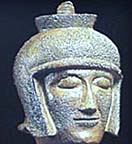
Livia Augusta regains her head

Caesar's wife statue made whole again: "A caesar's wife may have to be above reproach, but one of them lost her head centuries ago."

The head was found late in the 19th century by Sir Arthur Evans of Knossos fame. He swapped a top hat for two marble heads from a shrine to the cult of Augustus, at what is now a village but was once the important Roman city of Narona.

"In the 1990s, archaeologists of Croatia's national museum in Split re-excavated the site and found many statues, including the rest of Livia, from the wealthy shrine, which was deliberately destroyed when the area became Christian."

Thursday, July 15, 2004

Recreating Pompey for Modern Eyes

Recreating Pompey for Modern Eyes: "In 55 B.C.E., Romans applauded the debut of the world's first modern entertainment complex, a mammoth structure constructed by Gnaeus Pompeius Magnus--better known as Pompey the Great, military conqueror and rival to Julius Caesar. The showy consul named the theater for himself. Today, using archaeology, three-dimensional modeling, virtual reality technology, and digital research, architecture experts are slowly raising the curtain on the Theater of Pompey. 'It's shockingly enormous,' says James Packer, a Northwestern University professor. 'The scale is just astonishing.'

Crowds of between twenty-five and forty thousand people flocked to see the latest spectacles played out on the 260-foot-wide stage. Modern sports fans would recognize the curved stadium seating, the barrel vaults, the VIP balconies--everything but the lack of advertising--and feel right at home.

Packer is directing the excavation of the theater as part of a research project begun in 1996 with Richard Beacham of the University of Warwick (U.K.). In 2002 Packer joined with archaeologist Cristina Gagliardo, architect Dario Silenzi, and engineer Massimo Aristide Giannelli to undertake the first excavation of the theater since 1865."

See also: The Theater of Pompey Project

Wednesday, July 14, 2004

Patara a gem of Roman ruins on Turkey's Turquoise Coast

"Patara is a small village on the south-west Aegean coast of Turkey, known as the Turquoise Coast, and is famous for having one of the longest beaches in the Mediterranean. Its 18km of sand provides plenty of raw material for armies of children to build metropoli of sandcastles, as well as a nesting place for turtles, which between June and August emerge at night to lay their eggs in the sands.

Patara is said to be the birthplace of Apollo and, when the Roman empire was at its height, it was one of the most important harbours in the western Mediterranean, sheltering ships from all over the ancient world. You can still find the remains of merchants' bath-houses, their roofs open to the skies. Fallen Porphyry columns lie beside the largest avenue that the Romans ever built.

Most atmospheric of all, though, is Patara's Roman amphitheatre. Once it seated 10,000 citizens, now half of it lies buried under an enormous sand dune. Shelley could have had this place in mind when he wrote his famous sonnet, Ozymandias - 'Round the decay/Of that colossal wreck, boundless and bare/The lone and level sands stretch far away'."

Roman Fort still visible at The Dip near Felixstowe

"Felixstowe has a rich Roman history - and the remains of a shore fort at The Dip, where seaweed-topped rocks can still be glimpsed at low tide.

The fort was built in 296 AD. It was of oblong construction and stood on low cliffs on a coastline which at that time was mainly saltmarsh and pocked with inlets. Its promontory was eventually eroded and it collapsed into the sea.

It housed about 100 soldiers whose route across the peninsula was a rough track - the forerunner of the A14 - and there have been a number of finds of coins and other items in the area over the years."

Monday, July 12, 2004

Rare 3rd Century Roman Cup to be Auctioned

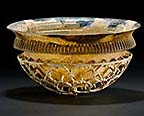
"About 1,700 years ago, one of the Roman empire's wealthier citizens commissioned an extraordinary piece of craftsmanship from a glassmaker working somewhere in the eastern Mediterranean. Months of painstaking work turned a single thick piece of colourless glass into a delicate 4in-high cup connected by slender bridges to a surrounding network cage. Just one mistake by the craftsman at any stage would have destroyed this fragile masterpiece.

The cage-cup was probably not a drinking vessel but was instead used as a hanging lamp filled with clear oil and placed high up in one of the rooms of its owner's home, where it cast an intricate shadow on to the walls."

Friday, July 09, 2004

Remains of Samnite Temple Unearthed in Pompeii

"The discovery in Pompeii of a pre-Roman temple is being hailed as evidence that the city was sophisticated and thriving 300 years before Vesuvius erupted. The temple is said to be of Mephitis, a female deity worshipped by the Samnites, a mysterious ancient people who preceded the Romans in Pompeii.

The temple complex includes a sanctuary where it is thought girls from good families worked briefly in 'sacred prostitution' as a rite of passage to full womanhood."

Time Team Find Remains of Roman Era Child in Worksop

"A TWO-thousand-year-old child's skeleton has been found in a 'time team' dig at Worksop - hailed as one of the most significant archaeological finds in the region for years.

The child was still adorned with bangles and bracelets, and is believed to be from a high-ranking Iron Age tribe which flourished during the Roman occupation.

"It is impossible to say at this stage if it was a boy or a girl or what the cause of death was," said Ursilla Spence, senior archaeologist for Nottinghamshire County Council. "But we do know this was a 'high status' burial because of the objects that were buried with the body."

Also clear is the Roman influence on the burial - the Romans would have buried children and old people close to their homes so they could still be 'part of the family'.

The dig has discovered that the tribe living on the site probably had close links with the Romans and traded in what would have been the luxury goods of the period.

Remains of an imposing entrance to the compound have been unearthed - but the experts have been baffled by evidence that suggests the area was later cleared and abandoned."

Tuesday, July 06, 2004

Florida State Professor Hunts for Roman-era Pirate Ships

Florida State professor hoping to find Roman-era pirate ships: "When the Roman Empire got tired of pirates terrorizing shipping lanes and nearly bringing the known world's trade to a halt, it went after them hard.

With 120,000 men and 270 ships it reportedly took the Roman general Pompey just 40 days to locate and wipe out the ships and crews that were preying on shipping.

It has taken much, much longer for modern scientists to again find the pirates of the Mediterranean.

But Cheryl Ward, an anthropology professor at Florida State University, hopes she's on the verge of rediscovering the ships of the pirates, a thorn in the side of the Romans 2,100 years ago who now may help provide a unique window on what the larger world looked like in late antiquity.

Ward and her colleagues are hoping to paint a picture of a different class of people from those we know lots about - adding to what we know about the Roman Empire. Much of our knowledge comes from what the educated, wealthy Romans left us in the way of writing and artifacts.

But the pirates were the underclass - the rest of the story."

See also: The Rough Cilicia Maritime Survery Project

Friday, July 02, 2004

Roman Lead Sarcophagus Returned to Syria

: "A decorated fragment of a lead sarcophagus (or coffin) dating from the Roman period has been returned to the Syrian National Museum, thanks to the efforts of experts at Newcastle University's Museum of Antiquities.

The small fragment, which was brought into the University's Museum of Antiquities by a Newcastle resident, dates to the period between the 2nd century BC and the 2nd century AD.

Months of detective work followed, which eventually led to the island city of Aradus on the Ile d'Arwad, off the coast of Syria, a site with a complex Phoenician and Roman history."

Plundered Byzantine antiquities to be returned to Cyprus

Plundered antiquities head home: "HUNDREDS of Byzantine icons, mosaics, and artifacts valued at $52.4 million plundered from Cyprus almost 30 years ago and smuggled to Germany by thieves to sell on the black market will be returned, a German judge has ruled.

The artifacts, recovered during a sting operation in 1997, were looted from Greek Orthodox churches and museums in northern Cyprus in the chaos during the 1974 Turkish invasion of the island, Judge Hanreich said.

They include religious icons, wall paintings and ceiling mosaics - invaluable examples of early Christian art."

Tuesday, June 29, 2004

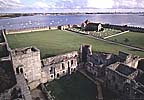
Portchester Castle Reveals Roman Origins

"Archaeologists working at Portchester Castle believe they have discovered evidence that it was once a Roman trading port.

Topographic and geophysical surveys of the ancient site have revealed a number of previously uncharted structures dating from Roman, Saxon and medieval times. "

In the outer bailey features were discovered that relate to the Roman, Saxon and medieval periods of the site. Between the inner and outer ditches possible remnants of the Roman fort and a number of medieval and post-medieval structural features were detected.

Portchester’s outer defences incorporate the well-preserved remains of a Roman fort. It is thought to have been established between AD 285 and 290 by Marcus Aurelius Carausius who was instructed by the Emperor Diocletian to clear the seas of pirates.

Roman Villa Unearthed in Shillingstone

"Archaeologists yesterday revealed they have unearthed a huge Roman villa and may have even identified who owned it. They believe the villa, in the heart of the Dorset countryside, was owned by a rich and important native Roman called Anicetus.

He was mentioned by Roman historian Tacitus who said that he possibly donated money to the Roman army.

The luxury residence was erected in the fourth century and fell into disrepair when the Romans left Britain in the fifth century. The two-storey villa was well built and included a bath house, central heating and mosaic floors."

I do hope they at least remove the mosaics before covering the site with new construction. It's always a pity when a mjor site cannot be preserved in situ.

Monday, June 28, 2004

Byzantium 1200

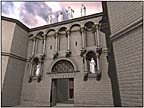
OLD GOLDEN GATE: "After the Theodosian land walls had been built, the wall of Constantine quickly fell in ruins. The only part of it that is known to have survived for a longer time is the old main or Golden Gate, that survived until the ottoman time and was destroyed by a earthquake only in 1509. The medieval name (H)exakionion means 'with six columns'; it suggests that the gate was similar to the Golden Gate of Diocletian's palace in Split and had a upper storey decorated with six columns and niches in between on the outer side. In the last centuries of the Byzantine Empire, this upper storey apparently was used as a funerary chapel, and parts of the building decorated with frescoes. "

I found this spectacular website while checking a reference for Constantine. The 3D architectural renderings of the structures of Byzantium reflect thousands of hours of research and design. I was also impressed by the digital portraits of Constantine and Justinian. I have written to the artist to ask if he would share information about the software and techniques used to create them. Their eyes and skin are so life-like. Justinian even has the stubble of a beard.

Pentecost brings rose petals to the Pantheon

"Every year during the Pentecost Mass, two or three firemen climb the huge lead-covered rings of the Pantheon's dome with huge sacks of rose petals, which they empty over the edge of the oculus to shower slowly, spectacularly down into the rotunda."

This image sounds so beautiful but unfortunately I could not find an actual picture of the Pentecostal service at the Pantheon with Google's image search. The article also mentions the 22 Roman drains that serve to carry away the rain that falls through the oculus. I thought the drains appeared quite elegant themselves.

I also found a poem by Byron about the Pantheon:

"Simple, erect, severe, austere, sublime Shrine of all saints and temple of all Gods, From Jove to Jesus spared and blessed by time, Looking tranquillity, while falls or nods Arch, empire, each thing round thee, and man plods His way through thorns to ashes glorious Dome! Shalt thou not last? Time's scythe and tyrants' rods Shine upon thee—sanctuary and home Of art and piety—Pantheon! Pride of Rome!"

and other interesting information at this website:

http://www.oldandsold.com/articles10/famous-buildings-12.shtml

Friday, June 25, 2004

Fragments of Roman armlets found in dig

Fragments of Roman armlets found in dig: "Fragments of two glass armlets, dating back to the Roman era, have been discovered during an archaeological dig at Knowes Farm near East Linton.
The remains of several circular Iron Age houses with stone-flagged floors, apparently belonging to the latest period of occupation, have also been uncovered."

New Archaeological findings in Palmyra

A French archaeological team has discovered skeletons buried in wooden coffins dating back to the Byzantine age near the Dora Ourbos gate. Two clay lanterns and a sculptured head of a Palmyran young man dating back to the same period were also discovered.

Head of the French archeological team, Dr. Christina Dablablas said the area is rich in artifacts, a legacy of thousands of years of human settlement. The team's findings will join the collection of religious and funerary art at the Palmyra Museum.

Tuesday, June 22, 2004

Saalburg offers glimpse into Rome's past

Emperor Antoninus Pius hails you as you approach the Saalburg, a Roman fort tucked away in Germany’s Taunus mountains.

Once it was an outpost guarding the borders of the empire. Today it is a place to step back into time and get an idea of how Roman soldiers once lived.

Wednesday, June 16, 2004

Huge Etruscan Road Brought to Light

Huge Etruscan Road Brought to Light: "Digging in Capannori, near Lucca, archaeologist Michelangelo Zecchini has uncovered startling evidence of an Etruscan 'highway' which presumably linked Etruscan Pisa, on the Tyrrhenian coast, to the Adriatic port of Spina.

Dating to the end of the 6th century B.C., the seven-meter-wide (23-foot) road supported intense chariot traffic towards Spina, an Etruscan-controlled trading emporium where Etruscan and Greeks lived and worked together, and through which were imported great quantities of Greek goods.

"A great amount of information, including tombs, monuments and villages, lie hidden along this road," Zecchini said.

The ancient highway was also mentioned by Greek geographer Skylax, who in the 4th century B.C. wrote that a great road linked Pisa with Spina by a three-day journey."

Tuesday, June 15, 2004

Maidstone Dig uncovers a Roman bath house

Dig uncovers a Roman bath house: A Roman bath house thought to be part of a large villa has been found by archaeologists digging on a building site in Maidstone.

In a month working on the site the archaeologists have uncovered parts of two sunken rooms - a plunge bath and a steam bath.

They have also found footings outlining a small suite of heated and unheated rooms, drainage ditches, pottery, mosaic fragments and painted plaster.

Beneath the villa a series of Iron Age ditches have been discovered, thought to be associated with a pre-Roman farmstead."

The Daily Star - Arts & Culture - What to do when you stumble onto a Roman 'city of the dead'? Call in the antiquities cops

What to do when you stumble onto a Roman 'city of the dead'? : "On a site in Gemmayzeh, Lebanon archaeologists have found the remains of 20 skeletons, buried in sand with funerary deposits consisting of small ceramic perfume bottles.

'This was the ritual at the time,' explains Assaad Seif, an archaeologist who was educated at the Lebanese University and the Sorbonne in Paris, and has been working with the DGA since 1996. 'On the analysis and interpretation level, this is what's interesting. ... The information (we have) comes from Pompeii, from texts. Archaeology helps us in Lebanon to discover the things not written, the traditions with local sub-traditions. Burial customs are not the same everywhere. There are small changes in the mainstream.'
In addition to the skeletons, Seif believes that the marble column found on the site belongs to an important structure, perhaps a mausoleum, which has yet to be fully discovered. 'Usually in Roman cities,' he says, speaking about a pattern of ancient urban development he's witnessed in such Lebanese cities as Tyre, where 'the cities of the dead are usually found off the eastern entrance of the city. A necropolis can remain so for thousands of years. When the city grows, it builds over it.'"

Ancient bowl found in second-hand shop - (United Press International)

Ancient bowl found in second-hand shop - (United Press International): "A Norwegian archeology student found an ancient Roman glass bowl in a second-hand shop and was able to buy it for less than 1 percent of its real value.

Espen Kutschera saw the bowl, which is about 1,900 years old and from the Roman Empire, at a store called Fretex and bought it for $15, the Bergensavisen newspaper reported Friday.

Experts put the bowl's real value at $7,500."

Haaretz - Israel News - Priceless Byzantine artifact stolen from archaeological park

Haaretz - Israel News - Priceless Byzantine artifact stolen from archaeological park: "A priceless 1,500-year-old Byzantine-era artifact was stolen early yesterday from an archaeological park near Herzliya, police said.

The thieves took a part of the floor of a glass kiln, one of only three still in existence in Israel. Police suspect the theft had been commissioned by a private antiques collector.

'This was a part of the glass kiln that served the Byzantine city of Apolonia 1,500 years ago,' said archaeologist Hagi Yohanan, director of the Apolonia park built over the ruins of the city.

Following the 4th century split in the Roman empire, the Holy Land came under the rule of Christian Byzantine, until it was conquered by the Arabs in 636. Archaeologically, the period is noted for the building of many monasteries and churches across the country."

Some Roman Britons may be descended from Africans

"Archaeologists say there is compelling evidence that a 500-strong unit of Moors manned a fort near Carlisle in the third century AD. Writing in the journal British Archaeology, Mr Benjamin describes a fourth century inscription discovered in Beaumount, two miles from the remains of the Aballava fort at Burgh by Sands. The inscription refers to the "numerus of Aurelian Moors" - a unit of North Africans, probably named after the emperor Marcus Aurelius.

The unit is also mentioned in the Notitia Dignitatum, a Roman list of officials and dignitaries. It describes the prefect of the "numeri Maurorum Aurelianorum, Aballaba".

The unit was probably mustered in the Roman province of Mauretania, in modern-day Morocco, by the emperor Septimus Severus and arrived in Britain in the second or third centuries AD. Aballava lay at the western end of Hadrian's Wall in Cumbria."

Roman 'industrial estate' found

"Experts who unearthed the best preserved example in Wales of a medieval track, have now found what they believe is the equivalent of a Roman 'industrial estate.'

"We think we're starting to uncover an example of a Roman industrial site that probably did some sort of smelting because there are examples of charcoals and other heavily burnt items, said Project manager Nigel Page, of Cambria Archaeology."

Pergamon Altar's Frieze Restored

"After a decade of painstaking cleaning, Berlin's Pergamon Museum has unveiled the restored marble frieze of the Pergamon Altar, the second century B.C. centerpiece of its collection. The 371 foot-long frieze decorated the outside walls of the altar, which was built between 197 and 156 B.C. in the present-day Turkish town of Bergama.
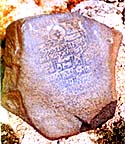
A German engineer discovered fragments of the frieze, which had been taken apart and incorporated into the walls of a fortress, in 1864. It displays mythological scenes of gods fighting giants, snarling lions and coiling snakes, with the muscular bodies of Artemis, Zeus and Athena clad in delicately sculpted folds of fabric. "

Tuesday, May 25, 2004

Pioneering archaeological research charts African links with the Roman world

"University of Southampton archaeologists Professor David Peacock and Dr Lucy Blue have just returned from a pioneering expedition investigating Roman sites in the East African country of Eritrea alongside colleagues from the University of Asmara. The University group is the first from the UK to work in the country since it won its independence more than a decade ago.
British involvement in the area has a long history. In 1868 General Napier landed his troops near Adulis in a daring bid to rescue British hostages held by Emperor Theodore at his fortress of Magdala, now in Ethiopia. Napier built a landing stage and a railway to transport troops and equipment to the interior, and traces still survive on the coast 6 km to the east of Adulis. Archaeologists from the British Museum, who accompanied the army, excavated a church at Adulis, which can still be seen in a ruinous state."

See also: Eritrea Ruins of History

Thursday, May 20, 2004

Algorithms from the Human Genome Project used to piece together ancient Roman Map

"It's the world's oldest and largest jigsaw puzzle - an ancient map of Rome in 1,200 fragments of marble. Archaeologists for centuries have tried to painstakingly piece together the sculpture, fragment by fragment. Now, computer wizards at Stanford University say they have created a software program that holds the key to the puzzle and the ancient city.
At the heart of the program are three-dimensional scans of the fragments and algorithms to find possible matches. Already the work has produced several dozen probable and possible matches.
'They've advanced farther and faster in the last months than we have in centuries,' said Roman archaeologist Margaret Laird, a visiting lecturer at the University of Chicago. 'These new matches are going to change a lot of what we know about the city of Rome.'

The undertaking is a five-year study conducted by Marc Levoy, an associate professor of computer science and electrical engineering at Stanford, to be completed by the summer. The findings and interactive 3-D models of the fragments are online, allowing scholars as well as elementary-school students unprecedented access to the monument."

Hopscotch: A Roman invention

On our imperial Rome discussion list we have been talking about how the Roman legions had to maintain a high level of physical fitness. So I found this item particularly interesting:

HOPSCOTCH: The Romans introduced Hopscotch to Britain. Their soldiers had to hop up and down along a 100ft court in their full armour to improve their footwork. Children copied this as a game and introduced scoring. Romans also played ball games, and had building blocks, swings and kites.

Apparently, the Romans also played marbles and may have adopted yo-yos from the ancient Greeks as well:

MARBLES: The earliest marbles were made of flint and clay, and in some cases marble, and date back as far as Ancient Egypt and Rome. The Venetians were the first to make glass marbles and the Germans began to mass produce them in the 19th century.

YO-YOs: Yo-Yos are the second oldest known toy. In ancient Greece they were made of terracotta, wood and metal and decorated with the pictures of the gods. As a rite of passage adult Greeks used to give up their childhood toys and place them on the family altar.

Thursday, May 13, 2004

Yale Acquires Roman Coin Collection

"Yale University Art Gallery has acquired a collection of 4,100 coins of Greek and Roman origin. The collection was established over a period of forty years by Peter R. Franke, formerly Professor of Ancient History and Numismatics and head of the Institute for Ancient History at the University of Saarbrucken, Germany. Franke was mentor to many of the numismatists on staff at various collections throughout Europe, and taught until recently at the Institut fur Numismatik in Vienna. He is well-known as the author of a number of specialized monographs as well as introductory treatments of coinage. Although it covers the entire Mediterranean basin, the principal focus of the collection on Greek coins of the Roman period, which were produced at individual cities to meet local currency needs. "I am delighted that my collection has been acquired by Yale," said Professor Franke, "since I know that there the coins will be employed for teaching as well as research, and my work will be continued."

William E. Metcalf, who was appointed the first curator of coins and medals at the Yale Art Gallery in 2002 as well as adjunct professor of Classics, remarked, "Franke did not collect just to fill gaps in his holdings, every coin has a reason for being there. For the art historian, there are continuous streams of imperial portraits from various regions of the Roman Empire; for the historian there is evidence of local cults and magistrates, as well as representations of local buildings and such customs as games and religious festivals."

Tuesday, March 30, 2004

Archaeologists Locate Ancient Indo-Roman Trading Site

"Striking archaeological evidence suggests that the legendary seaport of Muziris, which was a bustling Indo-Roman centre of trade during the early historic period between the first century BC and the fifth century AD, could have been located at Pattanam, near Paravur on the south of the Periyar rivermouth.

What led Dr. K.P. Shajan, geoarchaeologist, and his team to Pattanam was clear geological evidence which suggested that the river Periyar had shifted its course from the south to the north over the millennia. A branch of the Periyar, called the Periyar Thodu, runs close to Pattanam and satellite imagery indicates that the Periyar delta lies on the southern side and the river could have flowed close to Pattanam about 2,000 years ago. This would place the ancient site alongside the Periyar in keeping with the descriptions in literary sources.

The site covers an area of about 1.5 sq km and the deposit is about two metres thick. It has produced fragments of imported Roman amphora, mainly used for transporting wine and olive oil, Yemenese and West Asian pottery, besides Indian rouletted ware common on the East Coast of India and also found in Berenike in Egypt. Bricks, tiles, pottery shards, beads and other artefacts found at Pattanam are very similar to those found at Arikamedu and other early historic sites in India.

The most striking finds from Pattanam are the rim and handle of a classic Italian wine amphora from Naples which was common between the late first century BC and 79 AD, when pottery production in the region was disrupted by the eruption of Mt. Vesuvius. Islamic glazed ware from West Asia indicate that the site remained active beyond the early historic period.

Monday, March 22, 2004

1st and 2nd Century Artifacts Recovered in Naples

"750 Artifacts including 22 high-quality marble and terracotta artefacts from the 1st and 2nd centuries a.C., probably belonging to patrician families from Pozzuoli and Baia who lived in the Roman Empire era, have been recovered by police in Naples. Some of the 350 terracotta artefacts from Cales dating back to the 1st and 2nd century A.C. are still covered in soil. 'These finds have an incredible value - says Paolo Caputo, head of the police archaeology department for Naples and Caserta."