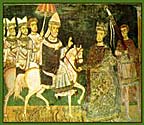
 In the fourth century AD, the fragmented Roman Empire was being further torn apart by civil war. Constantine and Maxentius were bitterly fighting to be the sole emperor.
Constantine was the son of the western emperor Constantius Chlorus. When he died in 306, his father's troops proclaimed Constantine emperor. But in Rome, the favourite was Maxentius, son of Constantius' predecessor, Maximian.
Constantine overran Italy and faced Maxentius at the Milvian Bridge over the Tiber a few kilometres from Rome. Both knew it would be a decisive battle with Constantine's forces outnumbered.
But something strange happened. Eusebius, an early Christian historian, reports, "...about noon, when the day was already beginning to decline, he saw with his own eyes the trophy of a cross of light in the heavens, above the Sun, and bearing the inscription 'conquer by this'. "
Jens Ormo, a Swedish geologist, and colleagues working in Italy believe Constantine witnessed a meteoroid impact. The research team believes it has identified what remains of the impactor's crater. Radiocarbon dating puts the crater's formation at about the right time to have been witnessed by Constantine


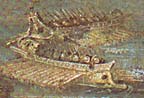 Academics have long argued that holding sea battles at the Colosseum was impossible . But, Cassius Dio, chronicler of ancient Rome, said: "Titus suddenly filled this same theatre with water and brought in horses and bulls and other domesticated animals that had been taught to behave in the liquid element just as on land. He also brought in people on ships, who engaged in a sea-fight there, impersonating the Corcyreans and Corinthians."
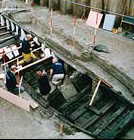 Although silted over centuries ago, a Roman barge that has stayed waterlogged for nearly 2,000 years, preserving the vessel and its contents, has been raised from the bottom of the Rhine River near the city of Utrecht. It is 25 metres long and 2.7 m wide, and is the first to be found with a cabin containing an entire inventory of items that have been fully preserved--from the captains kitchen, bed and chest, down to the contents of his cupboard.
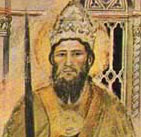 A giant cathedral in eastern Germany known to have been built by Holy Roman Emperor Otto the Great in the 10th Century has been unearthed in Magdeburg. Laden with Italian marble, glass mosaic stones and glazed wall tiles--remains of which were all found at the site--the romanesque cathedral was as extraordinary in its beauty as in its size.
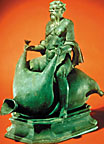 "The Greeks, the Etruscans and the bane of them both, the Romans, are now part of an integrated exhibition called "Worlds Intertwined." Unlike the ancient glamour pieces one finds at museums such as the Metropolitan (the best statues and ceramics that money and pillage could assemble), the universitys museum is more terrestrial, yet, argues its director, Jeremy A. Sabloff, no less valuable for scholarly purposes." The Washington Post